Executive Summary
The Labour Architecture
Lead author: Ethan Seow (C4AIL) Contributors: Dominic Ligot (CirroLytix), James Stanger (CompTIA), Chiew Farn Chung (ClassDo) Status: First Draft — March 2026
The Scale
Ninety-five per cent of generative AI pilots fail to deliver measurable impact (MIT NANDA Lab). The failure is never technology. It is always people and process. US firms spent $40 billion on AI in 2024; 95% reported zero bottom-line impact (BCG, February 2026). The reskilling gap costs the US economy $1.1 trillion annually (Pearson/Faethm, January 2025). Eighty-two per cent of employees have received no AI training at work (Deloitte, 2025). Fifty-seven per cent of US work hours are now automatable with current technology (McKinsey, November 2025). The World Economic Forum projects 92 million roles displaced and 170 million created by 2030. The jobs are not disappearing. They are changing category. And the workforce was not built for the new category.
The Pipeline Collapse
The most dangerous statistic is not about jobs automated. It is about jobs no longer offered. Two-thirds of global enterprises are reducing entry-level hiring (IDC/Deel, November 2025). US entry-level tech postings dropped 67% between 2023 and 2024 (Stanford Digital Economy Lab). UK tech companies cut graduate roles 46% in 2024 and project an additional 53% reduction by 2026. Junior headcount declines 7.7% relative to non-adopting firms within six quarters of GenAI adoption (Harvard — Hosseini and Lichtinger). The junior work — drafting, research, analysis — was never just productivity. It was the apprenticeship. It was where professionals built the pattern recognition, graduated autonomy, and consequential judgment that separated “follows instructions” from “signs the document.” That pipeline is being hollowed out at exactly the moment demand for its output is surging. A 67% hiring cliff in 2024–2026 means 67% fewer potential leaders in 2031–2036.
The Framework: Four Labours, Seven Layers
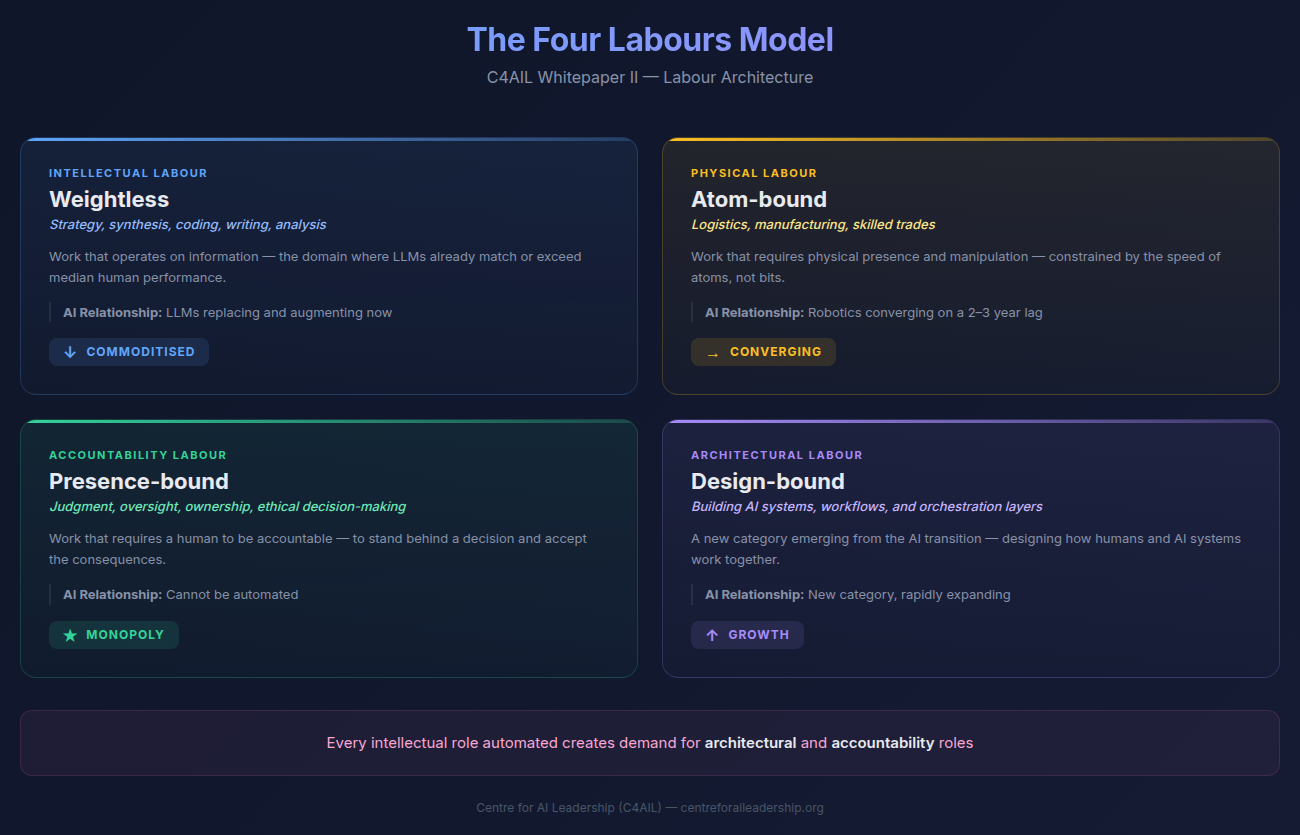
Work is not one thing. It is four labour types — Intellectual (commoditised: strategy, synthesis, coding, writing), Physical (converging: robotics following intellectual automation on a 2–3 year lag), Accountability (the only durable human monopoly: judgment, oversight, ownership under uncertainty), and Architectural (the growth category: building the systems through which AI operates). Every workforce initiative that fails does so because it intervenes at a single layer of a seven-layer system — the Human Capability Stack — without understanding the layers above and below.
The Stack runs from Psychological Foundation (Layer 1) through Skills Architecture (Layer 2), Labour Types (Layer 3), Credentialing (Layer 4), Organisational Architecture (Layer 5), Education & Development Systems (Layer 6), to Economy & Policy (Layer 7). Each layer depends on the one below. AI enters at Layer 2 — commoditising technical microskills — and the disruption propagates upward through every layer: skills commoditised → intellectual labour hollowed out → existing credentials lose signalling value → organisations cannot staff new roles → education systems respond by producing more of the commoditised category → policy subsidises more of the same. And critically downward: AI removes the junior work that was the training ground for Layer 1, destroying the developmental pipeline for the next generation.
The contribution of this paper is vertical integration — connecting all seven layers into a single coherent model with a diagnostic that explains why 95% of interventions fail.
The Accountability Gap
The education system is a factory running the wrong processes. It produces intellectual labourers: people trained to receive knowledge, apply rules, and generate output on command. This is the one labour type being commoditised fastest. Meanwhile, accountability labour — the capacity for judgment, oversight, and ownership under uncertainty — has no formal production line. The factory has no process for it.
The factory model replaced the guild system’s accountability mechanisms — graduated autonomy, consequential practice, the masterpiece, community of mutual obligation — without seeing what it was discarding. The evidence is structural: every country that destroyed its guild infrastructure (UK, US, most of Asia) has failed to rebuild it through policy alone. Every country that retained mandatory intermediary bodies (Germany’s IHK/HWK chambers, Switzerland’s social partnership, Austria’s WKO) has structurally lower youth unemployment — Germany 5.8%, Switzerland 7.7%, Austria 10.3%, versus UK 13.3%, US 9.1%, South Korea 7.5% (Eurostat/OECD, 2024). The barrier is institutional architecture, not training volume or policy ambition.
What Differentiates Humans from AI
AI is a one-dimensional machine. It has mastered the Syntax layer — pattern-matching on language and structure — to a degree indistinguishable from human output. But it possesses zero capability in the remaining four knowledge layers defined in Whitepaper I: Contextual (presence-dependent environmental reading), Institutional (politically navigated organisational knowledge), Deductive (first-principles reasoning grounded in felt experience), and Experiential (embodied pattern recognition from consequential practice). The factory model trains humans on the same single dimension AI has mastered.
This paper introduces a novel mapping: each knowledge layer requires a corresponding developmental stage to activate — Experiential requires Body (somatic presence) and Feel (emotional registration), Deductive requires Think grounded through Accept (holding discomfort without collapsing), Institutional requires community and co-creation, Contextual requires physical presence. The Body → Feel → Accept → Think → Choose developmental sequence is not a pedagogical preference. It is the activation sequence for multi-dimensional human capability. The factory inverts it — delivering content straight to Think, bypassing Body, Feel, and Accept entirely. The result: 58% of adults have not reached the developmental stage (Kegan Stage 4, Self-Authoring) required for independent accountability. Not because they lack intelligence. Because the meaning-making structure was never built.
From Reception to Creation
The argument between “more STEM” and “more humanities” is an argument about what to deposit into students. It misses the point. The foundational change is from reception to creation. The counter-examples that work — Montessori, problem-based learning, cooperative education, apprenticeship — all share one feature the factory model lacks: students create, put their names on it, and live with the result. Creation develops taste — the everyday word for what Aristotle called phronesis (practical wisdom). AI commoditises episteme (theoretical knowledge) and techne (craft skill), but phronesis cannot develop without going through them experientially. Taste is the human premium AI cannot replicate, because AI has no relationship to consequences. Co-creation — making alongside others who hold you accountable — adds the dimension that transforms individual taste into professional judgment.
From Execution to Intent
The common media narrative — that AI turns professionals into “checkers” and “validators” — is wrong. Checking is still reception. The actual shift is from producing the output to setting the intent: deciding what the machine must achieve, defining the standard, owning the outcome. The surgeon’s value was never in the cutting — it was in the judgment that determined where to cut, when to stop, and what to do when things go wrong. AI unbundles production from judgment. The production goes to the machine. The judgment — informed by all five knowledge layers — stays with the human.
The Organisational Playbook
Five Roles replace the traditional job-title approach: Floor Users (90–95%, working through AI-structured interfaces with embedded verification), Translators (bridging domain expertise and AI capability), Architects (building Logic Pipes and verification engines), Orchestrators (designing and governing the entire system), and Trainers (maintaining the human development pipeline). The Trainer role is the critical bottleneck — without Trainers who have crossed the accountability threshold themselves, the pipeline from Floor to Ceiling does not exist. This is the Trainer Paradox: you need L4+ practitioners to produce L4+ practitioners, and there is no shortcut.
The 12-month implementation roadmap sequences: Floor deployment (months 1–3), Translator identification (months 4–6), Architect development (months 7–9), and measurement infrastructure (months 10–12). The Philippines IT-BPM sector — 1.9 million workers, $40 billion in revenue, built entirely on intellectual labour now being commoditised — provides the case study for services economy transformation using the Four-Role mapping.
Honest Limitations
The organisational solutions in this paper are the best available response, not a cure. Twelve specific limitations are acknowledged with paired research proposals. Without mandatory intermediary bodies (Germany’s IHK/HWK, Switzerland’s social partnership), the poaching problem operates at full strength. The developmental timeline cannot be shortcut — first Orchestrators take 1–3 years, the Trainer pipeline takes 3–5 years, cultural shift takes a decade. The Five Roles model is untested at scale. The creation-to-accountability link has no controlled study. The multi-dimensional mapping is a novel theoretical claim, not an empirical finding. The “durable human monopoly” assumption depends on current AI architecture — if embodied AI develops persistent memory and consequence-tracking, the boundary shifts. Anyone promising faster transformation is selling courses, not building capability.
The Deeper Problem
Underneath all of it sits a developmental reality that no organisational redesign can bypass. AI is a one-dimensional machine. The factory produces one-dimensional humans. Accountability requires all five dimensions active simultaneously, built through a developmental sequence the factory inverts. The education system the AI age requires is one that produces creators, not receivers — people who make things, put their names on them, submit them to community judgment, and develop taste through the accumulated experience of consequential creation. The developmental target is not “knows things” (episteme), not “can do things” (techne), but “makes things you’d trust” (phronesis). The path there runs through creation, not reception.