Part I: The Diagnosis
Why 95% of AI Workforce Initiatives Fail
Lead author: Ethan Seow (C4AIL) Contributors: Dominic Ligot (CirroLytix), James Stanger (CompTIA), Chiew Farn Chung (ClassDo) Status: First Draft — March 2026
1.1 The Scale of the Transformation
The numbers are no longer speculative.
The World Economic Forum’s Future of Jobs Report (January 2025) projects 92 million roles displaced and 170 million created by 2030 — a net gain of 78 million jobs, but 22% of today’s jobs undergoing structural transformation. McKinsey’s November 2025 analysis found that 57% of US work hours are now automatable with current technology — up from 30% just two years earlier. Goldman Sachs estimates 300 million jobs globally exposed to generative AI. The ILO puts it at one in four workers worldwide with meaningful GenAI exposure.
These are not future projections. They describe current capability. What varies is deployment speed — and that speed is accelerating. Demand for AI fluency in job postings grew 7x between 2023 and 2025 (McKinsey). Workforce AI access grew from under 40% to 60% in a single year (Deloitte, January 2026). Skills in AI-exposed roles are changing 66% faster than in other roles (PwC, 2025). The WEF estimates that 59% of the global workforce — nearly 2 billion people — needs reskilling by 2030.
The labour market response is already visible. PwC cut 5,600 roles globally while investing $1.5 billion in AI. Baker McKenzie is eliminating 600-1,000 business services positions. Salesforce customer service went from 9,000 to 5,000 staff. Klarna is targeting a reduction from 5,500 to 2,000. Citigroup estimates that 54% of all banking roles have high AI displacement potential, with global banks expected to cut 200,000 jobs over 2025-2030 (Bloomberg Intelligence). Challenger, Gray & Christmas tracked approximately 55,000 AI-linked US layoffs in 2025.
But the pattern is not job destruction. It is labour type substitution. Every intellectual role automated creates demand for architectural and accountability roles. The organisations cutting headcount are simultaneously hiring for positions that did not exist two years ago. BCG’s February 2026 analysis found that AI transformation value follows a 10/20/70 split: 10% from algorithms, 20% from technology infrastructure, and 70% from people — upskilling and workflow redesign. Bain projects a US AI talent gap of 700,000 workers by 2027. Germany could see 70% of AI roles unfilled. The jobs are not disappearing. They are changing category. And the workforce was not built for the new category.
1.2 The Pipeline Is Collapsing
The most dangerous statistic is not about the jobs being automated. It is about the jobs that are no longer being offered.
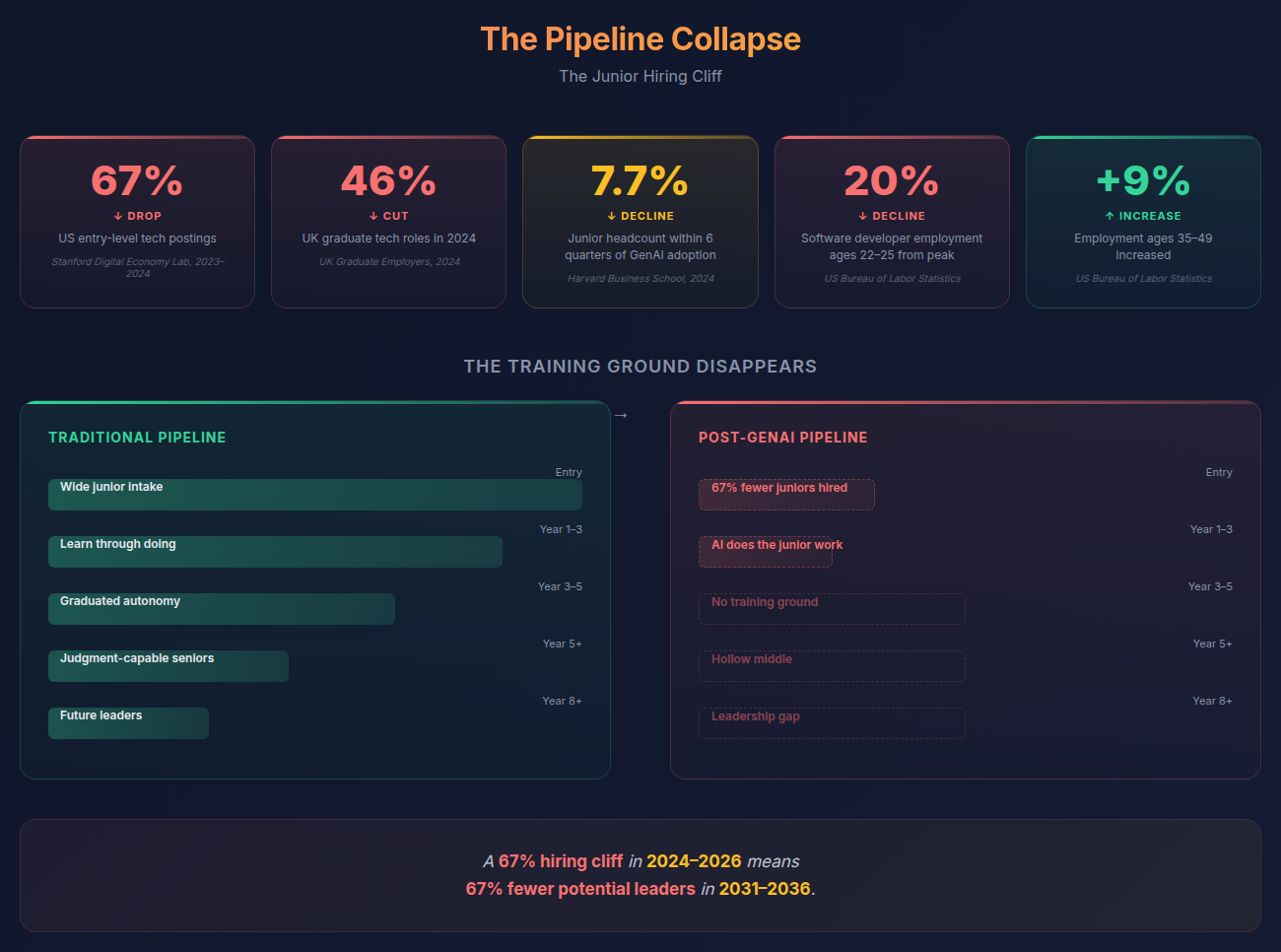
Two-thirds of global enterprises are reducing entry-level hiring due to AI (IDC/Deel, November 2025). Entry-level job postings have declined 35% across all sectors since January 2023 (Revelio Labs). In the UK, tech companies cut graduate roles by 46% in 2024 and project an additional 53% reduction by 2026 (Institute of Student Employers). Goldman Sachs found that unemployment for 20-30 year olds in tech-exposed occupations rose 3 percentage points — four times the national average. US entry-level tech postings specifically dropped 67% between 2023 and 2024 (Stanford Digital Economy Lab). Software developer employment ages 22-25 declined approximately 20% from peak, while ages 35-49 increased 9%.
A Harvard study (Hosseini and Lichtinger, “Generative AI as Seniority-Biased Technological Change”) confirmed the mechanism: when companies adopt GenAI, junior headcount declines 7.7% relative to non-adopting firms within six quarters. Industry observers have captured the structural reality: “Plenty of seniors at the top, AI doing the grunt work at the bottom, very few juniors learning the craft in between.”
This is not a recession. This is a structural elimination of the training ground. The junior work — drafting, research, analysis, data processing — was never just productivity. It was the apprenticeship. It was where professionals built pattern recognition, earned graduated autonomy, and crossed the threshold from “follows instructions” to “makes judgment calls.” That pipeline is being hollowed out at exactly the moment demand for its output — people capable of judgment, oversight, and accountability — is surging.
A 67% hiring cliff in 2024-2026 means 67% fewer potential leaders in 2031-2036.
1.3 The Factory With the Wrong Processes
Organisations that combine workflow redesign with human capability development see 25-30% productivity gains. Those that only deploy tools see 10-15% (Bain, 2025). MIT’s NANDA Lab reports that 95% of generative AI pilots fail to deliver measurable impact — and the failure is always people and process, never technology. The Section AI Proficiency Report finds that 85% of the workforce has zero AI use cases driving business value. Eighty-two percent of employees have received no training on generative AI at work (Deloitte, 2025). Only 5% of organisations have reaped substantial financial gains from AI (BCG, February 2026).
The gap is not about the AI. It is about the labour architecture — the practical design of jobs, roles, teams, and human systems around AI. And underneath the labour architecture sits a deeper problem.
The education system — from primary school through university through professional development — is a factory. It has been a factory since it was designed for the industrial revolution’s 80/20 labour split. But it is a factory running the wrong processes and producing products of the past. It produces intellectual labourers: people trained to receive knowledge, apply rules, and generate output on command. This is the one labour type being commoditised fastest. Meanwhile, the labour type growing fastest — accountability, the capacity for judgment, oversight, and ownership under uncertainty — has no formal production line. The factory has no process for it. And the informal training ground that historically produced it — apprenticeship, supervised junior work, graduated autonomy, the slow accumulation of consequential decisions — is being destroyed by AI itself.
The reskilling gap costs the US economy $1.1 trillion annually (Pearson/Faethm, January 2025). Closing it could boost global GDP by $6.5 trillion by 2030 (WEF). But closing it with more courses — more intellectual labour production — accelerates the wrong cycle. The factory needs new processes, not a faster assembly line.
This is a pedagogical crisis — the factory that produces the workforce is running processes designed for a labour market that no longer exists. This whitepaper diagnoses the crisis, provides the workforce transformation playbook, and shows what must replace the factory’s current output.
1.4 The Human Capability Stack — Why Piecemeal Solutions Fail
Every failed workforce initiative intervenes at a single layer of a system that spans seven. Tools-only deployments target the skills layer but ignore the labour types those skills serve. Reskilling programmes target the credentialing layer but certify the wrong microskill domain. Organisational redesigns target roles but ignore the psychological foundation that determines whether people can actually fill them. Policy interventions target the economy layer but have no model of how capability develops in individuals.
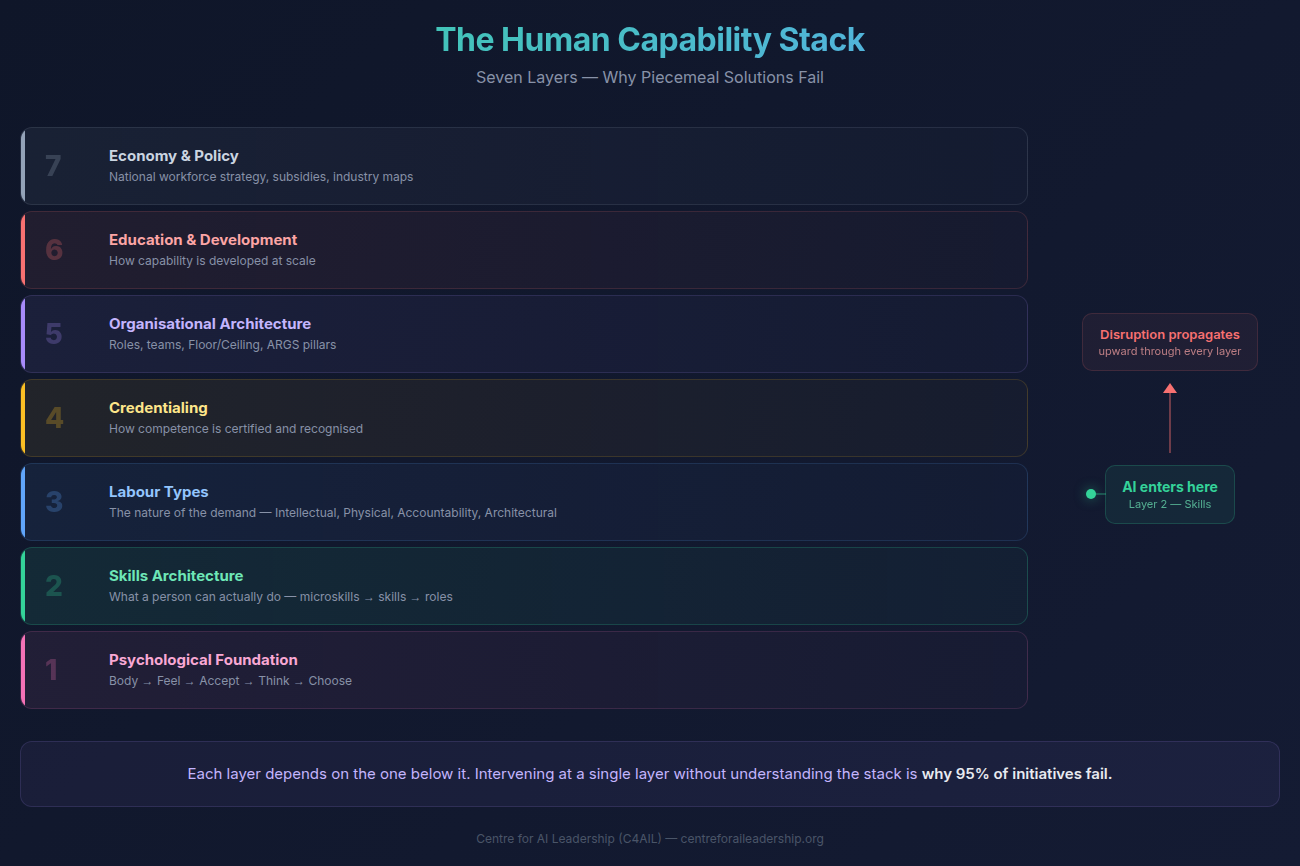
The full system — from individual psychology to national workforce strategy — is a stack. Each layer depends on the one below it. Intervening at a single layer without understanding the stack is why 95% of initiatives fail.
The Human Capability Stack:
| Layer | Domain | What It Contains |
|---|---|---|
| 7 | Economy & Policy | National workforce strategy, subsidies, industry transformation maps (SkillsFuture, ILO frameworks, ASEAN workforce policy) |
| 6 | Education & Development Systems | How capability is developed at scale. The banking model produces intellectual labour. Apprenticeship and the ZPD produce accountability. The factory model produces compliance. Engaged pedagogy produces agency. |
| 5 | Organisational Architecture | How roles and teams are structured. Floor (L0-2) / Ceiling (L3-6). Five Roles. The ARGS pillars. |
| 4 | Credentialing | How competence is certified and recognised. WSQ/NVQ/AQF certify technical skills only. Degrees certify episteme. Professional licensing certifies accountability. C4AIL L0-6 certifies all three domains. |
| 3 | Labour Types | What the work IS — the nature of the demand. Intellectual. Physical. Accountability. Architectural. |
| 2 | Skills Architecture | What a person can actually do — the supply of capability. Microskills (atomic) → Skills (compiled clusters) → Job Roles (integrated sets). Three domains: Technical, Emotional, Accountability. |
| 1 | Psychological Foundation | Who the person is and how they decide. The Body → Feel → Accept → Think → Choose developmental sequence. Emotional maturity. Values and frame direction. The decision pipeline. |
1.5 How AI Disruption Propagates Through the Stack
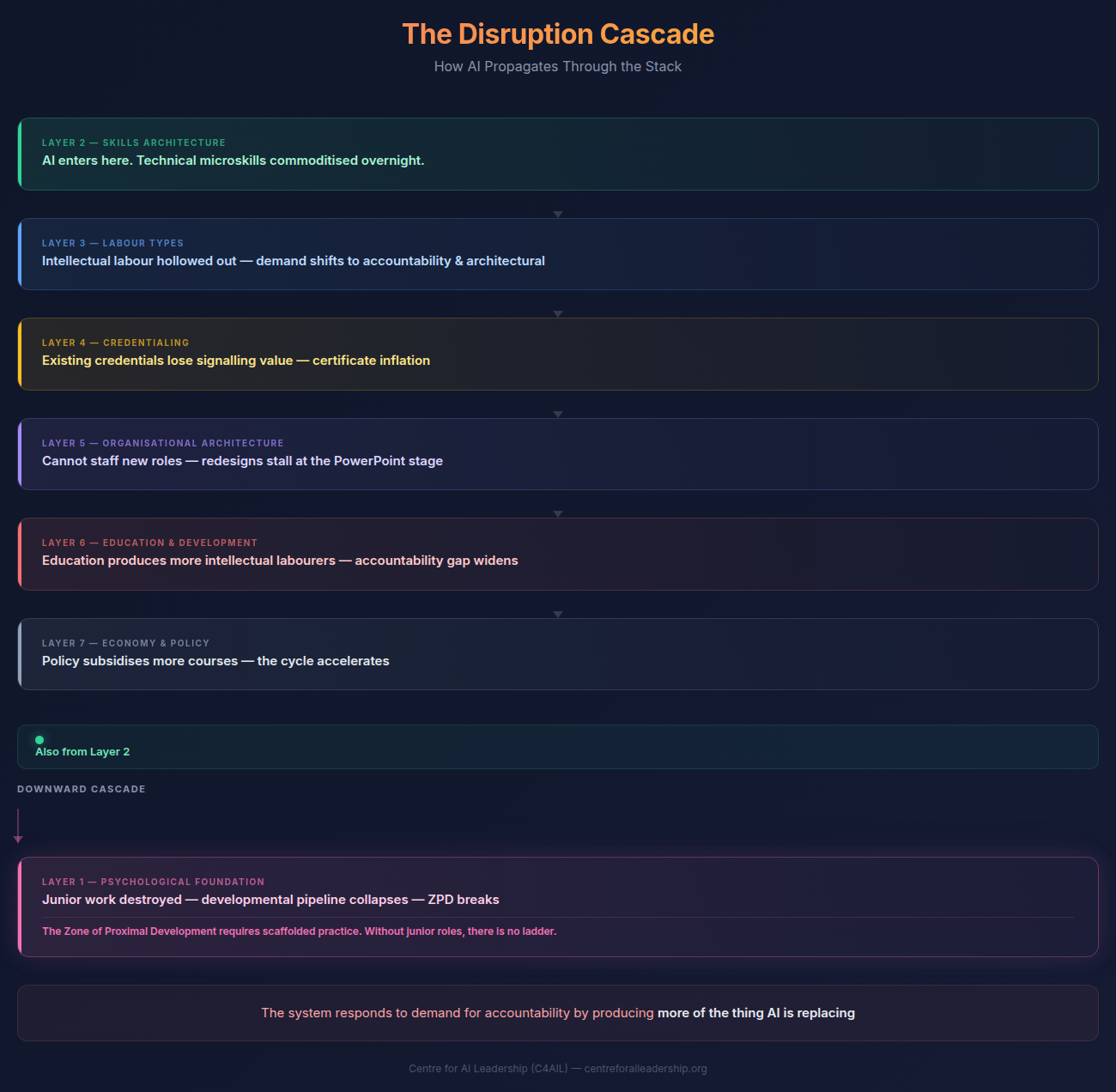
AI enters at Layer 2. It commoditises technical microskills — the atomic units of intellectual labour. A language model that can draft a contract, analyse a dataset, or write a report is replacing the smallest teachable units of professional work. But the disruption does not stop there. It propagates upward through every layer:
Layer 2 → Layer 3: Technical microskills commoditised → intellectual labour hollowed out → demand shifts to accountability and architectural labour. The layoffs documented in 1.1 are not job destruction — they are labour type substitution. Every organisation cutting intellectual headcount is simultaneously hiring for roles that did not exist two years ago: AI governance leads, verification architects, human-AI workflow designers. The headcount shifts. The labour type shifts with it.
Layer 3 → Layer 4: Labour demand shifts → existing credentials (which certify technical skills) lose signalling value → certificate inflation → employers cannot identify who is actually capable. A bootcamp certificate in “AI for Business” certifies intellectual labour competence. The employer needs accountability competence. The credential does not signal what matters.
Layer 4 → Layer 5: Credentialing fails → organisations cannot staff the new roles (Architect, Orchestrator) → organisational redesigns stall at the PowerPoint stage. The roles exist on paper. The people who can fill them do not exist in the pipeline.
Layer 5 → Layer 6: Organisations demand “more training” → education systems produce more intellectual labourers (the commoditised category) → the accountability gap widens. The system responds to demand for accountability by producing more of the thing AI is replacing.
Layer 6 → Layer 7: Education failure → policy responds with more subsidies for more courses → the cycle accelerates. SkillsFuture credits fund more AI upskilling courses. The courses produce more intellectual labourers. The cycle continues.
And critically, downward:
Layer 2 → Layer 1: AI removes the junior work that was the training ground for accountability. The pipeline collapse documented in 1.2 — the 67% entry-level hiring cliff, the hollowed-out junior ranks — is not just a labour market problem. It is a developmental problem. Vygotsky’s Zone of Proximal Development collapses → the pipeline that produced emotionally mature, judgment-capable professionals is destroyed → Layer 1 capacity degrades for the next generation.
The contribution of this whitepaper is vertical integration — connecting all seven layers into a single coherent model. The Four Labours (Layer 3) explain what is changing. The Skills Architecture (Layer 2) explains how capability is built and where AI disrupts it. The Accountability Gap (Layer 6) explains why education systems produce the wrong output. The Five Roles (Layer 5) operationalise the redesign. And the Psychological Foundation (Layer 1) explains why none of it works unless you start with the human.
The rest of this paper walks the stack from bottom to top.