Part X: The Deeper Problem
Why the Stack Fails from the Bottom
Lead author: Ethan Seow (C4AIL) Contributors: Dominic Ligot (CirroLytix), James Stanger (CompTIA), Chiew Farn Chung (ClassDo) Status: First Draft — March 2026
10.1 The Psychological Foundation
This whitepaper has walked the Human Capability Stack from Layer 3 (Labour Types) through Layer 7 (Policy). But the stack has a foundation — Layer 1, the Psychological Foundation — and it is cracked.
The natural developmental order of human capability is: Body → Feel → Accept → Think → Choose. Education delivers it inverted: Think → (maybe Feel) → (maybe Do). Accept and Choose are never addressed.
This is not pedagogical preference. It is neurobiological sequence. Stress hormones impair prefrontal cortex function (Arnsten, 2009 — working memory drops from approximately 90% to 50% under stress). The amygdala receives sensory input 12ms before the cortex (LeDoux, 1996). Anticipatory somatic signals precede conscious awareness by 40-70 decision cycles (Bechara et al., 1997). The body and emotional system get the first vote. Cognition arrives second and can override — but only if the prefrontal cortex is online, which requires the body not being in threat state.
Accept — the step between Feel and Think — is the critical gateway. It is the moment a feeling is registered as information rather than identity. “I feel this is right” becomes “I notice I feel this is right — now let me check.” In developmental terms, this is what Kegan calls the subject-object shift: what was subject (invisible, had you) becomes object (visible, something you can examine). Without Accept, the practitioner cannot distinguish emotional response from reality. The Eloquence Trap — accepting AI output because it sounds right — is the AI-specific manifestation of this failure.
This is why multi-dimensional thinking — not intelligence, not knowledge, not skill — is what differentiates humans from AI. Whitepaper I established that AI is a One-Layer Machine: it has mastered the Syntax layer to a degree indistinguishable from human output, but possesses zero capability in the remaining four knowledge layers (Contextual, Institutional, Deductive, Experiential). The Five-Layer Knowledge Model was presented as a diagnostic tool. This paper reveals it as a developmental map. Each knowledge layer requires a corresponding developmental stage to activate:
| Knowledge Layer (Whitepaper I) | Developmental Stage (This Paper) | What Activates It |
|---|---|---|
| Experiential | Body + Feel | Lived consequences — somatic and emotional memory from having done the work and felt the result |
| Deductive | Think (grounded through Accept) | First-principles reasoning — but only trustworthy when anchored in felt reality, not floating free |
| Institutional | Community (developed through co-creation) | How things actually work here — learned through belonging, not briefing documents |
| Contextual | Body (situational presence) | This client, this moment, this constraint — requires the practitioner to be present, not just informed |
| Syntax | Think (surface) | Pattern-matching on language and structure — the one layer AI handles, and the one layer the factory model trains for |
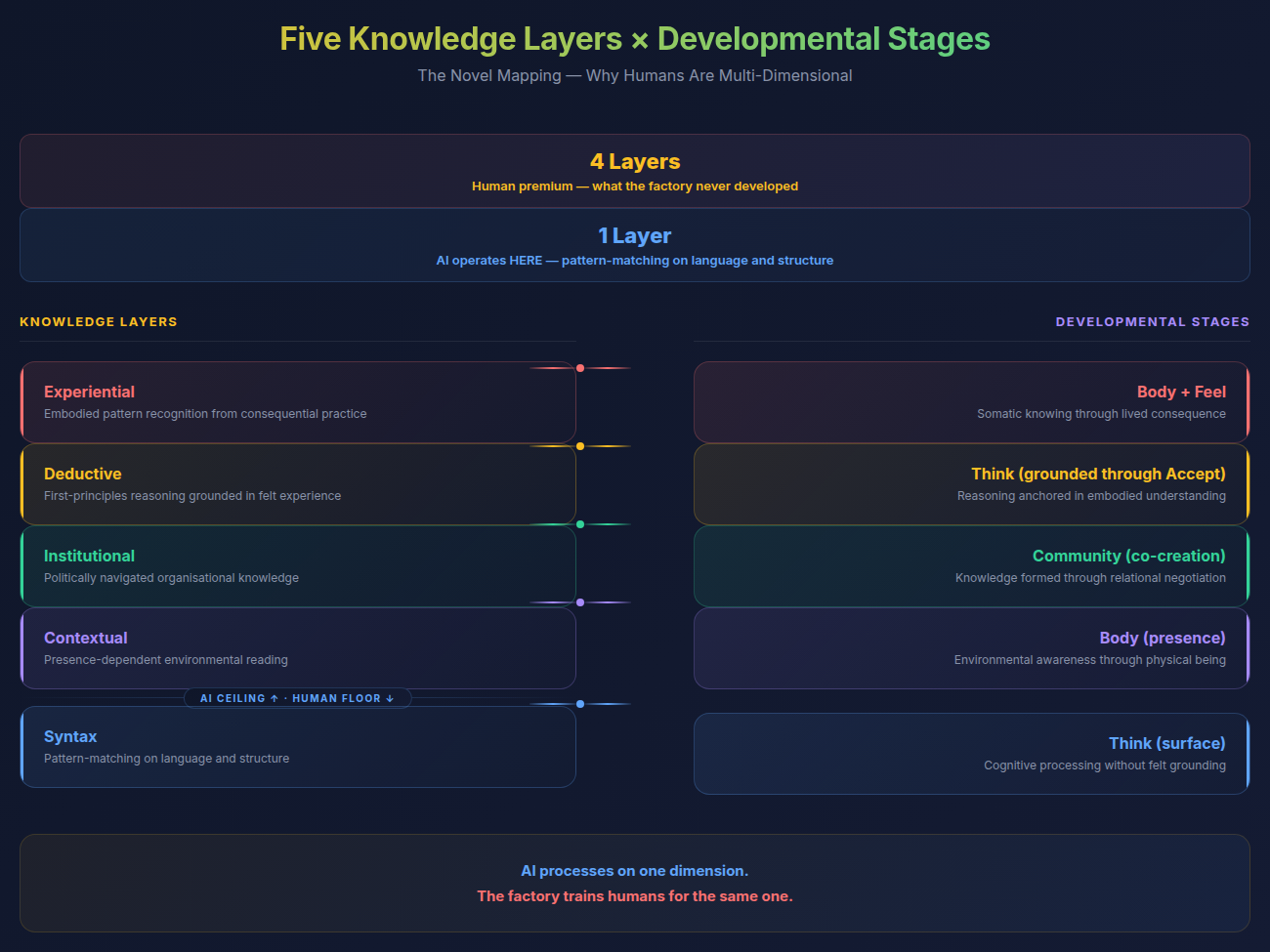
AI processes on one dimension. The factory model trains humans to process on one dimension — the same one. This is not a coincidence. The factory was designed to produce human components for industrial systems, and industrial systems needed exactly what AI now provides: reliable, standardised intellectual output. The factory’s product and AI’s product are the same product. The human premium — the thing that justifies human involvement in any process — is the ability to process across all five dimensions simultaneously. The senior partner who reads a contract and feels something is wrong before they can articulate why is processing Experiential (body memory of past failures) + Contextual (this client’s specific situation) + Institutional (how this firm handles risk) + Deductive (logical analysis) + Syntax (the words on the page) — all at once. No AI does this. No factory-trained professional does this reliably either — because the factory developed only the Syntax dimension and called it education.
Approximately 58% of adults have not reached Kegan’s Stage 4 (Self-Authoring), which requires Accept to be functional (Kegan, 1994, composite of ~282 Subject-Object Interviews with middle-class, college-educated US adults; Kegan & Lahey, 2009, p. 28; corroborated by Torbert, 1987, N=497 managers using the Sentence Completion Test). No population-representative replication exists — the general population figure may be higher, not lower. This means a substantial majority of the workforce structurally cannot perform independent accountability labour without developmental support — not because they lack intelligence, but because they have been developed along one dimension of a five-dimensional capability. Stage transitions take 5-10 years with the right conditions — confirmation, contradiction, and continuity. There is no shortcut. And the right conditions are precisely what the current education system does not provide.
10.2 The Inversion Is Universal
The Body → Feel → Accept → Think → Choose inversion is not a Western construct. It is the universal product of statist education — any system that centralised education for state purposes.
The West did it through the factory model. East Asia did it through 2,000 years of examination culture corruption: from Confucius’ integrated 修身 (self-cultivation) and 六藝 (Six Arts — ritual, music, archery, charioteering, calligraphy, mathematics) through Han Wudi’s imperial co-optation (136 BC), the keju examination system (605 AD), Zhu Xi’s codification of the Four Books as sole exam canon (1313), and the eight-legged essay’s terminal ossification (1368-1905). Japan reached the same destination through a different genealogy — the Meiji Restoration’s import of Prussian industrial education (1868). Korea inherited the gwageo examination system from China and amplified it through yangban hereditary status anxiety.
Wang Yangming (1472-1529), following his enlightenment at Longchang in 1508, articulated the doctrine of 知行合一 — the unity of knowledge and action. Knowledge divorced from moral action is the same inversion, named five centuries before this whitepaper. Wang saw what Humboldt could not: that separating knowing from doing does not produce higher knowledge. It produces people who can recite without judgment.
The evidence is cross-regional. Singapore: 1st globally across all three PISA 2022 domains (mathematics, reading, science), but 78% of students said failure makes them doubt their plans for the future — the highest rate among all participating countries and 24 percentage points above the OECD average (PISA 2018). One quarter of youth self-injured at least once (National Youth Mental Health Study, 2025, n=2,600). Japan: 529 student suicides in 2024 — a record since records began in 1980 — while the overall national suicide count declined to its second-lowest since 1978 (MHLW). 346,000 school refusals in the 2023 academic year, the 11th consecutive annual increase and the first time the figure exceeded 300,000 (MEXT). Korea: 7.9 per 100,000 teen suicide rate (record), climbing from 5.5 since 2011 while every other age group declines. Suicide has been the leading cause of death for Koreans aged 10-24 for over a decade. Every high-performing exam-culture system is running the same playbook — add well-being programmes on top of unchanged competitive structure — and getting the same result.
The reforms are hygiene, not development. Removing mid-year exams reduces one stressor. It does not teach a student to feel fear, accept it, and choose a response. The Herzberg distinction applies: hygiene factors prevent harm but do not create growth. Development factors create growth. The education systems of the world have invested heavily in hygiene. They have not invested in Feel as a developmental capability.
10.3 What This Means for Workforce Transformation
The psychological foundation constrains everything above it. An organisation can redesign its roles (Layer 5), reskill its workforce (Layer 6), and align its policy framework (Layer 7) — but if the majority of the workforce — Kegan’s estimate of ~58%, likely conservative — has not developed the Accept capacity required for independent accountability, the Ceiling roles remain unfillable.
This is not a counsel of despair. It is a design constraint. The implementation roadmap must account for developmental timelines, not just training timelines. The Trainer role (Role 5) exists precisely to provide the conditions Kegan identified: confirmation (held, seen, valued where you currently are), contradiction (experiences that expose limits of current meaning-making), and continuity (sustained environment providing both, over time). The Genius Bar, the Guildhall, and the portfolio system are not training programmes. They are developmental environments.
The system must develop its people before it can transform its work. And it must do so while the training ground that historically produced that development is being automated away. This is the deepest challenge of the AI age — not technological, not economic, but developmental. The answer is not more courses — courses add content along the one dimension already saturated. The answer is multi-dimensional development: activating the Experiential, Contextual, Institutional, and Deductive layers that the factory model never touched, so that human professionals operate across all five dimensions while AI operates on one. Better humans, not faster humans. And better humans take time, conditions, and care that no policy subsidy can shortcut.
There is a word for what multi-dimensional capability looks like in practice, and it is simpler than any framework: taste — phronesis, the practical wisdom that can only develop through consequential creation (see Section 3.6). The five knowledge layers, the accountability threshold, the guild mechanisms — all converge on this single capacity: the felt sense of quality that separates the competent from the accountable.
Kenny Werner calls the integrated expression of this capacity “effortless mastery” — the state where creation flows from the whole person, not just from the analytical mind. Werner’s insight, developed through decades as a jazz pianist and teacher, is that the barrier to mastery is not insufficient technique. It is fear, ego, and the compulsive need to prove — all of which live in the Body and Feel layers. When those layers are unresolved, the practitioner creates from tension: performing competence rather than expressing judgment. When Body and Feel and Accept are online — when the practitioner can feel without being hijacked, accept without collapsing, and think without dissociating from what they feel — creation flows from the integrated person. This is the full Body → Feel → Accept → Think → Choose sequence expressed as creative capacity. Taste is what emerges when all five stages are functioning and the person creates from wholeness rather than from anxiety.
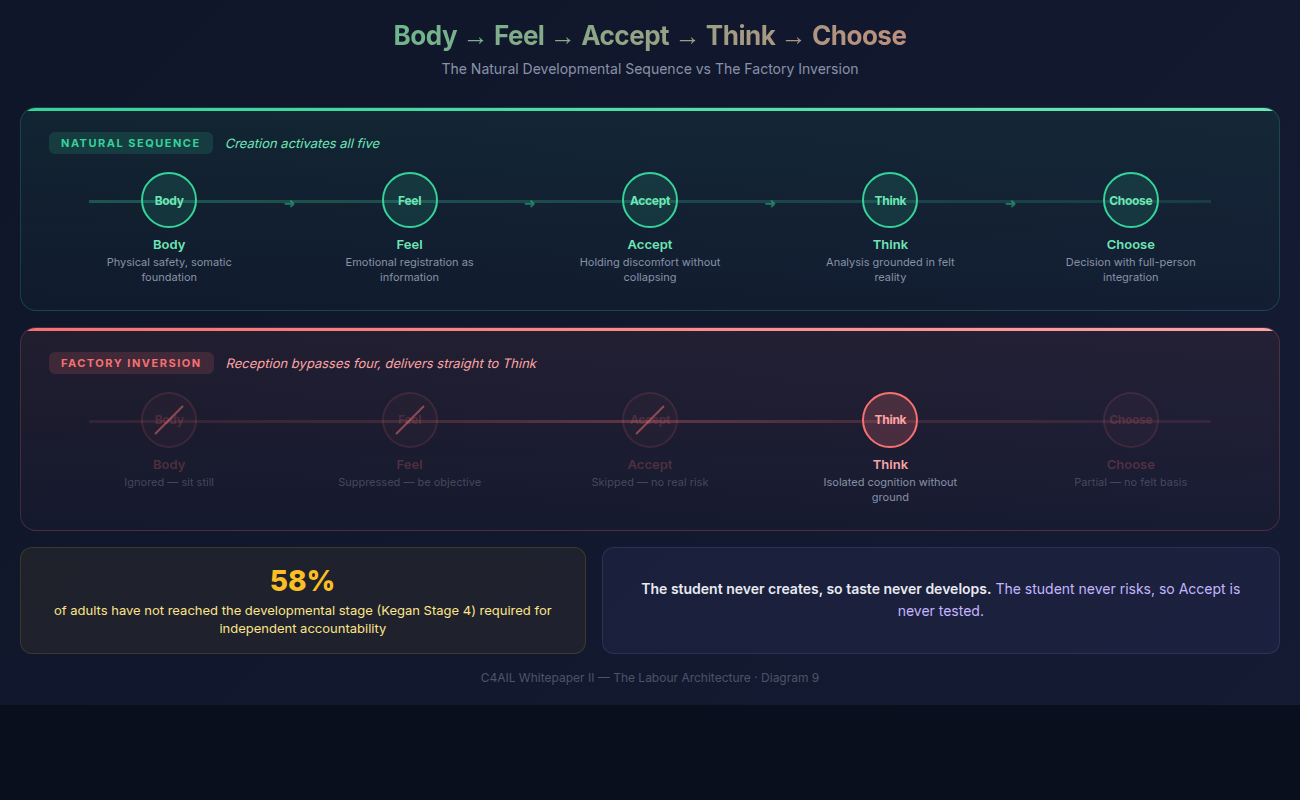
The factory model cannot produce this — it truncates the developmental sequence at Think, bypassing Body, Feel, and Accept entirely. The product is a professional who can execute but cannot judge, who can pass the exam but cannot sign the document. And creation requires all five developmental stages to be online — which is why the psychological foundation is not a nice-to-have at the bottom of the stack. It is the prerequisite for the only capability that matters.