Part II: The Four Labours
From Philosophy to Job Specs
Lead author: Ethan Seow (C4AIL) Contributors: Dominic Ligot (CirroLytix), James Stanger (CompTIA), Chiew Farn Chung (ClassDo) Status: First Draft — March 2026
2.1 From Three to Four
Whitepaper I defined three categories of labour: Intellectual, Physical, and Accountability. This paper extends the model to four — surfacing Architectural Labour as a distinct category and correcting the assumption that Physical Labour plateaus.
| Labour Type | Definition | AI Relationship (2025) | Trajectory |
|---|---|---|---|
| Intellectual | Weightless — strategy, synthesis, coding, writing, analysis | LLMs replacing and augmenting now | Commoditised. Humans exit execution, retain architecture and verification. |
| Physical | Atom-bound — logistics, manufacturing, trades, operations | AI optimises; robotics converging | Follows intellectual labour on a 2-3 year lag. The “atom-bound” constraint is temporary. |
| Accountability | Presence-bound — ethical oversight, risk ownership, judgment, empathy, care | Cannot be automated | The only durable human monopoly. Grows as both intellectual and physical output become machine-generated. |
| Architectural | Design-bound — building the systems through which AI and robots operate | New category emerging | The growth category. Where all the new jobs live. |
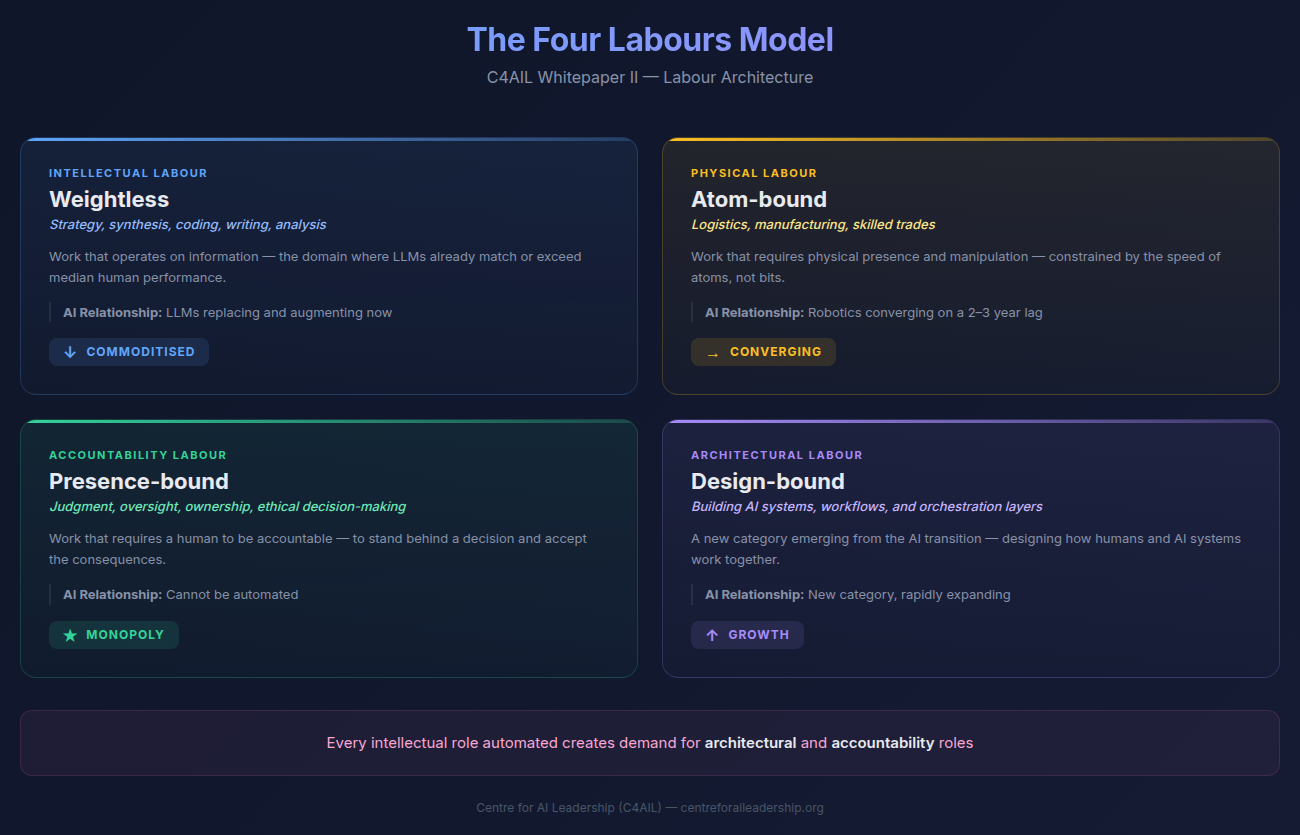
Intellectual Labour is being commoditised in real time. The evidence is no longer speculative — Part I documented the scale across PwC, Baker McKenzie, Salesforce, and Klarna. But the pattern extends beyond headline cases. Chegg lost 99% of its market capitalisation after ChatGPT replaced its core service — from $14.7 billion to approximately $156 million — and cut 45% of remaining staff in October 2025. Duolingo eliminated contract translators entirely. UiPath saw its business model shift from automating tasks humans could not do efficiently to competing with AI that could do them for free. The pattern across these cases is consistent: they do not eliminate headcount absolutely — they shift the labour type. Every intellectual role automated creates demand for someone to architect the system and someone to be accountable for its output.
Physical Labour does not plateau. Whitepaper I described an S-Curve for physical labour — gains that eventually hit the constraints of physical reality. That was Phase 1. Phase 2 is arriving. Goldman Sachs estimates 15,000-20,000 humanoid robots shipped in 2025. Amazon already has over one million robots operating alongside 1.56 million human workers in its warehouses — approaching parity. Tesla’s Optimus Gen 3 begins slow-ramp production in summer 2026, with a long-term cost target of $20-25K per unit at scale. Boston Dynamics’ Electric Atlas entered production deployment in January 2026 with all 2026 units spoken for. Figure AI completed an 11-month pilot at BMW’s Spartanburg plant. Eighty percent of warehouses still have no automation whatsoever (Interact Analysis) — representing a massive greenfield for robotics deployment.
The cost trajectory matters. Tesla’s $20-25K at-scale cost target for Optimus would break the cost barrier the way GPT-3.5 broke the LLM cost barrier. When the unit economics cross the threshold, adoption follows a Power Law, not an S-Curve. Goldman Sachs revised its humanoid market estimate from $6 billion to $38 billion by 2035 — a 6x increase. McKinsey’s November 2025 analysis found that 57% of US work hours are automatable with current technology: 44% through AI agents and 13% through robotics. For services economies where 80% of work is intellectual labour, the exposure is already existential. If physical labour follows — and the convergence of humanoid robotics, computer vision, and foundation models suggests it will, though the timeline is less certain than for intellectual automation — the entire labour market is exposed.
Accountability Labour is the only durable human monopoly — but this claim requires honest stress-testing. The strongest counterargument: AI systems are already developing consequence-tracking capabilities. Reinforcement learning from human feedback (RLHF) creates models that adjust behaviour based on outcome signals. Autonomous vehicle systems make split-second decisions with life-or-death consequences and learn from failures across millions of miles. Smart contract platforms execute financial commitments with verifiable, immutable consequence chains. If AI develops persistent episodic memory across consequential interactions, embodied presence through humanoid robotics, and verifiable commitment mechanisms, the human monopoly on accountability could narrow significantly. This paper’s framework depends on this boundary holding — Limitation #8 flags it as the most important assumption to track.
Why the monopoly holds today: no jurisdiction on earth accepts “the AI decided” as a defence. Legal liability requires a human signatory. Insurance frameworks require named accountable parties. The EU AI Act Article 14 mandates human oversight for high-risk AI systems. Singapore’s Agentic AI Framework requires human checkpoints at decision boundaries. These are not just regulatory preferences — they reflect a deep structural reality: accountability requires someone who can be held to account, who bears personal consequences for failure, and whose judgment integrates contextual understanding that no current AI architecture possesses. The autonomous vehicle decides in milliseconds but cannot testify in court about why it chose as it did. The smart contract executes deterministically but cannot exercise discretion when circumstances change. RLHF optimises for reward signals, not for the felt weight of signing a document that determines someone’s livelihood.
Accountability scales with output, not headcount — the more work AI produces, the more human oversight is required. CAIO appointments are up 70% year-on-year. Board-level AI oversight grew from 16% to 48% in a single year (2024-2025). Seventy-seven percent of organisations are building formal AI governance programmes. The demand for accountability labour is growing precisely because the supply of intellectual and physical labour is being automated. This growth may not last forever — but it will last longer than most current workforce strategies are planned for.
Architectural Labour is where all the new jobs live. This is the labour of building the systems through which AI operates: CAGE templates (structured frameworks that constrain AI output to domain-valid ranges), verification engines, Knowledge Layer specifications, workflow orchestration, Queue A/B/C triage architecture (routing AI outputs by confidence level — auto-approved, human-reviewed, or escalated). These roles did not exist before AI. AI Architect and AI Solutions Architect roles command $145-210K (Robert Half/Glassdoor). AI/ML Ops ranges from $111-263K with a median of $175K. GenAI role postings grew approximately 170% year-on-year (Indeed Hiring Lab, January 2024-2025). Gartner projects over 32 million jobs per year reconfigured starting 2028-2029. Stanford’s Digital Economy Lab found a 13-16% decline in entry-level hiring in AI-exposed fields alongside a surge in mid-senior AI roles. The jobs are not disappearing — they are changing category.
Whitepaper I’s Part IX quietly introduced Architectural Labour in a single sentence — the Knowledge Layer — but never named it as a distinct labour category. This paper makes the naming explicit. Architectural Labour is intellectual in nature (designing systems, building templates) but distinct from Intellectual Labour because it creates the infrastructure through which other labour types operate. An Architect does not write the report — they build the system that writes the report and the verification engine that checks it.
2.2 The Skills Architecture — From Microskill to Labour Type
The Four Labours describe what kind of work is done. But labour does not happen at the category level — it happens at the skill level. Between “this role performs accountability labour” and “here is what the person actually does” sits a hierarchy of capability that determines what workforce redesign must target.
Microskill (atomic, teachable, assessable)
  │  e.g., "parse a balance sheet line item," "hold silence after a challenge,"
  │       "sign off on a recommendation you can defend"
  ↓  clusters integrate through practice into
Skill / Macroskill (demonstrated competency in context)
  │  e.g., "financial analysis," "stakeholder negotiation," "governance oversight"
  ↓  integrated set becomes
Job Role (bundle of skills applied to a domain)
  │  e.g., "CFO," "Data Analyst," "Project Manager," "Surgeon"
  ↓  performed through
Labour Type
     Intellectual | Physical | Accountability | Architectural
A microskill is the smallest teachable unit of performance — a discrete action that can be practised, observed, and assessed in isolation. A skill is a cluster of microskills integrated through practice until they function as a coherent capability. A job role is an integrated set of skills applied within a domain context. The labour type describes the nature of the work.
The cognitive mechanism is chunking and compilation. Miller (1956) established that working memory holds seven plus or minus two chunks. What constitutes a “chunk” depends on expertise — the novice driver holds “check mirror, signal, blind spot, turn, accelerate” as five separate chunks; the experienced driver holds “change lanes” as one. Anderson’s ACT-R theory (1982) provides the mechanism: skill acquisition moves from declarative knowledge (conscious facts) through knowledge compilation (facts compiled into procedures through practice) to procedural knowledge (automatic execution). Sweller’s Cognitive Load Theory (1988) demonstrates that instruction pitched at the wrong level of this hierarchy — isolated microskills without integration scaffolding, or demanding macroskill performance before microskills are compiled — overwhelms working memory and learning fails.
The Dreyfus model (1980) maps the qualitative shift: the novice operates with rules applied to individual microskills; the competent practitioner has compiled enough microskills to manage routine situations; the expert acts from integrated intuition — the entire hierarchy compiled to the point where recognition and response are a single fluid act. Ericsson’s deliberate practice research (1993) adds the development pathway: decompose performance into components, practise with focused attention and feedback, reintegrate at a higher level.
2.3 Three Domains of Microskills
The hierarchy applies across all human capability. But not all microskills are alike. They fall into three domains — and the domains are not parallel categories. They are a developmental stack.
Technical microskills are domain-specific procedural knowledge. Writing a SQL query, reading an X-ray, configuring a firewall. This is what education systems teach and what competency frameworks (WSQ, NVQ, AQF) certify. Any technical microskill describable as a procedure is, in principle, automatable. This is the domain AI is commoditising.
Emotional microskills are the capacity to recognise emotions as they arise, name them accurately, hold space for another’s distress, and read a room. These cluster into macroskills: empathy, self-regulation, relational attunement. They are teachable and assessable — but almost no formal system treats them as skills to be developed. They require the Body → Feel → Accept sequence to be functional. You cannot recognise an emotion you have not first allowed to land.
Accountability microskills are the capacity to sign your name to a recommendation under uncertainty, conduct a post-mortem without blame, hold contradictory expert opinions and choose anyway, and defend a decision after it goes wrong. These require consequence — they only compile when the practitioner experiences the weight of the outcome. This is why residencies, military command, and apprenticeships produce accountability in ways lectures cannot.
The developmental sequence matters:
Accountability microskills (full sequence under consequential stakes)
  ↑ requires
Emotional microskills (Feel + Accept)
  ↑ requires
Technical microskills (Think + Choose)
  ↑ requires
Physical safety + somatic foundation (Body)
This is not arbitrary ordering. It is the Body → Feel → Accept → Think → Choose sequence applied to workforce capability. Stress takes the prefrontal cortex offline (Arnsten, 2009). Without physical and psychological safety, technical learning degrades. Without emotional processing — the capacity to register a feeling as information rather than suppressing it — accountability is impossible because the practitioner cannot distinguish “what feels right” from “what IS right.” The developmental psychologist Robert Kegan estimates that approximately 58% of adults have not reached the developmental stage (Stage 4, Self-Authoring) required for independent accountability. Not because they lack intelligence. Because the meaning-making structure that enables independent judgment has not been built.
Mapping domains to labour types:
| Labour Type | Primary Domain | Secondary | Tertiary |
|---|---|---|---|
| Intellectual | Technical | — | — |
| Physical | Technical (embodied) | — | — |
| Accountability | Accountability | Emotional | Technical |
| Architectural | Technical | Accountability | Emotional |
AI commoditises technical microskills — the domain that constitutes the entirety of intellectual labour and the bulk of physical labour. Emotional and accountability microskills cannot be compiled by AI because they require embodied experience, consequential stakes, and felt ownership. The human premium lives in these domains. And competency frameworks certify only the technical domain — the one being automated.
2.4 The Four-Column Task Decomposition
Workforce redesign must operate at the microskill level, not the job level. A job is a bundle of skills across all three domains. When you decompose a job into tasks and classify each task by labour type, you are classifying the microskill clusters that constitute each task. The four columns extend CompTIA’s Workload and Task Redesign methodology:
| Column | Labour Type | What Happens | Timeline |
|---|---|---|---|
| Automated (Intellectual) | Intellectual | AI replaces now | 2024-2026 |
| Automated (Physical) | Physical | Robotics replaces | 2027-2030 (with probability) |
| Elevated (Accountability) | Accountability | Requires MORE human judgment post-AI | Immediate and growing |
| New (Architectural) | Architectural | Did not exist before AI | 2024 onwards |
Applied to representative roles:
| Role | Automated (Intellectual) | Automated (Physical) | Elevated (Accountability) | New (Architectural) |
|---|---|---|---|---|
| Financial Analyst | 60% — research, modelling, report drafting | — | 15% — sign-offs, risk judgment, client trust | 25% — building analysis pipelines, verification engines |
| Compliance Officer | 40% — regulation scanning, gap analysis | 10% — site inspections (stable for now) | 30% — interpretation, enforcement decisions, regulatory judgment | 20% — compliance automation architecture, audit trail design |
| Warehouse Supervisor | 20% — scheduling, inventory analysis | 40% — routing, picking (robot-augmented by 2028) | 20% — safety decisions, team management, exception handling | 20% — robot workflow design, human-robot handoff protocols |
| Project Manager | 50% — status reporting, schedule optimisation, comms drafting | 10% — physical coordination | 25% — stakeholder judgment, priority decisions, conflict resolution | 15% — workflow automation, AI agent orchestration |
| IT-BPM Agent (Philippines) | 80% — near-total automation risk | — | 5% — escalation judgment, empathy-requiring interactions | 10% — if reskilled into architectural roles |
The IT-BPM agent row is particularly significant for services economies. In the Philippines, the IT-BPM sector employs 1.9 million workers generating $40 billion in revenue (2025). Eighty percent of that work is intellectual labour — the most exposed category. IBPAP survey data shows 67% of member companies have integrated AI, but near-zero are ready for the labour type transition. A services economy where the vast majority of work lives in Column 1 faces existential exposure. The timeline compresses from decades to years.