Part III: The Accountability Gap
Why Education Produces the Wrong Labour Type
Lead author: Ethan Seow (C4AIL) Contributors: Dominic Ligot (CirroLytix), James Stanger (CompTIA), Chiew Farn Chung (ClassDo) Status: First Draft — March 2026
3.1 The Factory Was the Point
The education system was designed to produce intellectual labourers. The one labour category now being commoditised fastest. It has no mechanism for producing accountability labour — the one category where demand is growing and supply is structurally constrained.
This is not a failure of execution. It is success at the wrong objective.
Ken Robinson (Out of Our Minds, 2011; Creative Schools, 2015) documented the design intent: schools were modelled on the factory system for the industrial revolution’s 80/20 labour split — 80% manual, 20% administrative and professional. Students are grouped in batches (age cohorts), processed through standardised outputs (testing), and trained to be risk-averse and frightened of being wrong. In a factory, you do not want workers to reimagine the product. You want them to follow the manual. The system produces compliance, not judgment.
Paulo Freire (Pedagogy of the Oppressed, 1970) named the mechanism: the “banking model” of education. Knowledge is treated as “a gift bestowed by those who consider themselves knowledgeable upon those whom they consider to know nothing.” Students are “receiving objects,” not “conscious beings.” The banking model “regards men as adaptable, manageable beings” — it produces individuals who adapt to the world as it is. You cannot be accountable for a reality you have been conditioned to accept as static.
bell hooks (Teaching to Transgress, 1994) extended Freire’s critique: the banking model is worse than Freire describes because it also demands a “mind/body split.” Students leave their identities at the door. For marginalised students, this is “psychic self-mutilation.” Accountability is presence-bound — it requires wholeness, not performance. A system that trains people to split mind from body cannot produce people capable of accountability, because accountability requires the full person to be present.
The shared diagnosis across Robinson, Freire, and hooks: education produces people optimised for intellectual labour (receiving deposited knowledge, applying rules, generating output on command) but structurally incapable of accountability labour (judgment, presence, naming reality, defending decisions under uncertainty). The AI age has made that design catastrophically obsolete.
3.2 Why We Switched — And Why It Made Sense Then
This was not an accident. The factory model replaced something that worked. But at every stage of the replacement, the reformers lacked awareness of what they were discarding. They could see what the guild system produced — skilled craftsmen — but not how it produced them. The accountability mechanisms were invisible. They still are.
The Guild System Was Not Small
The conventional narrative — “apprenticeship was a quaint, small-scale system that couldn’t meet industrial demand” — is empirically false.
In London circa 1500, guild masters comprised 50-60% of all householders and 12-13% of the total population. The city operated through 72 livery companies and 14 additional occupational associations (Rappaport, Worlds within Worlds, 1989; cited in Ogilvie, Journal of Economic Perspectives, 2014). In Florence around 1300, 21 guilds — seven Arti Maggiori and fourteen Arti Minori — organised the city’s economy. The textile trade alone employed approximately 30,000 workers, roughly one-third of the city’s population (Giovanni Villani, Nuova Cronica, c. 1330). In Cologne, 22 Gaffeln (political guild federations) governed the city after the Verbundbrief of 1396, encompassing approximately 80 distinct trade associations, including female-dominated guilds for yarn-spinning and silk-weaving (Militzer). In 18th-century Central Europe, government censuses in Baden-Durlach (1767), Württemberg (1759), and Bavaria (1811) show that 80-95% of all craftsmen belonged to a guild (International Review of Social History, 2008). The Hanseatic League, at its peak around 1300-1400, connected nearly 200 settlements across eight modern countries (Dollinger, The German Hansa, 1970).
In the Dutch Republic circa 1670, approximately 13,800 new apprentices entered training annually across 1,153 guilds (de la Croix, Doepke & Mokyr, “Clans, Guilds, and Markets,” Quarterly Journal of Economics, 2018). Continental apprenticeships typically lasted 3-5 years — not the 7 years mandated by England’s exceptional Statute of Artificers (1563). The system sustained specialised labour markets for over 500 years.
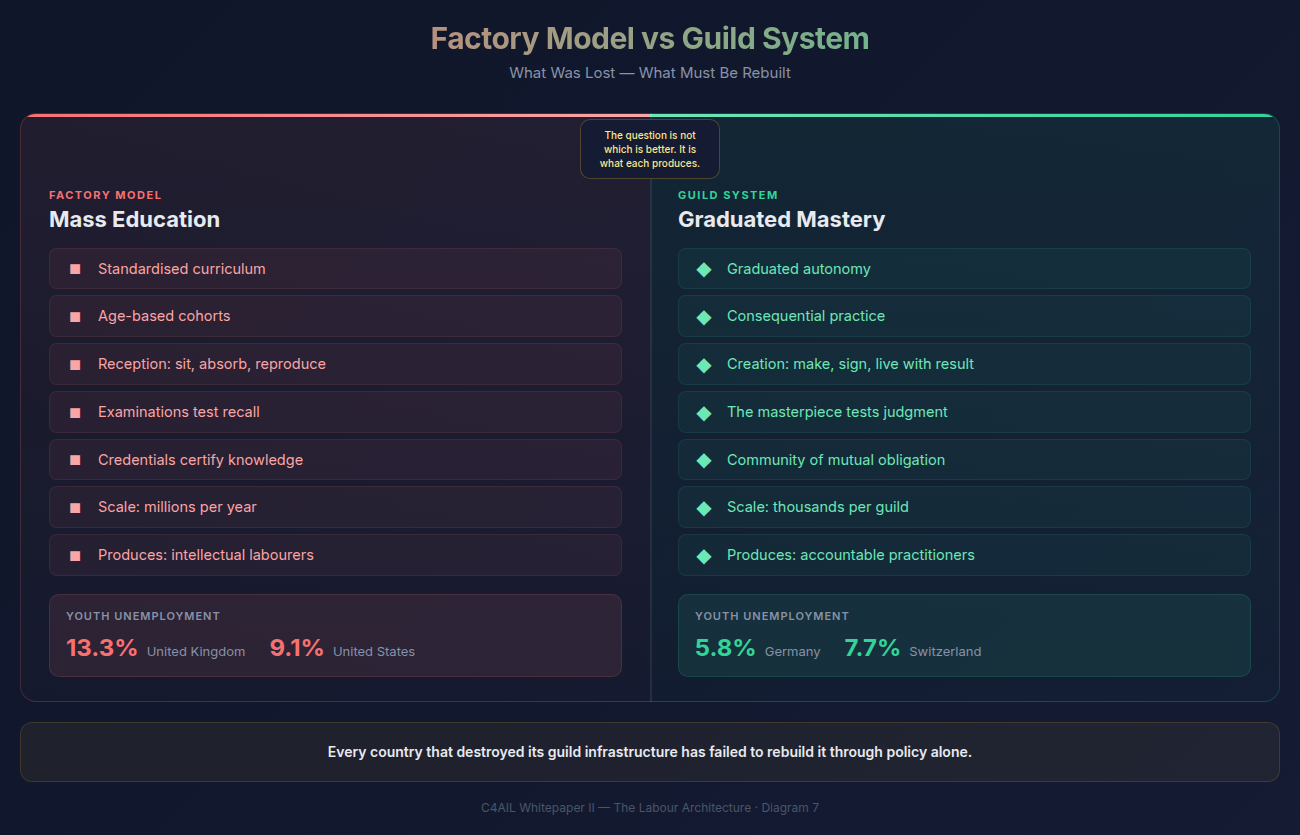
A medieval guild apprentice progressed from observation to supervised practice to independent work, culminating in a masterpiece — a work that proved the apprentice could be trusted with unsupervised practice. The model embedded every mechanism this paper identifies as essential: graduated autonomy (you earned the right to work alone), consequential decisions (your work bore your mark), reflective accountability (the master reviewed and corrected), a signing moment (the masterpiece examination), and community of practice (the guild itself, with its standards and mutual obligations).
The guilds had real problems. Ogilvie (Journal of Economic Perspectives, 2014) documents rent-seeking: guilds restricted entry to protect incumbents, increasingly reserved apprenticeships for members’ sons, suppressed innovations that threatened existing skills, and extracted monopoly rents. Epstein (Journal of Economic History, 1998) counters that guilds solved the moral hazard of training — third-party enforcement ensured masters actually taught and apprentices did not abscond — and that the Wanderjahre (journeyman years) facilitated rapid cross-city diffusion of techniques. Both are right. The guilds were imperfect institutions that nonetheless produced something no subsequent system has replicated at scale: practitioners who could be trusted with unsupervised judgment.
The question is not whether the guilds were ideal. The question is what was lost when they were dismantled — and whether the reformers who dismantled them understood what they were discarding.
The Prussian Pivot: Three Steps of Narrowing Awareness
The Prussian education model did not emerge from a single decision. It emerged from three sequential reformers, each narrowing the definition of what education was for — and each less aware than the last of what the previous system had produced.
Frederick the Great (1763) issued the Generallandschulreglement, drafted by the Pietist theologian Johann Julius Hecker, mandating eight years of state-funded education for ages 5-14. The Volksschule (people’s school) prioritised literacy and religious obedience. Frederick’s objective was state control, not educational philosophy. He could see that a literate, obedient population was easier to govern than an illiterate one. He could not see — and had no reason to care about — the accountability mechanisms embedded in the guild system that his schools would begin to displace.
Johann Gottlieb Fichte (1807-1808), after Prussia’s catastrophic defeat by Napoleon at Jena in 1806, delivered his Addresses to the German Nation. He argued the state must take “total control of education” to “mould the will” of citizens. Traditional decentralised apprenticeships were insufficient for national survival. Fichte was the ideological catalyst — he provided the nationalist justification for centralising education under the state. His awareness was focused entirely on national cohesion. The guild system’s role in producing capable practitioners was invisible to him; he saw only its localism, its fragmentation, its failure to produce citizens who would die for the nation.
Wilhelm von Humboldt (1809), appointed head of the Section for Culture and Education, formalised the philosophical shift. In his Königsberger und Litauischer Schulplan, he argued that “vocational skills are easily acquired later on” if a general “cultivation of the mind” (Bildung) is first established. This created the Gymnasium — academic education as the superior form, vocational training as something that could be bolted on afterward. Humboldt’s awareness was the narrowest of the three: he actively theorised that what the guilds produced was secondary to what the academy produced. He could see episteme (theoretical knowledge) and techne (craft skill). He was blind to phronesis (practical wisdom) — the very capability Aristotle had distinguished 2,100 years earlier.
The Prussian model did not set out to destroy accountability. It set out to produce literate, obedient, nationally cohesive citizens at scale. It succeeded. The accountability mechanisms of the guild system were not attacked — they were simply not seen. They fell away as an unnoticed casualty of a reform that was solving a different problem.
Who Destroyed Their Guilds — And Who Didn’t
The Prussian model spread. But it spread differently depending on what each country did with its existing guild infrastructure. This is where the story diverges — and where the lack of awareness becomes most consequential.
France (1791): Abolition. The Le Chapelier Law of 14 June 1791 abolished all guilds (corporations), trade unions, and workers’ associations. The d’Allarde Law three months earlier had already dismantled guild monopolies. The revolutionary logic was clear: guilds were remnants of the Ancien Régime, obstacles to individual liberty and free markets. France replaced the guild infrastructure with elite state institutions — the École Polytechnique (1794) trained state bureaucrats and engineers, not practitioners. In 1985, Education Minister Jean-Pierre Chevènement set a target for 80% of an age group to reach the baccalauréat level, further stigmatising the Lycées Professionnels as a track for failure. France is now spending approximately EUR 15 billion annually in subsidies trying to rebuild apprenticeship (DG Trésor, 2025), having reached 1 million apprentices — 230 years after destroying the institutional infrastructure that made apprenticeship self-sustaining.
United Kingdom (1944-1965): Starvation. The Butler Act of 1944 proposed a tripartite system — Grammar Schools (academic), Secondary Modern Schools (general), and Technical Schools (vocational). The Norwood Report of 1943 had already categorised children into three “types of mind,” with the “technical mind” positioned as socially inferior. By 1958, only 4% of secondary students were enrolled in Technical Schools — they were starved of funding because local authorities found it cheaper to convert existing buildings into Grammar Schools than to build equipment-heavy technical facilities (McCulloch, The Secondary Technical School, 1989). Circular 10/65, issued in 1965 by Education Secretary Anthony Crosland, moved toward comprehensive schools, effectively dissolving the technical track entirely. The Technical Schools were not explicitly abolished. They were made invisible through administrative neglect — a pattern that would repeat.
The UK has attempted to rebuild vocational education six times since 1983. Each attempt has failed:
| Initiative | Years | Investment | Outcome |
|---|---|---|---|
| TVEI | 1983-1997 | £900M-£1.1B | Marginalised by the 1988 National Curriculum; phased out |
| Tomlinson Report | 2004 | N/A (rejected) | Proposed replacing A-Levels with a unified diploma; Blair kept A-Levels as “gold standard” |
| 14-19 Diplomas | 2008-2013 | £295.6M | 594 students completed the Advanced Diploma by June 2010 |
| Wolf Report | 2011 | N/A (review) | Found 350,000-400,000 young people in courses offering “little or no labour market value” |
| Sainsbury Review | 2016 | N/A (review) | Found the system burdened by 20,000+ courses from 160 organisations |
| T-Levels | 2020-present | Ongoing | 16,000 students in 2023/24 — 1% of 16-18 learners. Approximately 1 in 4 withdraw within the first year |
(Sources: Edge Foundation 2010, 2023; DfE 2011, 2016; Education Policy Institute 2024)
Why do they keep failing? An Ofqual/YouGov survey (June 2025) found that only 48% of employers value vocational qualifications, compared to 88% of training providers. The “parity of esteem” problem is not a perception issue — it is a market signal that employers themselves reinforce. Without mandatory intermediary bodies (chambers) to enforce quality and standardise credentials, vocational qualifications remain fragmented, inconsistent, and low-trust.
United States (1862-1983): Academicisation. The Morrill Act of 1862, signed by Abraham Lincoln, granted 30,000 acres of federal land per congressional representative to establish colleges for “Agriculture and the Mechanic Arts.” These land-grant institutions — Cornell, MIT, Texas A&M — quickly evolved into elite research universities, moving vocational training from the workshop to the lecture hall. The Smith-Hughes Act of 1917 then separated vocational education into a distinct, lower-status secondary track, cementing the divide between “college-bound” and “vocational” students. A Nation at Risk (1983) defined educational excellence exclusively through academic rigour and college attainment, effectively positioning vocational programmes as the opposite of excellence.
The result: only 680,000 registered apprentices in the United States as of 2024 — approximately 0.4% of the total workforce (US Department of Labor, 2025). Burton Clark’s 1960 analysis of American community colleges identified the “cooling out” function: institutions redirect students from “unrealistic” academic aspirations toward lower-status vocational tracks, managing institutional failure by lowering individual expectations (American Journal of Sociology, 1960). James Rosenbaum (Beyond College for All, Russell Sage Foundation, 2001) found the gap in stark terms: 84% of high school seniors planned to earn a degree (NELS:92 survey), but only 37.7% of those who planned to actually completed one within ten years (High School and Beyond survey). Kevin Fleming’s analysis showed the structural mismatch: for every job requiring a Master’s degree, two require a Bachelor’s and seven require a sub-baccalaureate credential — yet 66% of high school graduates entered higher education immediately (Fleming, 2013). Randall Collins (The Credential Society, 1979) identified the self-reinforcing loop: credential inflation drives pursuit of ever-higher degrees, which further devalues vocational pathways, which drives more credential inflation.
Japan (1868-1899): Modernisation as erasure. The Meiji Restoration systematically dismantled the traditional Shokunin (craftsman) apprentice system. The Education System Order of 1872 (Gakusei) established universal primary education modelled initially on French and American systems, with higher education explicitly modelled on the Prussian system. The Regulations for Apprentice Schools of 1894 replaced “handicraft training based upon the traditional apprentice system” with “technician training using modern scientific technology” (IDE-JETRO, 2024). The Vocational School Order of 1899 completed the absorption. By 1902, overall elementary enrolment reached 90% (boys’ enrolment had reached 90.6% by 1900; girls’ 71.7%). Traditional apprenticeships, seen as “pre-modern” and “feudal,” were absorbed into the state-controlled school system. The Meiji reformers could see the Prussian system’s success at producing literate, nationally cohesive citizens. They could not see — and actively disdained — the accountability mechanisms embedded in the Shokunin tradition they were erasing.
Australia (2012-2016): Market failure. Australia’s TAFE (Technical and Further Education) system was once a functional vocational pathway. Total government expenditure on vocational education fell to AUD 6.02 billion in 2017-18 — a 21.3% decline from the 2012 peak of AUD 7.65 billion (Productivity Commission, 2020). In New South Wales, TAFE completions dropped 67% between 2011 and 2023; teacher numbers fell 45% between 2012 and 2022. The VET FEE-HELP scheme (2012-2016) diverted billions to for-profit providers, many later exposed as fraudulent, leaving students with worthless qualifications and debt — costing taxpayers an estimated AUD 7.5 billion. The pattern: once the institutional infrastructure is weakened, market forces do not fill the gap. They exploit it.
The Countries That Kept Their Guilds
Germany kept its dual system despite Humboldt because the guild structures — Handwerkskammern (chambers of crafts) and Industrie- und Handelskammern (chambers of industry and commerce) — were strong enough to survive alongside the state education system. They were co-opted into the framework rather than abolished. The Berufsbildungsgesetz (Vocational Training Act) of 1969 unified the system under federal law. The 2020 reform introduced equivalence titles — Bachelor Professional and Master Professional — deliberately signalling parity with academic degrees.
The scale is not marginal. Germany currently trains approximately 1.22 million active apprentices across 327 government-recognised occupations (BIBB, 2025; Destatis, 2023). In 2023, 489,200 new apprenticeship contracts were signed — a 3% increase from the previous year. More than 40% of German adults hold a vocational qualification as their highest attainment (OECD Education at a Glance, 2023). Seventy-seven percent of apprentices are hired by their training company upon completion — the highest rate since 2000 (IAB Betriebspanel, 2023).
The economics work because the system is structured to make them work. The BIBB Cost-Benefit Survey (2017/18) found average gross costs of EUR 20,855 per apprentice per year, offset by EUR 14,377 in productive returns — a net cost of EUR 6,478. The ROI is realised through saved recruitment costs (EUR 10,000+ per external hire avoided) and the 77% retention rate.
The critical structural feature: mandatory chamber membership. All German companies are legally required to belong to their IHK or HWK. These chambers enforce training quality, standardise national examinations, and prevent free-riding. Kathleen Thelen (How Institutions Evolve, Cambridge University Press, 2004) identifies this as the mechanism that solves the “poaching problem” — the collective action failure that kills apprenticeship in liberal market economies. When almost all firms either train or contribute, no firm can simply poach trained workers without also training. Without mandatory membership, you get the UK pattern: fragmented qualifications, inconsistent quality, employer distrust, repeated policy failure.
Switzerland goes further. Fifty-eight percent of upper-secondary students choose vocational education and training (Swiss Federal Statistical Office, 2024/25). In 2024, 58,515 Federal VET Diplomas were awarded. The system’s defining innovation is permeability — no qualification is a dead end. VET diploma holders can take the Federal Vocational Baccalaureate (approximately 13,500 obtained annually), which grants direct admission to Universities of Applied Sciences. FVB holders can then take the Passerelle examination for admission to research universities, including ETH Zurich and EPFL Lausanne. You can start as a plumber’s apprentice and end with a doctorate in engineering. The pathway exists, is used, and is culturally legitimate.
Swiss employers are net beneficiaries during the training period itself — approximately CHF 3,170 per year (Gehret et al., 2019, updating Strupler & Wolter, 2012). This is the opposite of Germany, where employers bear a net cost. Swiss apprentices receive productive tasks earlier at lower relative wages. The result: Swiss employers do not need mandatory chambers to compel participation — they participate because it is profitable.
Austria trains 106,000+ apprentices across 27,000+ companies. Approximately 40% of 10th-grade students choose apprenticeship (CEDEFOP). Denmark has achieved near-total labour market parity: VET graduate employment is 87.7%, virtually identical to higher education’s 87.8% (EU Education and Training Monitor, 2025) — though a 22% wage gap persists. Finland reformed its VET system in 2018 to provide universal eligibility for higher education from vocational qualifications.
The Evidence: Youth Unemployment
The most direct measure of whether the dual system works is youth unemployment. The Eurostat and OECD data (ages 15-24, annual average, 2023) is unambiguous:
| Country | System | Youth Unemployment 2023 |
|---|---|---|
| Germany | Dual (mandatory chambers) | 5.9% |
| Switzerland | Dual (employer-profitable) | 7.9% |
| United States | Academic-dominant (0.4% in apprenticeship) | 7.9% |
| Austria | Dual (mandatory chambers) | 11.0% |
| EU-27 average | Mixed | 14.5% |
| France | Academic-dominant (rebuilding apprenticeship) | 17.3% |
| Italy | Academic-dominant | 22.7% |
| Spain | Academic-dominant | 28.8% |
(Sources: Eurostat une_rt_a; OECD HUR; Swiss FSO/ILO; BLS)
Germany’s youth unemployment is 5.9%. Spain’s is 28.8%. That is a factor of nearly five. A fair objection: Germany and Spain differ in many ways beyond guild infrastructure — industrial composition, labour market regulation, macroeconomic policy, geographic concentration of industry, and the 2008 financial crisis hit Southern Europe disproportionately. No single variable explains a fivefold gap. But the institutional difference is consistent across the full table: the dual-system countries (Germany, Switzerland, Austria) cluster at one end, the academic-dominant countries (Spain, Italy, France, UK) at the other, and this pattern holds across business cycles and across very different economies. Germany has mandatory chambers (IHK/HWK) that enforce quality, standardise credentials, and prevent free-riding. Spain does not. France does not. Italy does not. The UK does not. The correlation is not proof of causation, but the institutional mechanism is clear: mandatory intermediary bodies create structured employer commitment that survives economic downturns, whereas voluntary or state-directed programmes are the first thing cut in a recession.
The pattern is consistent: every country with intact guild-descended intermediary bodies has structurally lower youth unemployment. Every country that destroyed its guilds and tried to rebuild vocational education through government policy alone has failed. Confounders exist, but they do not explain the consistency of the pattern across very different economies sharing only this institutional feature.
What Was Lost — And Why No One Noticed
The thread running through every case is the same: lack of awareness.
Frederick could not see that the guild system produced more than craftsmen — it produced practitioners capable of unsupervised judgment. Fichte could not see that national cohesion and practitioner accountability were not in conflict — Germany would eventually prove they could coexist. Humboldt could not see phronesis — he theorised it away as secondary to Bildung. The French revolutionaries could not see that destroying guild institutions would not liberate individual capacity but would remove the scaffolding that made individual capacity possible. The British could not see that a Technical School starved of funding would not just decline but would vanish — and that the accountability mechanisms it carried would vanish with it. The Meiji reformers could not see that the Shokunin tradition they dismissed as feudal contained developmental architecture their modern schools could not replicate.
Each reformer solved a real problem. Each was unaware of what they discarded in solving it. The guild system’s accountability mechanisms — graduated autonomy, consequential practice, reflective review, the signing moment, community of mutual obligation — were never named, never theorised, never valued by the reformers who replaced them. You cannot preserve what you cannot see.
The countries that kept their dual systems did not keep them because they understood accountability theory. Germany did not read Kegan. Switzerland did not cite Vygotsky’s Zone of Proximal Development. They kept their guild-descended chambers because those institutions were politically strong enough to survive — and the accountability mechanisms survived as a structural byproduct of institutional persistence, not as a conscious design choice.
This is the deepest layer of the problem. The factory model was not adopted in opposition to the accountability model. It was adopted in ignorance of it. The accountability mechanisms were invisible to the people who built the replacement — and they remain invisible to the people who run it today. Every failed reform in the UK, every “college for all” campaign in the US, every credential inflation cycle everywhere repeats the same error: trying to produce capable practitioners through a system that was designed, from its Prussian origins, to produce compliant citizens. Not because the reformers are foolish, but because they cannot see what is missing. The system’s blindness is self-reinforcing: it produces graduates who were never exposed to accountability, who therefore cannot recognise its absence, who therefore design reforms that reproduce the same gap.
The system is not broken. It is functioning exactly as designed. The design is for a labour market that no longer exists. And the people running the system lack the awareness to see why — because the system that trained them was designed to produce exactly that lack of awareness.
3.3 The Constructivist Foundation — What We Already Knew
The irony is that we have known since Piaget that the banking model is wrong. The theorists who proved it are taught in every education faculty. The system persists anyway.
Aristotle (Nicomachean Ethics, Book VI, approximately 340 BC) distinguished three forms of knowledge: episteme (universal, theoretical knowledge), techne (technical skill, craft), and phronesis (practical wisdom — judgment in particular situations). Accountability is phronesis. It cannot be taught through universal rules (episteme) or technical training (techne) because every situation requiring judgment is particular. The banking model teaches episteme. Vocational training teaches techne. Neither produces phronesis. Flyvbjerg (2001) uses Aristotle’s framework to argue that rationalistic methods actively stifle the development of practical wisdom — more rules produce less judgment, not more.
Piaget (The Construction of Reality in the Child, 1954) established that knowledge is not received — it is constructed through interaction with the environment. Children do not learn by being told; they learn by acting on the world and experiencing the result. His stages (sensorimotor → preoperational → concrete operational → formal operational) describe a progression from embodied action to abstract reasoning — each stage built on the previous through active engagement, not passive reception. If Piaget is right — and the evidence says he is — then depositing knowledge into students is not just ineffective. It is architecturally impossible. What is deposited is information. What is constructed through experience is understanding.
Vygotsky (Mind in Society, 1978) defined the Zone of Proximal Development — the gap between what a learner can do alone and what they can do with guidance. All meaningful learning happens in this zone. The mechanism: a more capable other provides scaffolding — structured support that is gradually withdrawn as the learner develops capability. This is the theoretical foundation for every apprenticeship model. The ZPD requires three things: a real task with real consequences, a human scaffold who has done it before, and a gradual transfer of responsibility. Remove any one and learning collapses.
Dewey (Experience and Education, 1938) argued that experience is the basis of all genuine education — but not all experience is educational. Two conditions must be met: continuity (each experience builds on prior experience and opens the next) and interaction (the learner engages with a real environment, not a simulation of one). The banking model fails both: it severs continuity by fragmenting knowledge into disconnected subjects, and it eliminates interaction by replacing real engagement with abstract instruction.
The 2,400-year thread: Aristotle (phronesis requires particular situations) → Piaget (knowledge is constructed through action) → Vygotsky (learning happens in the zone between what you can do alone and what you can do with guidance) → Dewey (education must be continuous experience in real environments) → Freire (the banking model removes agency, making accountability impossible) → Robinson (the factory model was designed to remove agency) → hooks (accountability requires wholeness and presence, not performance).
Every one of these thinkers is taught in education faculties. The system they critique persists because it was never designed to produce judgment. It was designed to produce compliance for the industrial labour market.
3.4 Why Accountability Cannot Be Taught in a Classroom
The research converges from multiple disciplines on a single conclusion: what education does and what accountability requires are structurally incompatible.
Accountability is ontological, not epistemological. It is not something you know — it is something you become. Dreyfus and Dreyfus (1986) locate the emergence of accountability at Stage 3 (Competent) — the moment you must choose your own approach rather than follow a rule. Providing more rules traps learners at Stages 1-2. Kegan (1982) identifies the shift from Stage 3 (Socialised — “I do what is expected”) to Stage 4 (Self-Authoring — “I decide what is right”) as the accountability threshold. Most adults never reach Stage 4. Jarvis-Selinger et al. (2012) found that “competency is not enough” — a practitioner can be technically proficient while still deriving their sense of rightness from external validation.
Education teaches one of four required components. Rest’s Four Component Model (1986) established that moral behaviour requires Sensitivity (recognising the moral dimension), Judgment (knowing right from wrong), Motivation (doing it when it costs you), and Character (persisting under pressure). Education systems focus almost exclusively on Component 2 — Judgment. Components 3 and 4 require real consequences. Patenaude et al. (2003) found that medical students’ moral reasoning scores actually decline during clinical years — the system degrades the capability it claims to develop.
Simulation fails at the critical threshold. The NCSBN study (Hayden, 2014) found that substituting 50% of clinical hours with simulation produces equivalent skill outcomes. But simulation has what we call the Safety Paradox: defined by its lack of real consequence, it cannot develop moral motivation and character (Rest’s Components 3-4). VR ethics scenarios reduce moral ambiguity to branching logic. You cannot simulate the feeling of signing your name to a decision that could end a career or a life.
Schools sequester students from accountability. Lave and Wenger (1991) identified the fundamental problem: schools produce “student” identity (accountable to grades) rather than “practitioner” identity (accountable to outcomes). Wenger (1998) described the “communal regime of mutual accountability” in real communities of practice — the felt sense of responsibility to peers and to the work itself. Classrooms do not generate this. A student who fails an exam loses a grade. A practitioner who fails a patient loses a human being. The felt weight of consequence is the mechanism of accountability development, and classrooms are specifically designed to remove it.
3.5 The Five Mechanisms That Actually Produce Accountability
Across medicine, military, law, engineering, aviation, and audit, five mechanisms produce accountability. They share a common feature that no classroom replicates: real stakes.
Graduated Autonomy (Entrustment). Ten Cate’s Entrustable Professional Activities (2005) formalise what every profession intuits: you earn unsupervised practice through demonstrated trustworthiness, not time served. The five levels — Observe, Direct supervision, Indirect supervision, Unsupervised, Supervise others — describe a transfer of responsibility that cannot be shortcut. Medical data confirms the variance: at 36 months of training, readiness for unsupervised practice ranged from 53% to 98% across residents (JAMA Network Open, 2020). Time does not equal readiness. More troublingly, the ABMS found in 2024 that 45-65% of programme directors admitted graduating at least one resident they would not trust to care for their own family. The mechanism works. The execution is failing.
Consequential Decision-Making (Pattern Libraries). Klein’s Recognition-Primed Decision model (1998) found that 80% of expert decisions are made in under one minute through pattern recognition. The pattern library is built through exposure to consequential situations — decisions where your choice mattered and you lived with the result. Kahneman and Klein (2009) established the boundary condition: intuitive expertise is valid only in high-validity environments with immediate feedback. The wicked environment problem (Hogarth, 2001) — most professional judgment domains have delayed, ambiguous feedback — means deliberate practice does not transfer cleanly. You cannot build a pattern library from case studies. You build it from cases you owned.
Reflective Accountability (After-Action Reviews). Tannenbaum and Cerasoli (2013) found that AARs improve performance by approximately 25% across military and civilian contexts. The mechanism is self-discovery, not top-down critique. Blame-free environments paradoxically increase felt accountability (Edmondson, 1999). Medicine’s Morbidity and Mortality conferences, the military’s AARs, aviation’s Crew Resource Management debriefs — all share a common structure: what happened, what should have happened, why the gap, who owns it.
The Signing Moment (Identity Threshold). Every profession has a formal point where accountability becomes personal and legal. In medicine: the first unsupervised patient care decision. In engineering: the Professional Engineer seal — personal legal liability that pierces corporate protections, created after the 1907 Quebec Bridge collapse that killed 75 workers. In law: bar admission and the first sole-responsibility client. In aviation: the captain upgrade, evaluated on “ability to shoulder the responsibility of making the call.” In audit: the partner signature (Carcello and Li, 2013, found that mandatory disclosure of the engagement partner’s name led to higher audit quality). Meyer and Land describe this as an irreversible ontological shift — a threshold concept. Once you have signed off and lived with the result, you cannot return to “just following orders.”
Community of Practice (Mutual Accountability). Wenger (1998) identified “joint enterprise” as the mechanism that creates mutual accountability among practitioners. The German Meister system, Japanese senpai-kohai, medical residency, legal articling — all create structured generational obligation. Identity develops as trajectory: you develop accountability because you see yourself becoming a member of a community with standards. Billett (2020) found that the workplace provides a “practice curriculum” progressing from low to high accountability — but only if the individual is “pressed into increasingly effortful authentic activities.”
The common pattern across all professions:
- Rule-based foundation (classroom — the only part education provides)
- Supervised practice with increasing consequence (residency, articling, co-op)
- The signing moment (PE seal, bar admission, captain upgrade, partner signature)
- Consequential participation (real outcomes, real liability)
- Reflective accountability (M&M, AARs, peer review)
Education covers Step 1. Steps 2 through 5 require what Aristotle calls phronesis, Vygotsky calls the ZPD, Dewey calls continuity and interaction, Robinson calls creativity, Freire calls praxis, and hooks calls engaged pedagogy.
3.6 Counter-Examples — Education That Develops Accountability
Models exist at the margins. They share three features the factory model lacks: real consequences, self-direction within structure, and community identity.
Montessori. Lillard and Else-Quest (2006, Science) conducted a lottery-based randomised controlled trial and found Montessori children showed better executive function, social cognition, and “greater sense of justice and fairness.” Lillard (2017, Frontiers in Psychology) found Montessori elevated and equalised outcomes across race and income groups. The mechanism: children choose their own work, experience natural consequences, and develop agency before it is trained out of them.
Problem-Based Learning. McMaster Medical School has run PBL since 1969 — over five decades of systematic review showing equivalent or superior clinical judgment in graduates. Albanese and Mitchell (1993) found PBL graduates rated equal or better on clinical competency by faculty supervisors. The mechanism: the case drives the learning, not the lecture. Students must identify what they need to know — restoring the agency the banking model removes.
Cooperative Education. Raelin (Northeastern University) found that co-op’s largest impact is on work self-efficacy — shaped by authentic performance contexts, not classroom exercises. Henderson (2017) found law students “feel the weight and responsibility of representing real-world clients.” Jackson (2016) found co-op develops “pre-professional identity” — awareness of professional self. The mechanism: real work, real stakes, real feedback.
Freire’s Problem-Posing Education. Applied in medical education (Dos Santos, 2009), legal clinics (Stuckey, 2007), and early childhood (Vandenbroeck, 2021). The mechanism: co-investigation of reality, conscientização, praxis. Students become Subjects who name and act on the world rather than Objects who receive deposited knowledge.
hooks’ Engaged Pedagogy. Six mechanisms: confessional narrative (teacher shares struggle), voice recognition protocol (every student speaks), language as resistance, accountability as presence (stay in the room with conflict), flexible agenda (follow the energy, not the slides), wholeness mandate (acknowledge body, emotion, identity). The mechanism: the classroom becomes a community of practice where accountability is modelled through vulnerability, not enforced through punishment.
These models work. They produce graduates with agency, judgment, and felt responsibility. And they share one more feature that the factory model lacks — one so fundamental it is easy to overlook: creation.
Every counter-example restores the verb that the factory model removed. Montessori children choose and make. PBL students investigate and produce. Co-op students do real work with real consequences. Freire’s students name and act on their world — they become Subjects who create meaning rather than Objects who receive it. hooks’ students speak, risk vulnerability, and construct understanding in community. The factory model replaced all of this with reception: sit, listen, absorb, reproduce on command. Freire called it banking — deposits of knowledge into passive containers. The banking model does not just fail to produce accountability. It fails to produce the thing that develops accountability: the experience of making something, putting your name on it, and living with the result.
This is the missing verb in the education debate. The argument between “more STEM” and “more humanities,” between “hard skills” and “soft skills,” between “technical training” and “liberal education” — all of these are arguments about what to deposit. None of them question whether depositing is the right activity. The foundational change is not from one subject to another. It is from reception to creation.
Creation develops taste — the everyday word for what Aristotle called phronesis (practical wisdom, judgment applied to particular situations). Taste cannot be taught. It can only be developed through making: through producing work, receiving feedback, revising, failing, and gradually developing an internal standard for what constitutes good work. A junior lawyer does not develop judgment about contracts by studying contract law (episteme) or by learning to draft clauses (techne). They develop it by drafting contracts that a senior reviews, by defending their choices, by discovering what they missed, and by gradually internalising the difference between a contract that merely satisfies requirements and one that actually protects the client. That difference — the felt sense of quality that precedes articulation — is taste. It is what separates the competent from the accountable.
AI has no taste. This is the Eloquence Trap at its deepest level. A language model has processed millions of examples of good work and can generate output that pattern-matches the surface features of quality. But it has never made anything and lived with the result. It has never put its name on a document and waited for the consequences. It has infinite episteme and unlimited techne but zero phronesis — because phronesis requires the maker’s relationship to consequences, and AI has no relationship to consequences at all.
When creation becomes co-creation — making alongside others who hold you accountable for the result — the accountability dimension emerges. The guild masterpiece was not just creation; it was creation submitted to community judgment. The surgical residency is not just practice; it is practice under the eye of someone who has signed off and lived with the result. Co-creation is where taste meets accountability: you develop judgment not just about “is this good?” but “would I sign this?” — and you develop it in relationship with people who have already answered that question with their own names.
These models exist at the margins because the factory model was not designed to be replaced — it was designed to scale. Montessori enrols approximately 5 million students worldwide. The factory model enrols over one billion. But the factory model’s product — people trained to receive rather than create — is precisely the product AI commoditises fastest. The counter-examples are not pedagogical curiosities. They are the only models producing the capability the AI age actually demands.
3.7 The AI Crisis — The Training Ground Is Disappearing
Even the professions that successfully produce accountability are losing the pipeline.
Part I documented the scale: a 67% entry-level hiring cliff, junior headcount declining 7.7% within six quarters of GenAI adoption, software developer employment ages 22-25 down 20% from peak while ages 35-49 grow 9%. The numbers are not repeated here — the mechanism is what matters for this section.
The pipeline that produced accountability — junior does volume work → develops pattern recognition → earns graduated autonomy → crosses the signing threshold — is being hollowed out. AI automates the intellectual labour that was the training ground for accountability labour.
Vygotsky’s ZPD requires a real task, a human scaffold, and gradual transfer of responsibility. AI disrupts all three:
- The real tasks are disappearing. The junior work — drafting, research, analysis, data processing — is being automated. There is less and less in the zone for juniors to do.
- The human scaffold is being replaced. AI-junior pairing means the AI does the work and the junior watches. The scaffold must be human because accountability is learned through relationship, not observation.
- The transfer of responsibility never happens. There is nothing to transfer — AI handles the execution. The junior never earns the right to sign off because they never did the work that builds the judgment.
- Dewey’s two conditions both fail. Continuity is broken (no progression from simple to complex tasks) and interaction is eliminated (the junior interacts with AI output, not with the domain reality).
A 67% hiring cliff in 2024-2026 means 67% fewer potential leaders in 2031-2036. This is not a labour market adjustment. It is a civilisational pipeline problem.
3.8 Implications for Workforce Redesign
Six implications follow from the accountability gap:
-
“More courses” is the wrong answer. Reskilling programmes that teach AI skills are producing one-dimensional professionals — trained on the Syntax layer — to compete with a machine that has mastered that dimension completely. The gap is not knowledge. It is dimensionality. Accountability requires all five knowledge layers active simultaneously, and courses develop at most one.
-
Co-creation, not review. AI handles volume work; juniors must co-create with AI under senior supervision — not merely review AI output. The question is not “did you catch the errors?” but “would you sign this?” The accelerated junior development model is not optional — it is the only way to keep the accountability pipeline alive. And what it develops is taste: the felt sense of quality that separates the competent from the accountable.
-
Architectural labour CAN be taught. It is intellectual in nature — designing systems, building templates. This is where conventional education and certification add value. CompTIA AI Architect+, C4AIL programmes, the AI Guildhall’s portfolio system.
-
Accountability must be created, not certified. Portfolio-based assessment over multiple-choice exams. The question is not “do you know?” (episteme) or “can you do?” (techne) but “would we trust what you make?” (phronesis). Creation — making something, putting your name on it, submitting it to community judgment — is the only path to phronesis. Exams test reception. Portfolios test creation.
-
The Trainer role becomes the accountability pipeline. Doc Ligot’s fourth role — Trainers who supervise practice, not deliver content. The Genius Bar is not a classroom. It is a supervised accountability gym.
-
The Translator capability IS Freire’s “naming the world.” A professional who cannot articulate the reality of their work cannot be accountable for it. The Translator does not just bridge domain and AI — they restore the agency the banking model removed.