Part IV: The New Organisation Chart
Five Roles for the AI Age
Lead author: Ethan Seow (C4AIL) Contributors: Dominic Ligot (CirroLytix), James Stanger (CompTIA), Chiew Farn Chung (ClassDo) Status: First Draft — March 2026
4.1 The Institutional Gap — And What Organisations Can Do Without It
The previous section demonstrated that the countries which successfully produce accountability at scale share one structural feature: mandatory intermediary bodies — chambers, guilds, social partnership institutions — that enforce training quality, standardise credentials, and prevent free-riding. Countries that destroyed these institutions have spent decades and billions trying to rebuild them. None have succeeded.
This creates an uncomfortable question: if institutional infrastructure is the structural prerequisite, what can an individual organisation do without it?
The honest answer is: less than the full solution, but more than nothing. An organisation can build a private guild — an internal system that embeds the five accountability mechanisms (graduated autonomy, consequential decisions, reflective accountability, the signing moment, community of practice) within its own structure. Medical residency programmes, McKinsey’s associate-to-partner pipeline, Big Four training academies, military officer development — these are all private guild systems operating within countries that lack national guild infrastructure. They work. But they work at organisational scale, not civilisational scale.
The limitations are real and this paper does not pretend otherwise:
-
The poaching problem. Without mandatory chambers, Company A invests two years developing an Orchestrator; Company B hires them at a premium. Company A stops investing. Thelen’s collective action failure operates at full strength in liberal market economies. The only organisational defence is to make the developmental environment itself part of the value proposition — people stay because the conditions for growth exist nowhere else.
-
The developmental timeline. The 12-month roadmap in Part IX produces Floor capability (3-6 months) and begins Architect development (12-24 months). It does not produce Orchestrators in 12 months. The accountability development that makes someone trustworthy with system-level governance takes 3-5 years in the best conditions — and Part X will show that 58% of adults have not yet developed the psychological foundation that makes accountability possible. Stage transitions take 5-10 years. There is no shortcut.
-
The SME problem. The Five Roles model assumes a 500-person enterprise with enough internal depth to staff Architects, Orchestrators, and Trainers. Most of the global economy is not that. SMEs — firms with 10-50 employees — cannot maintain a Genius Bar, run an internal Architect pipeline, or absorb the opportunity cost of dedicating senior practitioners to development. A 20-person accountancy firm has no one to spare as a Trainer. A 30-person logistics company cannot justify a dedicated Orchestrator. Yet these firms face the same AI disruption and the same accountability gap. The solution is external infrastructure. The AI Guildhall, C4AIL’s diagnostic and certification system, and industry-specific communities of practice serve as the shared developmental architecture that SMEs cannot build alone — the modern equivalent of the guild chamber that provided training infrastructure, quality standards, and credentialing across firms too small to maintain these functions individually. This is not a nice-to-have add-on. For SMEs, external developmental infrastructure is the only path to Ceiling capability. Without it, smaller firms become permanent Floor-only operations, dependent on hiring from larger organisations that do invest in development — which is precisely the poaching dynamic that destroyed training investment in liberal market economies.
-
The systemic problem remains unsolved. No country has successfully rebuilt guild infrastructure from scratch after destroying it. France is spending EUR 15 billion annually trying. The UK has failed six times in 40 years. Singapore’s polytechnic system produces technical competence but a 55% wage gap against university graduates tells you where the status hierarchy remains. The organisational solutions in Parts IV-IX are the best available response, not a cure. They work for organisations willing to invest. They do not solve the civilisational pipeline problem.
With that constraint made explicit, here is what organisations CAN build.
4.2 From Job Titles to Labour Functions
Traditional organisational charts describe reporting lines and job titles. They do not describe what kind of labour each role performs. In the AI age, this distinction is the difference between a functioning organisation and a PowerPoint transformation that never leaves the slide deck.
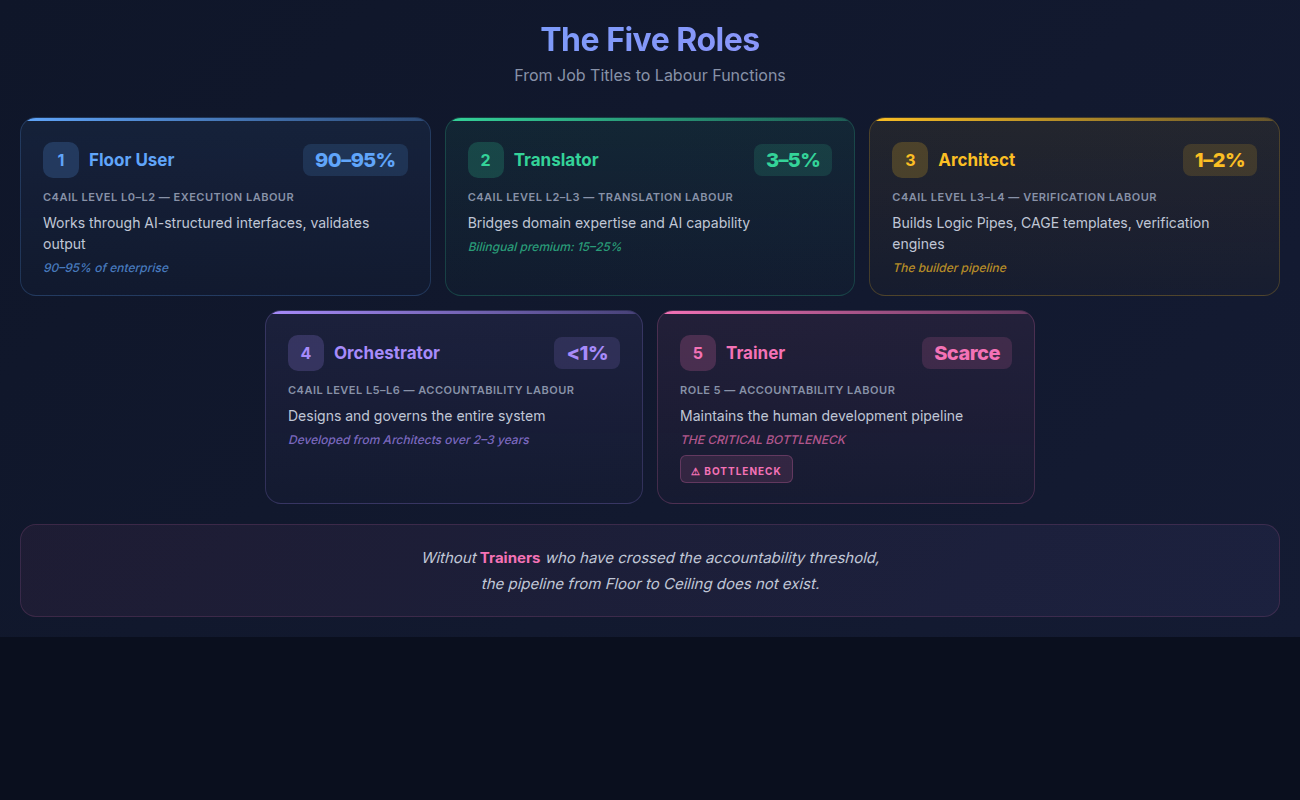
The Five Roles model replaces the job-title approach with a labour-function approach. Each role is defined by its primary labour type, its position on the C4AIL maturity scale, and its relationship to AI systems.
4.3 Role 1: Floor User (L0-2)
The Floor User works through AI-structured interfaces, validates suggestions, and executes within defined boundaries. This is not a lesser role. It is the backbone. Ninety to ninety-five percent of the enterprise operates here, and the enterprise literally cannot function without it.
What they do: Process AI-generated output within structured workflows. Validate recommendations against domain knowledge. Flag anomalies for escalation. Execute standard operating procedures enhanced by AI assistance.
What they do not do: Design workflows. Override AI recommendations without escalation. Make autonomous decisions with significant consequence.
Hiring criteria: Domain knowledge (they must know enough to validate), interrogation skills (they must ask the right questions of AI output), validation discipline (they must not accept the first answer).
Career path: Floor User → Translator (if they develop bilingual capability) → Architect (if they choose the technical path). Not everyone moves up, and that is explicitly legitimate. “The Choice to Have a Life” from Whitepaper I is operationalised here as a respected career track.
Evaluation: Measured on validation accuracy, interrogation quality, and throughput. NOT measured on volume of AI output generated or number of prompts run.
4.4 Role 2: Translator (L2-3)
The Translator bridges domain knowledge and AI capability. This is the universal skill identified in Whitepaper I, now operationalised as a role. The Translator makes AI output legible to domain experts and domain requirements legible to AI systems.
What they do: Interpret AI output in domain context. Communicate AI capabilities and limitations to non-technical stakeholders. Identify where AI recommendations diverge from domain reality. Facilitate the conversation between what the technology does and what the business needs to decide.
Hiring criteria: Bilingual fluency (domain language AND AI capability language), communication skill, judgment about when AI output requires human review.
Career path: Translator → Architect (technical track) or Translator → Manager-of-Translators (leadership track).
The Translator premium: Bilingual capability — the ability to speak both domain and AI — commands a salary premium. Lightcast and Revelio Labs data consistently show that roles requiring both domain expertise and AI fluency attract higher compensation than either alone, with early market signals suggesting a 15-25% uplift though the range varies significantly by sector and geography. The premium exists because the capability is scarce: it requires enough technical understanding to interrogate AI output AND enough domain expertise to know what matters. Most professionals have one or the other. The Translator has both.
4.5 Role 3: Architect / Amplifier (L3-4)
The Architect builds Logic Pipes, CAGE templates, and verification engines. This is the hands-on builder who converts expert knowledge into deterministic workflows.
What they do: Design prompt templates and CAGE specifications. Build and maintain verification engines. Construct Knowledge Layer artefacts. Translate expert intuition into machine-readable logic. Test and iterate workflow designs.
Hiring criteria: Domain expertise, architectural thinking (ability to design systems, not just use them), AI fluency at the building level (not just the using level).
Career path: Architect → Orchestrator. This is the critical pipeline. Orchestrators are developed from Architects over a 2-3 year period. They are not hired externally.
Evaluation: Measured on template quality, specification maintainability, verification engine effectiveness, and the ratio of human intervention required in their workflows.
4.6 Role 4: Orchestrator (L5-6)
The Orchestrator designs the system and governs the architecture. Already defined in Whitepaper I, Part V — this section adds the HR operationalisation.
What they do: Design end-to-end AI-augmented workflows. Set verification standards. Govern the Queue A/B/C triage system. Make architectural decisions about which work is automated, which is elevated, and which is new. Coach and develop Architects.
Span of control: The Orchestrator’s leverage comes from designing systems, not supervising individuals — the ratio is mediated by the quality of the Logic Pipes and verification engines they build, not by direct management. In well-designed systems, one Orchestrator can govern workflows serving 50-200+ Floor Users. High-complexity domains (healthcare, financial regulation) require tighter ratios because the verification architecture must account for more edge cases and the consequences of failure are more severe. These ratios are design heuristics based on early implementations, not established benchmarks — they will sharpen as more organisations operationalise the model.
Hiring: Develop from Architects over 2-3 years. Do NOT hire externally. The Orchestrator must have built the systems they now govern — they must have earned the right to sign off through progressive accountability, not credentials. This is ten Cate’s entrustment model applied to organisational design.
Compensation: Premium role, tied to verified output metrics rather than hours worked. The Orchestrator is evaluated on system-level outcomes, not personal productivity.
4.7 Role 5: Trainer / Capability Builder
The Trainer maintains and grows the human pipeline. This is Doc Ligot’s fourth role — the one most organisations forget.
What they do: Run reskilling programmes. Staff the Genius Bar (the AI Guildhall’s supervised practice space). Mentor juniors through the accountability development pathway. Facilitate after-action reviews. Model the vulnerability and presence that hooks’ engaged pedagogy requires.
Hiring criteria: L4+ practitioners who can teach, not just do. The Trainer must have crossed the accountability threshold themselves — they must have signed off, lived with the result, and developed the capacity to hold space for others doing the same.
Why this role matters: This is where the accountability pipeline lives. Without Trainers, the ZPD collapses. AI handles the volume work; the Trainer ensures juniors still handle the judgment calls. The Genius Bar is not a classroom. It is a supervised accountability gym operating in Edmondson’s Learning Zone — high psychological safety AND high accountability simultaneously.