Part V: The Reskilling Pipeline
Who Moves Where, How Fast
Lead author: Ethan Seow (C4AIL) Contributors: Dominic Ligot (CirroLytix), James Stanger (CompTIA), Chiew Farn Chung (ClassDo) Status: First Draft — March 2026
5.1 The Dual-Track Migration
The workforce does not move as one. It moves in two tracks with fundamentally different timelines, mechanisms, and success criteria.
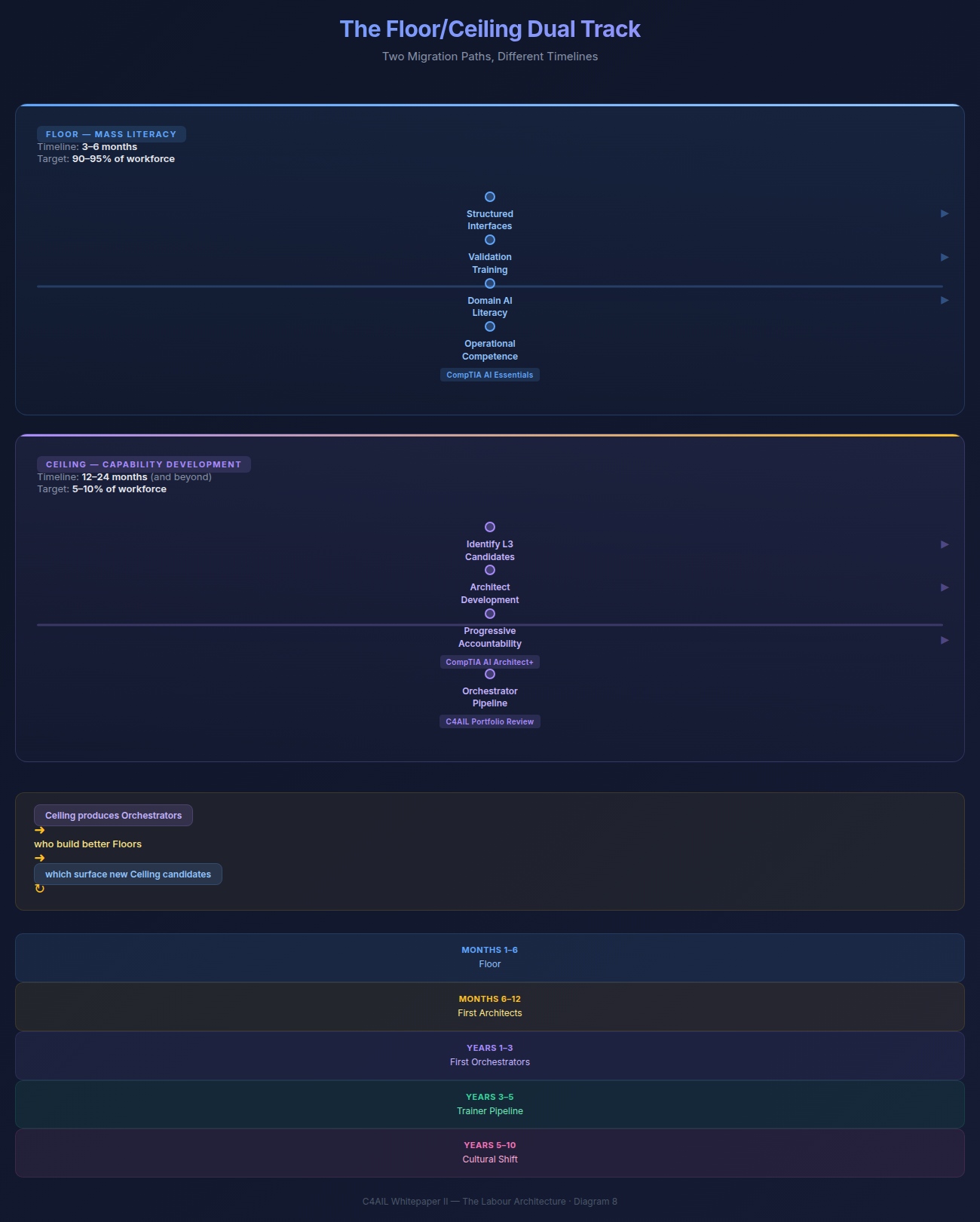
Track 1: Floor (Mass Literacy). Timeline: 3-6 months. Target: the 90-95% who will work through AI-structured interfaces. Mechanism: structured interface adoption → validation skills training → domain-specific AI literacy. Success criteria: the user can validate AI output against domain knowledge, flag anomalies, and use structured workflows effectively. This track is achievable through conventional training — courses, workshops, on-the-job practice. CompTIA AI Essentials provides a certification waypoint.
Track 2: Ceiling (Capability Development). Timeline: 12-24 months. Target: the 5-10% who will become Architects, Orchestrators, and Trainers. Mechanism: identify L3 candidates (existing senior professionals with architectural thinking) → Architect development programme → progressive accountability → Orchestrator pipeline. Success criteria: the practitioner can design, build, and govern AI-augmented workflows AND take responsibility for their output. This track cannot be achieved through courses alone — it requires the five accountability mechanisms (graduated autonomy, consequential decisions, reflective accountability, the signing moment, community of practice). CompTIA AI Architect+ and SecAI+ provide certification waypoints, but the certification validates the technical component only. The accountability component is validated through portfolio review.
5.2 The Missing Middle Solution
The whitepaper warned about the Missing Middle: juniors replaced by AI, the accountability pipeline destroyed. The solution is not to resist automation. It is to redesign the junior role.
The old model: Junior does volume work → develops pattern recognition over 5 years → earns graduated autonomy → crosses the accountability threshold.
The AI-age model: AI does the volume work. Junior co-creates with AI under senior supervision. This distinction matters. The junior does not simply review AI output for errors — that is still reception, still the banking model with a faster deposit machine. The junior creates with AI as a tool: drafts the contract using AI, then defends the choices — why this clause structure, why this risk allocation, what this protects the client from. The senior’s role is not to check accuracy (AI handles that). The senior’s role is to develop the junior’s taste — the felt sense of what constitutes good work versus work that merely satisfies requirements.
The question shifts from “did you catch the errors?” to “would you sign this?” From accuracy to judgment. From reception to creation.
The volume-to-judgment ratio inverts: instead of 90% volume / 10% judgment, the junior operates at 30% volume / 70% judgment from day one. Co-creation is the mechanism. Taste is what develops. The junior who co-creates with AI for two years under a senior who has taste emerges with something no amount of AI review could produce: an internal standard for quality that precedes articulation — phronesis, the practical wisdom that sits on top of episteme (knowing) and techne (doing) but cannot develop without having gone through both experientially.
The timeline compresses: junior → competent practitioner in 2 years instead of 5. But the compression only works if the creation is real — real work, real consequences, real names on the output. Without co-creation, you get a junior who has watched AI work for two years and can neither do the work nor judge the work. The accelerated model requires more senior supervision, not less — which means Trainers (Role 5) become the critical bottleneck. And what Trainers provide is not instruction. It is the developmental environment in which taste grows: confirmation (“your instinct here was right — here’s why”), contradiction (“this looks right but it would fail in court — here’s what you’re not seeing”), and continuity (the sustained relationship that allows both).
5.3 The Trainer Paradox
This creates a circularity the paper must name honestly. Trainers must be L4+ practitioners who have crossed the accountability threshold. Part X will show that approximately 58% of adults have not developed the psychological foundation for independent accountability — and that stage transitions take 5-10 years with the right conditions. So the system that needs Trainers to produce accountable practitioners cannot produce Trainers without already having accountable practitioners.
This is not a fatal flaw. It is a bootstrap problem — and bootstrap problems have a known solution: you start with the small number who already have the capability and build outward.
Every organisation has people who crossed the accountability threshold despite the system, not because of it. The surgical attending who trained through a real residency. The audit partner who signed off and lived with the result. The engineering lead who shipped a product and took the call when it broke. These people exist — they are just not identified, not valued for this specific capability, and not deployed as Trainers. The first step is not to create Trainers from scratch. It is to find the ones you already have, name what they do, and redirect their capacity toward developing others.
The Guildhall community provides the second lever: cross-organisational mutual accountability. A single organisation’s pool of L4+ practitioners may be thin. A community of practice that spans organisations — where Trainers from different companies mentor each other’s juniors, review each other’s portfolios, and maintain shared standards — partially replicates the guild function that mandatory chambers provide at the national level. It is not a substitute for institutional infrastructure. But it is a better approximation than any individual organisation can build alone.
The timeline remains honest: the first generation of Trainers is found, not developed. The second generation (their mentees) takes 3-5 years. Systemic change takes a decade. Anyone promising faster is selling courses, not building capability.
5.4 Certification as Waypoints
Certifications serve as objective markers of progress along the reskilling pipeline. They validate the technical component — the part that CAN be tested:
| Level | Role | Certification | What It Validates |
|---|---|---|---|
| L1-2 | Floor User | CompTIA AI Essentials | Baseline AI fluency, validation awareness |
| L3 | Architect | CompTIA AI Architect+ | Architectural capability, system design |
| L4+ | Security track | CompTIA SecAI+ | AI security governance, risk architecture |
| L3-5 | All Ceiling | C4AIL L3-5 Portfolio | Demonstrated accountability (portfolio-based, not exam-based) |
The critical distinction: certifications validate competence. They do not validate trustworthiness. The question for Floor roles is “can you do this?” The question for Ceiling roles is “would we trust you to do this unsupervised?” Only portfolio-based assessment — the Guildhall’s Level 3 Submissions and Level 4-5 Reviews — approaches the second question.