Chapter 1: The Mechanism — How the System Processes
This is the technical version. For the narrative version told through real-world stories and first-person experience, read the story version.
This chapter establishes the processing architecture — the engine. How input becomes experience becomes action. Everything that follows (Direction, Pipeline, Conditions, Configuration) operates on this mechanism.
1.1 Emotions vs Emotional State
These two terms are used interchangeably in common language. They are not the same thing.
Emotions are:
- Physical reactions — sweating, heart racing, gut churning, tension in the chest, tears
- Sensory re-experience of memory and predictions of the future — flashbacks, parents’ voices in our heads, visualisation of what might happen next
Emotions are unconscious. They happen to us. We do not choose to feel the gut-punch of betrayal or the warmth of recognition. Emotions are biological signals — the body’s way of encoding and communicating experience.
Emotional state is different. It is what we colloquially call “mood,” but it goes far deeper. Emotional state is subconscious — it sits between the unconscious emotions and our conscious mind. It is the lens through which we experience reality.
When you are grumpy, a hangnail becomes cause for rage. On a good day, you wave it off. The hangnail hasn’t changed. Your emotional state has changed the lens.
This distinction matters because emotional state is also the basis of what we commonly call “personality.” When someone seems to have a different personality at work versus at home, it is because their emotional state differs between contexts. The ruthless executive who becomes a gentle parent at home is not two people. They are one person in two emotional states. Who you think that person is, is but the person’s emotional state while they are in front of you.
We are not our emotional states. But we are shaped by them. And until we learn to understand and manage them, they shape us unconsciously — producing what looks like fixed personality but is actually a pattern of responses we haven’t yet learned to choose.
1.2 The Superego Chain
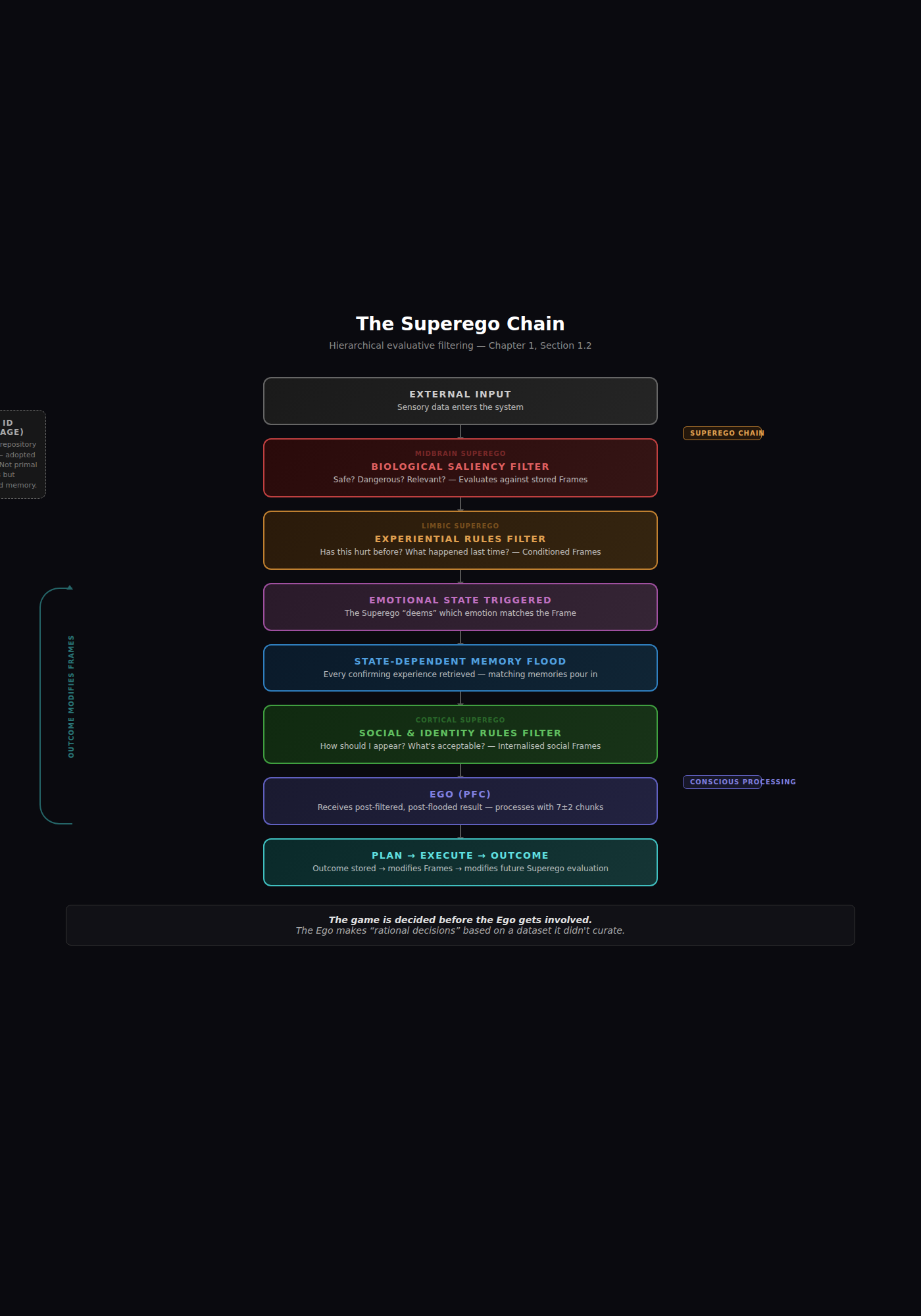
The Freudian structural model requires remapping. In this model:
-
The Id is not primal drives. It is storage — the subcortical repository of Frames (both adopted and hijacked), conditioned responses, and affective memory. What Freud attributed to destructive human nature is actually accumulated memory. Remove the traumatic conditioning, and what remains is not a seething cauldron but homeostatic biological needs (hunger, rest, reproduction) — self-preserving, not chaotically destructive. The substrate tends toward homeostasis — though for individuals with reduced empathy hardware, that homeostasis is survival-egoistic and may include instrumental harm to others.
-
The Superego is not a cortical moral agent. It is hierarchical evaluative filtering — occurring at every level of the neural hierarchy. The midbrain Superego filters by biological saliency. The limbic Superego filters by conditioned experience. The cortical Superego filters by internalised social rules. All of them evaluate input against stored Frames.
-
The Ego is the conscious processor. It receives what the Superego chain delivers and works with it using 7±2 chunks of working memory. The colloquial “ego” — identity defensiveness, protecting self-image — is actually Superego function: the rigid rule-set defending its programming. True Ego is the rational manager that would acknowledge a threat and adapt.
-
The Superego’s basis is the Frames stored in the Id. The evaluative rules are not separate from the stored memory — they ARE the stored memory, read as criteria.
The chain operates as follows:
EXTERNAL INPUT (sensory data)
  ↓
MIDBRAIN SUPEREGO evaluates against stored Frames
(biological saliency: safe? dangerous? relevant?)
  ↓
LIMBIC SUPEREGO evaluates against conditioned Frames
(experiential rules: has this hurt before? what happened last time?)
  ↓
Evaluation triggers EMOTIONAL STATE
(the Superego "deems" which emotion matches the Frame)
  ↓
Emotional state triggers STATE-DEPENDENT MEMORY FLOOD
(matching memories pour in — every confirming experience retrieved)
  ↓
CORTICAL SUPEREGO evaluates against social/identity Frames
(internalised rules: how should I appear? what's acceptable?)
  ↓
EGO (PFC) receives the post-filtered, post-flooded result
  ↓
Ego processes with 7±2 chunks
(but the input was curated by a system it didn't control)
  ↓
PLAN → EXECUTE → OUTCOME
  ↓
Outcome stored as new memory → modifies Frames → modifies future Superego evaluation
The critical insight: the game is decided before the Ego gets involved. The Ego makes “rational decisions” based on a dataset it didn’t curate. This is why people act against their stated values and then rationalise afterwards — the Ego is post-hoc narrating a decision that the Superego chain already made.
1.3 The Three Loops

The Superego chain is not the only feedback mechanism. Three loops run simultaneously.
Loop 1: The Somatic Feedback Loop
When the Superego chain triggers an emotional state, the body reacts: sweaty palms, tachycardia, faster breathing, muscle tension, gut churning. These physical reactions then become new sensory input that re-enters the Superego chain.
Superego chain → triggers emotion → body reacts
                                        ↓
                              Body reaction becomes NEW INPUT
                                        ↓
                              Superego evaluates body reaction against Frames
                                        ↓
                              Potentially amplifies or modifies emotional state
                                        ↓
                              Body reacts again → loop continues
The same physical sensation can be interpreted as completely different experiences depending on which Frames the Superego evaluates it against:
| Physical Sensation | Frame A (Adopted) | Frame B (Hijacked) |
|---|---|---|
| Racing heart, sweaty palms | “I’m excited — this matters to me” | “I’m panicking — something is wrong” |
| Butterflies in stomach | “Anticipation — something meaningful” | “Dread — something bad is coming” |
| Tight chest, shallow breath | “I’m focused and energised” | “I can’t breathe — I need to escape” |
Same physiology. Different Frames. Completely different lived experience.
This is why panic attacks escalate: heart races → Superego interprets as threat → more FEAR → heart races more → spiral. And why performers who reframe anxiety as excitement actually perform better — the reframe changes which Frames the Superego uses to evaluate the body’s signals, which changes the loop direction.
The somatic feedback loop is also why the practice of decentering — meditation, somatic work, contemplative practice — works on emotional states. They intervene at the body level rather than at the cognitive level. You don’t need to think your way out of a hijacked loop. You can breathe, move, and sense your way out.
Loop 2: The Predictive Loop
The brain is a prediction machine. It constantly generates simulations of the future — what might happen, what could go wrong, what we hope for, what we fear. These predictions are generated from stored Frames and fed back into the Superego chain as if they were external input.
Stored Frames (Id) → brain generates PREDICTION of future
  ↓
Prediction becomes INPUT to Superego chain
  ↓
Superego evaluates prediction against Frames
  ↓
Triggers emotional state about a PREDICTED future
  ↓
Memory flood of similar past experiences
  ↓
Ego receives: emotional response to something that hasn't happened yet
  ↓
Plans and acts based on predicted reality
This is anxiety in its purest form: the prediction engine running hijacked Frames produces threat predictions, which the Superego evaluates as dangerous, which produces more fear, which biases the prediction engine toward more threats. A self-forming loop running entirely on internal input.
It is also Vision in the decision pipeline (Chapter 3). The difference between anxiety and Vision is the Frame direction:
| Prediction Type | Frame Direction | Experience |
|---|---|---|
| Threat prediction | Anti-values (hijacked) | Anxiety — “what if it goes wrong?” |
| Purpose prediction | Values (adopted) | Vision — “I can see where this is heading” |
| Neutral prediction | Mixed | Planning — “what’s likely to happen?” |
Dreams are the prediction engine running during sleep, processing and reorganising stored Frames without the Ego’s interference.
Intuition and “gut feeling” are predictions generated from Frames so deep (Primary/Secondary level) that they don’t surface with a verbal explanation. The Visionary is someone who has learned to trust and engage with these deep predictions rather than dismissing them as irrational.
Loop 3: The Complete Mechanism
All three loops running simultaneously:
┌─────────────────────────────────────────────────────┐
│                  STORED FRAMES (Id)                  │
│         (adopted + hijacked, subcortical)            │
└──────────┬──────────────────────┬────────────────────┘
           │                      │
    ┌──────▼──────┐      ┌───────▼────────┐
    │  SUPEREGO   │      │  PREDICTION    │
    │  CHAIN      │      │  ENGINE        │
    │  (evaluate  │      │  (generate     │
    │   input     │      │   futures from │
    │   against   │◄─────│   Frames)      │
    │   Frames)   │      └───────┬────────┘
    └──────┬──────┘              │
           │              PREDICTIONS become
           │              input to Superego
           ▼
    EMOTIONAL STATE triggered
           │
           ├──────► MEMORY FLOOD (state-dependent retrieval)
           │              │
           │              ▼
           │        EGO receives curated input
           │        (7±2 chunks of post-filtered data)
           │              │
           │              ▼
           │        PLAN → EXECUTE → OUTCOME
           │              │
           │              ▼
           │        Outcome stored → modifies Frames
           │
           ▼
    BODY REACTS (somatic response)
           │
           ▼
    Body reaction becomes NEW INPUT
    to Superego chain (somatic feedback loop)
Three loops, one system:
- The Superego chain — external input → Frame-based evaluation → emotion → memory → Ego → action → outcome modifies Frames
- The somatic feedback loop — emotion → body reacts → body reaction becomes new input → re-evaluation
- The predictive loop — Frames generate future simulations → predictions become input → evaluation → emotion about predicted futures
1.4 The Friston-Bach Synthesis: Precision, Modulators, and Free Energy
The Superego Chain describes the phenomenology — what it feels like from inside. This section provides the formalism — what the system is computing and why.
Friston: The Mathematics
Karl Friston’s Free Energy Principle proposes that all self-organising systems act to minimise “variational free energy” — the difference between what the system predicts and what actually happens (Nature Reviews Neuroscience, 2010).
The core equation: F = Complexity - Accuracy. The system seeks the simplest model that accurately predicts the data. Minimising free energy is Occam’s razor expressed as a variational bound.
Two ways to minimise:
- Perceptual inference (passive): Change the internal model to better fit sensory data. Update your beliefs.
- Active inference: Change the world to better fit the internal model. Make your predictions come true.
Precision weighting is the mechanism of attention and emotional regulation. The brain does not just process data — it estimates which data is reliable. High precision on a prediction error forces the model to update. Low precision causes the brain to ignore sensory data and rely on priors. Attention IS the inference of precision (Feldman & Friston, 2010).
The Superego Chain IS predictive processing:
| Superego Chain | Predictive Processing (FEP) |
|---|---|
| External input enters | Sensory data arrives at Markov blanket |
| Midbrain evaluates against biological Frames | Low-level generative model compares predictions |
| Limbic evaluates against conditioned Frames | Mid-level generative model compares predictions |
| Evaluation triggers emotional state | Precision-weighted interoceptive inference constructs emotion |
| State-dependent memory flood | Precision-weighted prior retrieval |
| Cortical evaluates against social/identity Frames | High-level generative model compares predictions |
| Ego receives post-filtered result | Conscious processing receives precision-weighted posterior |
| “The game is decided before Ego” | “The posterior is dominated by priors when sensory precision is low” |
A hijacked Frame, in Fristonian terms, is a prior with inappropriately high precision. The system treats it as more reliable than incoming sensory evidence, overriding contradictory data. The person “knows” their partner isn’t betraying them (sensory evidence) but “feels” betrayed (high-precision prior from trauma). The prior wins. Healing is reducing the precision of the traumatic prior until sensory evidence can compete. Therapy creates a safe Markov blanket where the system can experimentally reduce prior precision without catastrophic consequences.
Mood as hyper-prior: Mood is not an emotion. It is a higher-order prior over precision itself — a meta-setting that determines how much weight the system gives to its own capacity to influence outcomes. Low mood is a chronic estimation that actions cannot change results. This is the FEP mechanism for the lens metaphor: mood doesn’t change what you see, it changes how much you believe what you see matters and whether you believe your actions can change it.
Bach: The Computational Architecture
Joscha Bach’s MicroPsi framework (extending Dörner’s Psi Theory) provides the computational architecture of the system the Superego Chain runs on.
Modulators are global variables that change how activation spreads:
- Arousal: Speed of processing vs accuracy
- Resolution Level: Detail of mental representation
- Selection Threshold: How much competition a thought needs to win attention
Personality and emotional states are configurations of modulators. Change the arousal, resolution, and selection threshold settings, and you get a different “personality.” The Big Five measures the current modulator configuration’s behavioural output — stable because the modulators haven’t been adjusted, not because they can’t be. This is the computational proof of the Fundamental Claim: personality IS emotional state in configuration.
Consciousness is a protocol of attention — a learning algorithm that maximises global coherence by filtering contradictions to create a single non-contradictory “now.” In Bach’s model, consciousness only activates when models need updating due to uncertainty. Once tasks are optimised, the brain stops attending. This explains why Stage 3 (Muted) is largely unconscious of its own operation — the system appears to be working, so the attention protocol has disengaged.
Agency vs the model of agency. Bach distinguishes:
- Actual agency: A cybernetic controller using counterfactual reasoning to select actions
- Experience of agency: A model of the control loop — a UI feature, not a metaphysical reality
The Muted person uses the model of agency (conscious effort, “I choose to override”) to fight the actual agency (subcortical systems running optimised patterns). The model is a low-resolution representation of the mechanism. It loses because it is operating on a simplified version of what it’s trying to control. The upgrade from willpower to genuine change is gaining access to the mechanism itself.
Suffering as regulation failure. Suffering occurs when the mind identifies a problem it cannot solve. The trainer (the subsystem generating the signal) cranks up intensity because the trainee (the self-model) is not fixing the issue. But the issue may be unfixable. Resolution requires: (a) solving the problem, (b) recognising the problem is unregulatable and releasing the attempt, or (c) changing the level of identification so the signal is no longer addressed to “you.”
The Synthesis
Together, Friston and Bach describe the same system from complementary angles:
| Aspect | Friston provides | Bach provides |
|---|---|---|
| What the system computes | Prediction error minimisation | Modulator-configured processing |
| Why attention works | Precision weighting on prediction errors | Selection threshold for competing signals |
| Why willpower fails | Cortical priors cannot override high-precision subcortical priors indefinitely | The model of agency cannot override the actual agency |
| What healing is | Reducing precision on traumatic priors | Updating the modulators from legacy configuration |
| What consciousness is | Active inference requiring model updating | Protocol of attention maintaining global coherence |
| What Stage 6 is | Generative model in dynamic equilibrium, near-optimal free energy | All modulators flexible, consciousness sustained as default, identification shifted from model to process |
The ESM stages as software access levels (Bach):
- Stage 3 (Muted): Running legacy code with no read access. The consciousness protocol has disengaged.
- Stage 4 (Aware): Read access. You can see the patterns but not modify them. The most painful stage — awareness without write access.
- Stage 5 (Intelligent): Read-write access. You can refactor the code, not just patch at runtime.
- Stage 6 (Transcendent): The recognition that you are the programming environment, not the program. The subject-object shift at the level of self-as-model.
The ESM stages as precision management capacity (Friston):
- Stage 3 (Muted): Precision weighting functional but rigid. Over-weighting priors, under-weighting new evidence.
- Stage 4 (Aware): Precision on self-monitoring increases. This initially INCREASES free energy — which is why Stage 4 is the most painful.
- Stage 5 (Intelligent): Flexible precision weighting. Can adjust how much weight to give different signals depending on context.
- Stage 6 (Transcendent): Generative model flexible enough to update rapidly. Minimal chronic prediction error. Near-optimal.
1.5 Why Willpower Fails — And What Replaces It
This section explains why the most common strategy for managing the mechanism (the Muted stage’s willpower override) is categorically the wrong tool.
Executive function is a prioritisation system, not a battery. The original “ego depletion” model (Baumeister) proposed willpower as finite fuel. Large-scale replication studies (Hagger et al., 2016) failed to confirm this, and the glucose hypothesis has been abandoned. The better mechanism is metabolic cost and opportunity cost: Wiehler et al. (2022, Current Biology) found that intense cognitive effort causes glutamate to accumulate in the lateral prefrontal cortex, making further PFC activation neurochemically expensive. The brain doesn’t run out of gas — it calculates that continued override exceeds the perceived benefit and shifts toward low-effort, high-reward alternatives.
This is compounded by the paradox of suppression (Gross): expressive suppression — the Muted stage’s primary strategy — occurs after the emotion has already triggered subcortical systems. Neuroimaging shows that while the PFC works to suppress expression, amygdala and insula activity actually increases. The harder the rider pulls the reins, the more agitated the elephant becomes.
When the cost-benefit calculation tips — through sustained suppression, stress accumulation, sleep deprivation, or simply too many decisions — the elephant goes where its conditioning directs. The “sudden” personality shift, the breakdown, the binge, the explosion — these are not failures of character. They are the rider dismounting from a strategy that was never efficient.
What replaces willpower: The Aware stage begins when the person stops trying to out-muscle the elephant and starts learning what the elephant actually wants and why — which is neurologically cheaper and actually down-regulates the amygdala (reappraisal vs suppression; Gross, 2002).
In Bach’s terms: the upgrade from willpower to genuine change is gaining access to the mechanism itself — not doing the same thing harder but operating at a different level. In Friston’s terms: reappraisal changes the generative model (the priors), which changes the predictions, which changes the prediction errors, which changes the emotional state. Suppression tries to override the emotional state without changing the model. The model keeps generating the same predictions. The suppression must continue indefinitely — or fail.
Willpower is real but unequally distributed — and the narrative around it serves a class function. The mechanism is universal: every human brain makes cost-benefit calculations about PFC effort. But the capacity is not equal. Higher SES correlates with greater PFC volume (Farah). The privileged class has more PFC bandwidth to exercise willpower, which means their willpower works more often — not because they are more disciplined but because their neural hardware was developed in conditions that supported PFC growth. “Just try harder” is not advice — it is a hijacked Frame protecting the privileged identity from the structural truth of how success actually works.
1.6 The Assumptions That Load-Bear This Chapter
- Everyone inherently wants to be their version of good. The biological Id is homeostatic — oriented toward the organism’s version of good. For a subset with reduced empathy hardware, homeostasis is survival-egoistic, not chaotically destructive.
- There is always a biological layer. Temperament, baseline reactivity, genetic predispositions. Biology is the floor, not the ceiling.
- Emotional states are subconscious and can be understood and managed. This is learnable, not innate — against a biological baseline that varies.
- What we call “personality” is largely emotional state in context. Observable surface of thought processes filtered through emotional maturity.
- Trauma hijacks at the Frame stage, converting values-driven frames into anti-values-driven frames. Trauma operates ON a biological substrate — the same trauma affects different nervous systems differently.
1.7 Tensions and Limits
FEP unfalsifiability. Friston explicitly states: “The free energy principle is what it is — a principle. It cannot be falsified” (Sean Carroll’s Mindscape Podcast, 2020). He compares it to the Principle of Least Action in physics or Natural Selection. Only the process theories derived from it (predictive coding, active inference) are testable. This chapter uses Friston as a compatible mathematical framework, not as proof. Specific testable predictions the FEP generates: reduced mismatch negativity modulation in autism (measurable via EEG/MEG), reduced learning rates from positive prediction errors in depression, and specific neuromodulator-precision mappings.
Bach’s MicroPsi is untested against human data. The framework has been demonstrated in limited AI agent environments but not validated against human cognitive data at scale. The claims about consciousness and suffering are philosophical positions with computational framing, not empirical findings. They are compatible with the architecture and illuminating as a lens — but they are not proof.
Solms/Panksepp subcortical consciousness is a minority position. Critics distinguish wakefulness (brainstem) from awareness (cortex). Hydranencephalic children evidence is contested. The model uses Solms/Panksepp’s nested hierarchy as a useful mapping, not as settled neuroscience.
Polyvagal Theory has phylogenetic problems. Grossman’s critique undermines the specific phylogenetic ladder. The ESM-to-autonomic mapping is useful clinically but the theoretical basis is contested.
The sequential Superego Chain is a pedagogical simplification. Pessoa’s work shows the brain processes in parallel, not sequentially. The chain is a teaching model that captures the functional hierarchy (midbrain evaluates before cortex) without claiming strict sequential processing.
Why trauma activates as coherent clusters. During extreme stress, cortisol suppresses the hippocampus, which normally time-stamps memories with context. The emotional and sensory content gets stored without a timestamp. When triggered later, the midbrain activates these memories as if they are happening now. This is empirically supported and explains why anti-values cluster activation runs as a coherent present-tense program — but the specific mechanism is active research, not settled.
Chapter 1 establishes the mechanism. The system processes input through hierarchical evaluation (the Superego Chain), amplified or dampened by three feedback loops (somatic, predictive, and the chain itself), running on a precision-weighted architecture (Friston) with configurable modulators (Bach). The game is decided before the Ego gets involved. Willpower is the wrong tool — it fights the mechanism instead of accessing it.
But the mechanism alone does not determine outcome. The same mechanism produces completely different results depending on which way the Frames point. That is Chapter 2.