Chapter 3: The Pipeline — From Purpose to Action
This is the story version. For the formal academic version with full theoretical apparatus, read the technical version.
I knew what I wanted. I always knew what I wanted.
I wanted to connect. To belong. To be part of something real — a group, a relationship, a team — where I wasn’t performing and nobody was performing for me. That was the Vision. It never changed. From the playground where I was watching the other kids read social cues I couldn’t see, to the boardroom where I was building teams that trusted me with things they wouldn’t tell their own managers — the underlying want was always the same. Connection. Belonging. Home.
But wanting something and getting it are separated by a pipeline — a chain of decisions that turns purpose into action. And that pipeline can be clean, or it can be contaminated. Mine was contaminated for decades, and I didn’t know it. I was producing the opposite of what I wanted while believing I was pursuing it perfectly.
This chapter is about that pipeline. It is called the Thought Action Paradigm — TAP — and it is the decision chain from who you are to what you do.
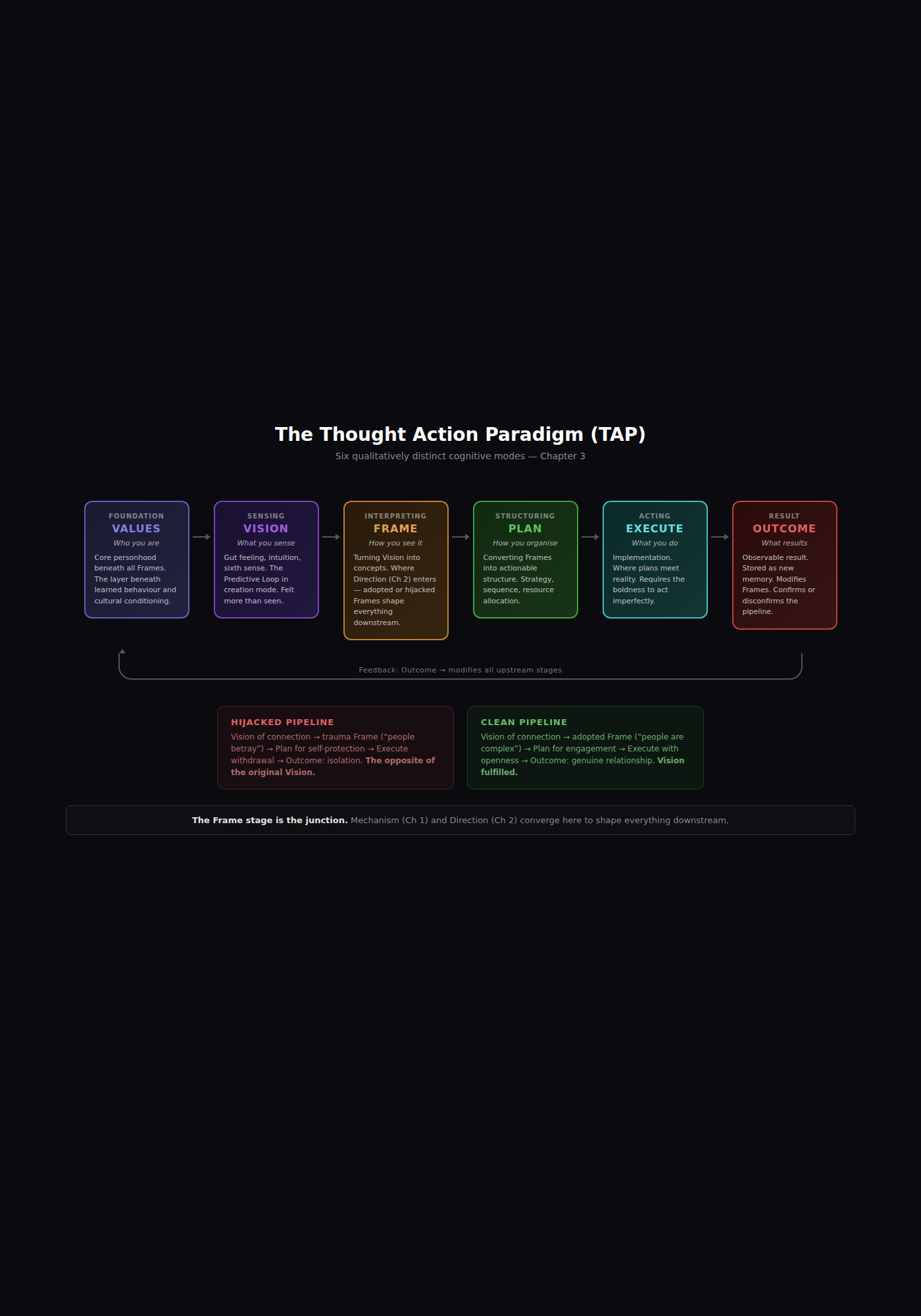 Not a process in the workflow sense. A paradigm — six qualitatively different kinds of thinking, each with its own logic, each with its own failure modes. Chapter 1 described the processing system. Chapter 2 described which direction the energy flows. This chapter describes how that directed energy becomes the thing people actually see you do.
3.1 The Full Chain
Values (Core Personhood) → Vision → Frame → Plan → Execute → Outcome
Each stage is both a thought process and a skill. Each can be identified, developed, and complemented. The pipeline runs constantly — not once but in overlapping cycles, at different scales, on different timelines. But the structure is sequential: upstream stages constrain downstream output.
VALUES ──→ VISION ──→ FRAME ──→ PLAN ──→ EXECUTE ──→ OUTCOME
  │           │          │         │          │           │
  │           │          │         │          │           │
  who you    what you   how you   how you   what you    what
  are        sense      see it    organise  do          results
                                  it
  └───────────────────────────────────────────────────────┘
                    feedback (Outcome → all stages)
I can trace my own pipeline running contaminated, step by step. Watch.
3.2 The Six Stages
Values (Core Personhood)
The starting point. Values are the person — their purpose, their being, their existence. This is not “I value honesty.” This is the layer beneath all Frames, beneath all learned behaviour, beneath all cultural conditioning.
Multiple perspectives can illuminate Values: philosophical inquiry, religious faith, atheistic existentialism, spiritual practice. What they share is the recognition of something foundational — a core from which everything else emerges.
My core — the thing underneath all the masks, all the saviour patterns, all the performance — was always the same. Connection. Understanding. Bridge-building between people who can’t see each other. It took me thirty years to excavate that from under the rubble of everything I’d piled on top of it. Values as core personhood is a topic worthy of a full exploration on its own. The Thought Action Paradigm focuses on what comes after Values — the process by which core personhood becomes observable action.
Vision
Visioning is the unconscious ability to sense purpose on multiple levels. It is commonly known as sixth sense, gut feeling, intuition.
I have always had this. A felt sense of where things are going, what people need, what a room requires. Before I had any of the vocabulary in this book, I could walk into a conversation and feel the shape of what was missing — not see it, not think it, feel it. A pull toward something. A gravity.
When feedback is inputted, Vision is also the ability to predict, envision, or foresee the future in a manner that is ideal or otherwise. In each individual, the Vision is something only they can sense, predict, and identify the purpose behind.
Internally: Vision can be viewed as spiritual purpose — whether atheist, monotheist, or polytheist — where a person has a natural gravity towards a certain way of living and being that points to something larger. The ability to have Vision is what is often sought during existential crisis: a personal purpose that guides one’s life.
On feedback: A rough form of Visioning that we all have are hunches. Many great businesspeople operate by gut feeling and a general sense of direction. Artists need this to create something new and original. The ability to Vision is the source of innovation and ideas.
Vision is hard to communicate. It is something felt more than it is seen, heard, or said. It comes as rough visualisations, emotions, and bodily sensations. Most people ignore it because modern society privileges logic and specificity over feeling and esotericism. The ability to feel the direction of where we’re heading is a rare skill.
Visionaries are people who have embraced this as their primary thought process. But Vision alone is insufficient — it requires the downstream processes to become effective. A vision that cannot be communicated, structured, or executed remains a feeling. I spent years generating visions that went nowhere — ideas, directions, felt senses — because I had no pipeline to bring them into the world. The Vision was always there. The pipeline was broken.
The mechanism beneath Vision: In Chapter 1’s terms, Vision is the Predictive Loop operating in creation mode. When Frames are adopted (Chapter 2), the predictive system generates futures oriented toward creation — sensing possibilities, feeling directions, modelling outcomes. When Frames are hijacked, the same Predictive Loop generates anxiety — sensing threats, feeling dangers, modelling catastrophes. Vision and anxiety are the same mechanism pointed in different directions. This is why healing the Frame (Chapter 2) is prerequisite for reliable Vision.
I know both versions intimately. The same gut that senses “this person needs help” also produces “this person will leave you.” The same predictive engine that generates “I could build something here” also generates “this will all fall apart.” The mechanism is identical. The direction depends entirely on whether the Frame stage is running clean.
Spiritual connection: Vision is where the practice of decentering directly intersects with the decision-making process. The meditative practices — sitting meditation, contemplative prayer, somatic awareness — all cultivate the ability to sense purpose beneath the noise of daily emotional states. Vision is the secular name for what spiritual traditions call calling, dharma, dao, or vocation.
Frame
Here is where everything went wrong for me. For years.
Framing is the process of turning feelings and Visions into specific, definable concepts. Much like a picture frame, this decides the elements of reality we perceive and value.
My Vision said: connect with people. My Frame — the one installed by eight years of bullying, by the learned pattern that I could only belong through service — translated that Vision into: be indispensable to people. Same underlying want. Completely different lens. And the lens determines everything that follows.
Internally: Frames are what most personality systems call values — the guides we use to view the world. They are learned, constructed, and maintained through experience, culture, and trauma.
Externally: Framing is the ability to turn the felt-sense of Vision into something communicable and understandable. The artist who can explain why their work matters is framing their vision. The entrepreneur who can articulate a market need is framing their intuition.
Reframing is the companion skill — the ability to break down an original frame to allow it to expand or change perspective. The most common form of Reframing is asking questions, most often the why’s. Reframing is about challenging assumptions and contextualising scenarios. It gives one the ability to take on more than one perspective and possibly merge them.
I turned out to be good at Reframing — eventually. The alien brain that needed to reverse-engineer social dynamics was, it turns out, naturally wired for seeing around the edges of things. Questioning assumptions was what I did with every social interaction: why did they react that way? What’s actually happening here? What am I not seeing? The problem was that I could reframe everything except the one Frame that was running my own life. The saviour Frame was invisible to me because it was me — or so I thought. A person whose primary role is to Reframe is a Reframer. They naturally question, challenge, and expand. They are not satisfied with a single perspective — they need to see around the frame.
This is where the Direction axis enters the pipeline. The Frame stage is the point in the TAP pipeline where everything from Chapter 2 operates. A Vision of connection and belonging, filtered through a trauma-hijacked Frame (“people will betray me”), produces Plans aimed at self-protection, Execution characterised by withdrawal, and Outcomes of isolation — the opposite of the original Vision. The Frame stage is the junction where Mechanism (Chapter 1) and Direction (Chapter 2) converge to shape everything downstream.
My Frame wasn’t “people will betray me.” It was subtler than that. It was: “people will leave unless I carry something for them.” Which meant every relationship I entered was pre-structured around me carrying. Not because I was generous — because I was terrified. Generosity was the costume the fear was wearing. And I couldn’t see it because the costume was so convincing that even I believed I was just a giving person.
Multiple perspectives: The spiritual practice of holding 10-20 perspectives per situation is Reframing elevated to a discipline. It is not relativism — it is the deliberate cultivation of frame flexibility. The Transcendent person does this naturally. At lower configuration stages, it is a skill that can be practiced and developed.
Plan
Planning is the ability to break down and organise ideas, thoughts, tasks, and things — and to assess whether they adhere to the rules established by the Frames.
Watch what happens when a hijacked Frame meets the Plan stage. My Frame said: “be indispensable.” So my Plans were always structured around being the one who helped. Volunteer for the difficult thing. Be the first to offer. Take on more than I should. Say yes when I should say no. Not because I was a martyr — because the Frame said this was how you earned your place. The Plans followed the Frame’s logic perfectly. They were excellent plans for someone who needed to be needed. They were terrible plans for someone who wanted to connect.
Externally: Planning organises. It takes the raw material from Vision and Frame and structures it into actionable sequences. It identifies priorities, delegates, sorts relevant from irrelevant information.
Internally: Planning is the ability to act in accordance with the rules and pre-defined Frames. It is the conscience-like function that compares proposed actions against the Frames and checks for alignment.
Planning as a thought process is specifically the area of identifying whether things fall within the Frames and organising them in a manner that is both aesthetically pleasing and functional. People with high focus here tend toward perfectionism — wanting things to fall within plans and expectations. I recognise this one. The need for things to be structured, complete, done right — it wasn’t discipline. It was the Plan stage serving a hijacked Frame: “if the plan is perfect enough, nothing can go wrong.” Perfectionism is the Plan stage trying to make the Frame feel safe.
A person whose primary internal thought process is Planning is a Planner. The Visionary analogue — someone who Plans from Vision rather than from Frames — is a Strategist.
Execution
Execution is the transition from thought to action.
So I executed. I helped. I carried. I showed up, overdelivered, stayed late, burned out, recovered just enough to do it again. The Execution was relentless because the Frame demanded it — if you stop being useful, you stop belonging.
Internal execution: Actions that are internally driven — habits, routines, instinctive ways of doing things. The manner in which we naturally take action.
External execution: Following plans that come from outside — job scope, recipes, instructions, processes that are not instinctive.
Execution is where the rubber meets the road. A perfect Vision, Frame, and Plan that never reaches Execution produces nothing. Conversely, Execution without the upstream processes produces activity without direction — busy without being productive. I was never idle. The pipeline was always running. The problem wasn’t Execution. It was what the Execution was in service of.
Outcome
And here’s the punchline.
The result of the full pipeline. Outcomes feed back into the system — they become new input for Vision (did the outcome match the felt sense?), new data for Frames (do my lenses need adjusting?), new information for Plans (did the structure work?).
The Outcome of twenty years of saviour-mode Execution was this: people relied on me, valued what I did for them, and never quite connected with me. Because I’d structured every relationship around service. They connected with the helper. Not with the person. The very thing I was trying to avoid — being outside the group, not truly belonging — was the thing I was producing. Every cycle. Reliably. Because the pipeline was running a contaminated Frame.
The feedback loop is where the TAP pipeline connects back to the Three Loops of Chapter 1. An Outcome is a real-world event. It enters the Superego Chain as new input. The midbrain evaluates biological saliency. The limbic system compares it against conditioned experience. The cortex checks it against social and identity rules. The resulting emotion feeds back through the Somatic Feedback Loop and the Predictive Loop — updating the very Frames through which the next cycle of the pipeline will run.
And the worst part? The Outcome confirmed the Frame. “See? People only value you for what you do for them.” Which was true — because I’d built every relationship that way. The Frame created the evidence for its own validity. The cycle tightened. And I ran it for years without seeing it.
This is where growth happens. An Outcome that disconfirms a hijacked Frame — “I was vulnerable and nothing bad happened” — begins the process of reducing the precision of that traumatic prior (Chapter 1, Friston). The Frame loosens its grip. The next cycle runs slightly differently. Over time, the pipeline cleans itself.
The day someone connected with me — not with what I could do, but with the awkward, intense, too-much version of me that I’d spent decades hiding — the Frame cracked. Just a little. Just enough for a different cycle to start running.
3.3 Roles and Complementary Thinking
Each person has thought preferences — stages in the TAP pipeline where they naturally concentrate their cognitive energy. These preferences produce identifiable roles:
| Primary Process | Role | Characteristic |
|---|---|---|
| Vision | Visionary | Senses direction, generates ideas, works from intuition |
| Frame/Reframe | Reframer | Questions assumptions, expands perspectives, synthesises |
| Vision + Frame | Integrator | Combines intuition with multiple perspectives |
| Vision + Plan | Strategist | Translates gut feeling into structured direction |
| Plan | Planner | Organises, structures, enforces adherence to rules |
| Execute | Executor | Translates plans into action, maintains momentum |
No single role is complete. A Visionary without a Planner generates ideas that never materialise. A Planner without a Visionary enforces rules that serve no purpose. An Executor without upstream processes produces motion without direction.
I know this from both sides. I am heavy on Vision and Reframe — the ideas come fast, the perspectives multiply, the felt sense is always running. What I am not is a natural Planner or a disciplined Executor. Left to my own devices, I generate a thousand directions and follow none of them to completion. The ADHD compounds this — novelty pulls attention, routine kills momentum, and the burst-rest cycle of the nervous system means that sustained linear execution is biologically expensive for me.
Every meaningful thing I’ve built required someone else covering the pipeline stages I’m weak in. The girlfriend who modelled what social fluency looked like — she wasn’t just teaching me to read people. She was an Executor and a Planner. She turned felt senses into structured actions without thinking about it. The mentors who shaped me — they were often Planners or Strategists, people who could take my raw Visionary chaos and say: “Here. This is the sequence. Do this first, then this.”
This is the foundation of complementary thinking. Instead of viewing differences as personality conflicts (“she’s too rigid,” “he’s too chaotic”), TAP reframes them as thought process differences that can be complementary. The rigid Planner and the chaotic Visionary are not mismatched — they are incomplete without each other.
The practical application: teams, relationships, and organisations can be designed for complementary coverage of the TAP pipeline. Instead of hiring for similarity (which produces blind spots), hire for complementarity (which produces coverage).
The anti-values distortion of complementary thinking: When Frames are hijacked (Chapter 2), difference becomes threat. “She thinks differently” becomes “she is against me.” The instinct to judge difference as deficiency is itself an anti-values response — the Frame converts a complementary resource into a rival. At the Intelligent configuration (Chapter 5), difference is recognised as complementary. At the Muted configuration, the same difference triggers the defence mechanisms of Chapter 2.
I’ve done this. I’ve taken someone whose thinking naturally covered my blind spots and turned them into an adversary — because the hijacked Frame read their structured approach as control, their precision as criticism, their different logic as a threat to my way of being. The same person who could have completed my pipeline became someone I was defending against. Not because they were wrong. Because my Frame was contaminated.
3.4 Where Hijacking Enters the Pipeline
The anti-values mechanism from Chapter 2 enters at the Frame stage and contaminates everything downstream.
When Frames are hijacked by trauma:
- Vision still generates direction — but the Frame distorts its interpretation. The gut feeling says “connect” but the hijacked Frame translates this as “be needed” or “control the outcome.”
- Plan becomes avoidance-oriented — structured around preventing the feared outcome rather than building the desired one. Perfectionism is a Plan stage hijacking: “if I plan perfectly enough, I cannot fail.”
- Execution becomes defensive — energy goes to protection rather than creation. The Muted person (Chapter 5, Stage 3) grinds through execution on willpower, performing productivity while the internal direction is survival.
- Outcome reinforces the trauma — because avoidance-based Plans produce the very isolation, conflict, or loss they were designed to prevent.
This is the self-fulfilling prophecy mechanism:
TRAUMA → hijacked Frame → anti-values Plan → defensive Execution → Outcome confirms trauma
   ↑                                                                          │
   └──────────────────────────────────────────────────────────────────────────┘
                              reinforcement loop
I can draw my own loop with exact labels. Childhood social exclusion → “I must earn belonging through service” → Plan: be indispensable → Execute: carry everyone → Outcome: people value the service, not the person → “See, I have to earn it” → loop tightens. Twenty years. Running perfectly. Producing exactly the opposite of what I wanted.
The pipeline runs clean or contaminated depending on the Frame stage. This is why therapy — when it works — targets Frames. Cognitive Behavioural Therapy identifies distorted Frames (cognitive distortions). Psychodynamic therapy traces Frames to their origin in trauma. ACT (Acceptance and Commitment Therapy) teaches the person to notice the Frame rather than be fused with it. All roads lead to the Frame stage because that is where the Direction (Chapter 2) enters the Pipeline.
Breaking the cycle requires intervention at the Frame stage: recognising the hijacking, healing the underlying trauma, and consciously reframing from away-from to towards. This is what the Emotional State Model’s Aware → Intelligent transition enables — the transition from seeing the contamination to having the tools to clean it.
For me, the break came not from therapy — though therapy helped — but from exhaustion. The saviour loop ran until it broke me. And in the breaking, I could finally see the Frame. Not from inside it. From above it. Like waking up mid-dream and realising the room you’ve been running through isn’t real. The Frame was never “I’m generous.” The Frame was “I’m terrified of being left.” Everything downstream — the Plans, the Execution, the Outcomes — suddenly made sense. Not as personality. As contamination.
3.5 The Integrated Stack: Three Layers, One System
The Mechanism (Chapter 1), the Direction (Chapter 2), and the Pipeline (this chapter) are not three separate systems. They are three views of one system:
MECHANISM (Ch 1) — how the system processes
  ↓ enables
DIRECTION (Ch 2) — which way the energy flows
  ↓ shapes
PIPELINE (Ch 3) — how decisions become behaviour
  ↓ produces
OBSERVABLE BEHAVIOUR (what people call "personality")
Together: core personhood → emotional maturity → frame direction → decision pipeline → observable behaviour.
The Flow in Practice
Person A (Emotionally Intelligent): Mechanism running with read-write access to precision weighting → Frames are values-driven (towards) → Vision of building a business → Frame: “I create value for people” → Plan: market research, product development, customer relationships → Execute: build, ship, iterate → Outcome: a growing business
Person B (Emotionally Muted): Mechanism running on cortical override, subcortical system suppressed → Frames are anti-values-driven (away-from, disguised) → Same Vision of building a business → Frame: “I must not fail, I must prove I’m not worthless” → Plan: overwork, perfectionism, risk avoidance → Execute: grind, burnout, defensive posture → Outcome: stalled growth, exhaustion, the very failure they feared
Same Vision. Same starting desire. Completely different pipeline, completely different outcome. The difference is not talent, intelligence, or opportunity. The difference is configuration state and frame direction.
I have been both of these people. Not as a thought experiment — as a lived experience. I built the same kind of thing twice, from the same Vision, with different Frames running. The first time, the Frame was “prove you’re worth something.” The Plans were perfectionist, the Execution was grinding, the Outcome was burnout and stalled growth. The second time — after the Frame cracked — the Frame was “build something that matters.” The Plans were simpler, the Execution was lighter, the Outcome was actually what I’d been aiming for all along. Same person. Same Vision. Same intelligence. Different Frame. Different everything.
What This Changes
1. Personality is not fixed. What looks like personality is thought processes filtered through emotional maturity. Change the configuration state, heal the trauma, and the “personality” shifts — because the person hasn’t changed, the filters have.
2. Conflict is not personal. Most interpersonal conflict is thought-process difference amplified by hijacked Frames. Two people with different TAP preferences (Visionary vs Planner) will naturally clash — but the clash becomes destructive only when anti-values Frames convert the difference into a threat. “She’s too rigid” becomes “she’s trying to control me” becomes “I must protect myself.” The Frame hijacking turns a complementary difference into a survival response.
3. Growth is skill development, not identity change. Each stage of TAP is a skill. Each configuration stage (Chapter 5) involves learnable capabilities. You don’t need to become a different person. You need to develop the skills you haven’t developed yet — and heal the Frames that are distorting the skills you already have.
3.6 Tensions and Limits
The TAP pipeline is the model’s own framework. It is not derived from or validated against existing decision-making models in cognitive science. It is consistent with them — dual-process theory (Kahneman), naturalistic decision-making (Klein), recognition-primed decision (RPD) — but it was developed independently from therapeutic observation, not from that literature. The pipeline’s strength is its clinical utility and its ability to locate specific failure points. Its weakness is the absence of external validation.
The roles taxonomy has no independent validation. Visionary, Reframer, Integrator, Strategist, Planner, Executor — these are useful clinical categories that emerged from observing how people process decisions. They have not been factor-analysed, validated psychometrically, or tested for predictive validity. They overlap with but are distinct from other typologies (Belbin team roles, Emergenetics thinking preferences). The roles are presented as practical lenses, not as scientifically established categories.
The pipeline implies sequential processing; actual decision-making is more parallel and iterative. In practice, a person does not neatly progress from Values → Vision → Frame → Plan → Execute → Outcome. Multiple cycles run simultaneously at different timescales. Vision and Frame interact bidirectionally. Planning may loop back to reframing. Execution generates real-time feedback that modifies the plan mid-stream. The sequential model is a teaching tool — a way to identify where a breakdown is occurring — not a literal description of cognitive architecture. The same caveat applies to the Superego Chain (Chapter 1): pedagogical sequence, not neurological claim.
The Frame stage carries disproportionate explanatory weight. The model locates almost all developmental pathology at the Frame stage (hijacking). This may overweight Frame and underweight other pipeline stages. A person might have impaired Execution not because of Frame hijacking but because of executive function deficits (neurological), depleted energy (biological), or hostile environments (structural). The model acknowledges these factors elsewhere (Chapter 1 for neurological, Chapter 4 for conditions) but the pipeline chapter itself centres Frame. This is a deliberate choice — Frame hijacking is the most clinically actionable intervention point — but it should not be read as a claim that Frame is the only place the pipeline breaks.
I should add: for someone with ADHD, the Execution stage breaks regularly — not because of Frame contamination but because the hardware doesn’t sustain linear output. The burst-rest cycle is neurological, not psychological. When I blamed myself for inconsistent Execution, I was making a Frame error about a hardware limitation. Healing the Frame didn’t fix the ADHD. It stopped me from hating myself for it.
Chapter 3 completes the foundation. The Mechanism (Chapter 1) describes how the system processes. The Direction (Chapter 2) describes which way the energy flows. The Pipeline (this chapter) describes how that directed energy becomes decisions and behaviour. Together, these three dimensions explain the individual — from neurology to observable action.
But individuals do not develop in a vacuum. The mechanism needs input. The direction is shaped by experience. The pipeline runs within conditions — relational, group, structural, cultural, technological — that either support or obstruct its clean operation. The conditions that the system needs to run well are Chapter 4.