Chapter 5: The Configuration — Distance from Transcendence
This is the story version. For the formal academic version with full theoretical apparatus, read the technical version.
I was twenty-six when I first drew the stages on a whiteboard. Not as theory — as observation. I had been watching people for a decade by then, studying them the way a naturalist studies a species, and I kept seeing the same pattern. Not personality types. Not moods. Something deeper — a configuration that determined how people processed everything.
Some people seemed to run on autopilot. They worked hard, showed up, managed their lives — and periodically collapsed. Others could see their own patterns, name them, explain them in extraordinary detail — and couldn’t change any of it. A smaller group could actually do what they knew: see the pattern, intervene, redirect. And an even smaller group didn’t seem to need to intervene at all — it just flowed.
I didn’t have the vocabulary yet for what I was seeing. The neuroscience came later (Chapter 1). The directional model came later (Chapter 2). The pipeline came later (Chapter 3). The conditions came later (Chapter 4). But the stages — the observable configurations — those were the first thing I mapped. 2017. Before I understood why they existed.
The Emotional State Model (ESM) was the starting point of this architecture — the first framework developed (2017), the first empirically tested (2018), and the foundation on which everything else was built. But in the unified architecture, it comes fifth. This is the central structural change.
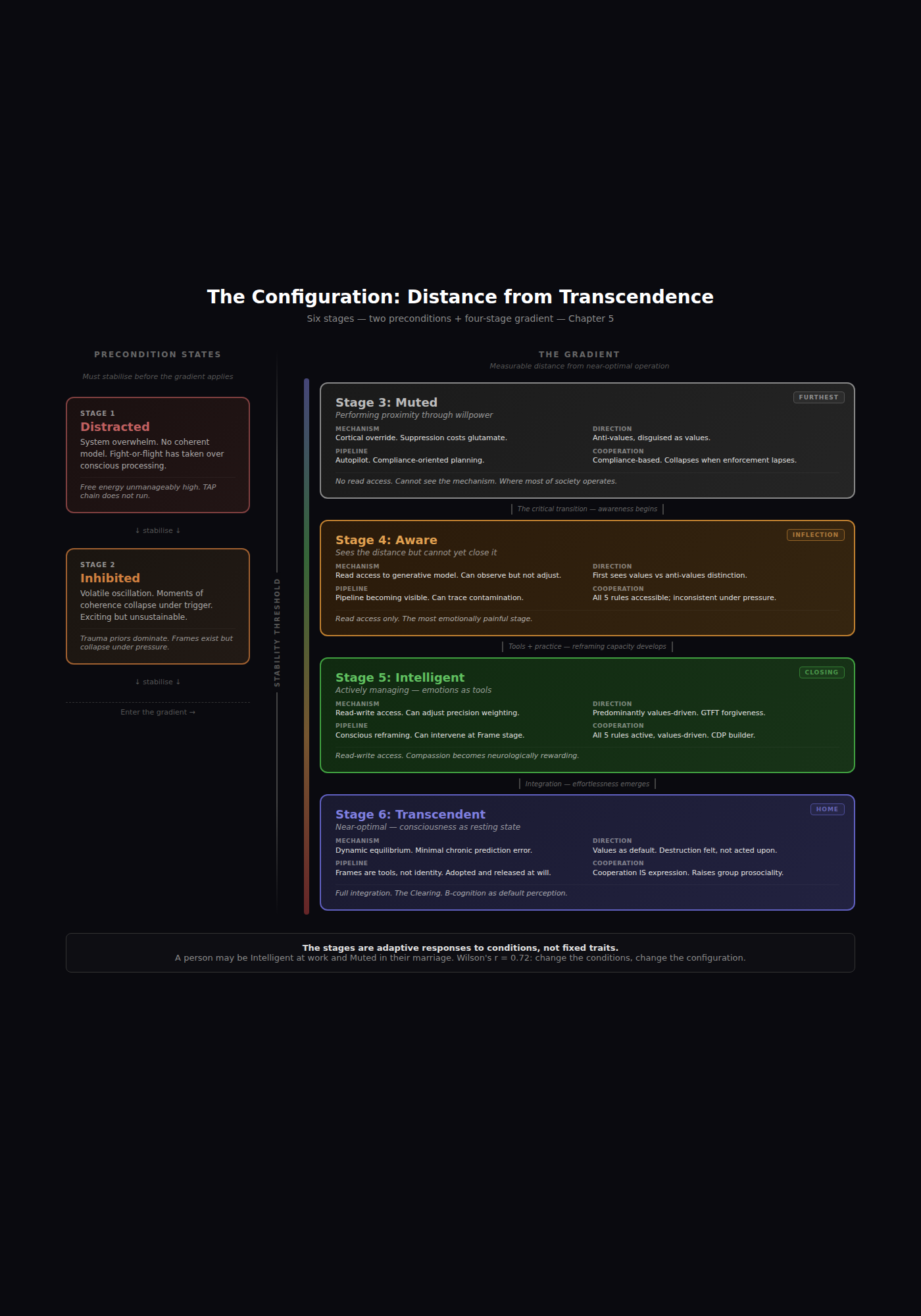
The reframe: The ESM stages are not a standalone framework. They are empirically observed configurations — validated by the GREAT psychometric instrument (n=123, KMO=0.813, Cronbach’s α=0.916) — that are explained and illuminated by the other four dimensions. Given a particular mechanism state (Chapter 1), direction (Chapter 2), pipeline configuration (Chapter 3), and set of conditions (Chapter 4), a particular ESM configuration results. The GREAT measures the configuration. Chapters 1-4 explain why it takes the form it does.
The specific number of stages (six), the boundaries between them, and the qualitative character of each — especially Stage 4’s distinctive “sees but cannot change” phenomenology — are empirical observations, not logical derivations from the other four dimensions. A different number of stages could plausibly be constructed from the same theoretical architecture. Six is what the data shows.
5.1 The Precondition States
The ESM stages are reframed as distance from transcendence — not a ladder but how far the system is from running near-optimally. But this distance measure has two zones, because the first two stages do not sit on a gradient. They are precondition states that must stabilise before the gradient applies.
Stage 1: Distracted — System Overwhelm
On the morning of June 7, 2004, Dan Harris was sitting in front of five million people.
He was a correspondent for ABC News, filling in as anchor on Good Morning America — the kind of assignment that should have been a career highlight for a 33-year-old journalist. He’d been in war zones. He’d interviewed world leaders. He’d built his career on being the person who stayed calm when everyone else panicked.
And then, live on national television, mid-sentence, his lungs stopped working.
Not literally — but that’s what it felt like. His heart rate spiked. His mouth went dry. His vision narrowed. The words on the teleprompter became meaningless symbols. Five million people were watching a man drown in his own nervous system. He managed to throw it to a colleague — “We’re going to go to commercial” — and staggered off set.
What Harris didn’t know, sitting in the green room afterward with his hands shaking, was that his system had been heading toward this cliff for years. After covering combat in Afghanistan, Iraq, and the Palestinian territories, he’d come home and started self-medicating with cocaine — chasing the adrenaline that war reporting had normalised. The cocaine amplified the anxiety. The anxiety amplified the cocaine. And the system that had been holding together through sheer journalistic bravado finally hit its wall — not privately, not gradually, but live in front of the country.
This is Stage 1. Not a position on the gradient. The system is overwhelmed — no coherent generative model, no stable Frames, no path visible. The precondition for any developmental work is stabilisation.
In Friston’s terms (Chapter 1): free energy is unmanageably high. Prediction errors flood in faster than the system can process. In Bach’s terms: arousal is maximal, resolution is minimal — the system processes fast but sees nothing clearly. The hardware is intact. The system just can’t process faster than the errors are flooding in.
Harris’s panic attack wasn’t a personality flaw. It was a system in overwhelm. The nervous system had determined that the threat level was too high for conscious processing and had taken over. Memory fragments. Decision-making becomes reactive, not processed. The person at Stage 1 isn’t choosing badly — they’re not choosing at all. The survival machinery has seized the controls.
I’ve been here. Not chronically — but acutely. The burnout that came after years of saviour-mode running (Chapter 3) didn’t produce a gradual decline. It produced a cliff. One week I was functional. The next, the system was in overwhelm. Couldn’t think clearly. Couldn’t plan. Couldn’t hold a Frame long enough to act on it. The hardware was intact. The system just couldn’t process faster than the errors were flooding in.
What Harris did next — the journey from that green room to eventually writing 10% Happier and becoming one of America’s most visible meditation advocates — is a Stage 1 to Stage 5 trajectory that took a decade. We’ll return to his story.
Stage 2: Inhibited — Volatile Oscillation
In 1961, a seventeen-year-old girl named Marsha was admitted to the Institute of Living in Hartford, Connecticut. She would spend 26 months there.
The Institute of Living was one of America’s oldest psychiatric hospitals — a sprawling campus of Georgian brick buildings that looked more like a New England college than a place where people were locked in seclusion rooms. Marsha was locked in seclusion rooms. She burned herself with cigarettes, slashed her arms and legs, banged her head against the wall and floor. The hospital records describe a young woman in agony — intelligent, articulate in her lucid moments, and then, without warning, consumed by a suffering so intense that destroying her own body was the only response that made the pain bearable.
The staff tried everything the 1960s had to offer. Psychoanalysis. Thorazine. Librium. Electroshock therapy. Seclusion. Nothing reached her. Or rather — things reached her temporarily. She would stabilise, engage, show the extraordinary intelligence that everyone around her could see. And then a trigger would fire, and the system would crash. Not gradually. Instantly.
This is Stage 2. Not at a fixed distance — oscillates. The system has moments of coherence that collapse under trigger. The version of the person that shows up when things are calm is extraordinary — warm, insightful, engaged. And then a trigger fires — a perceived slight, an echo of an old wound — and a different person appears. Not gradually. Instantly. The switch is the defining feature.
In the architecture’s terms: high-precision traumatic priors dominate the generative model (Chapter 1). When triggered, the prior overrides all sensory evidence — the person “knows” they are being betrayed regardless of what is actually happening. Arousal is volatile; resolution collapses under trigger. The direction (Chapter 2) is predominantly anti-values — the triggers are typically trauma-rooted, and the reaction is destruction before the person can choose. Frames exist but are unstable. The pipeline runs but collapses under emotional pressure.
Only direct reciprocity (Nowak Rule 2) is sustainable — the person can cooperate with someone they expect to interact with again, but cooperation collapses the moment a trigger fires.
I’ve watched this in people I cared about. The version of them that showed up when things were calm was extraordinary — warm, insightful, engaged. And then a trigger fired — a perceived slight, an echo of an old wound — and a different person appeared. Not gradually. Instantly. The switch was the defining feature. Not the anger itself, not the withdrawal itself, but the speed of the transition. The system oscillating between two configurations with no stable middle ground.
Marsha was discharged from the Institute of Living at age 19, into a world that had no framework for what she’d experienced and no tools for what she needed. She would not find those tools for another two decades. She would have to build them herself. We’ll return to her story too.
5.2 The Gradient: Distance from Near-Optimal
Stages 3-6 form a gradient — a measurable distance from near-optimal operation. Stage 3 is furthest (performing proximity through willpower). Stage 4 is seeing the distance. Stage 5 is closing the distance. Stage 6 is home.
“Near-optimal” rather than “as designed” — because that implies teleology neither Friston nor Bach would endorse. Near-optimal means: minimum chronic prediction error, cooperation as default expression, consciousness as resting state.
Stage 3: Muted — Furthest (performing proximity through willpower)
This is where I lived for most of my adult life. Where most of modern society operates. Where the mask fits so perfectly that even the wearer forgets it’s a mask.
The Muted person manages emotions through willpower — dragging themselves to work, using “rationality” to override what they feel. Appears functional. Controlled collapse on the inside. Periodically falls into addictions or breakdowns when the willpower runs out.
I was excellent at Muted. The alien brain was built for it. I could override anything — exhaustion, emotional distress, conflicting desires — through sheer cognitive force. I had rules for everything. Systems for everything. I could grind through any workload, appear composed in any crisis, perform competence under conditions that would have broken a less forceful override. From the outside, it looked like discipline. From the inside, it was a seven-item processor white-knuckling its way through a day while the rest of the system screamed.
The cultural instruction — “leave your emotions at the door,” “don’t bring feelings into the workplace” — is a recipe for mass Muting. The Muted stage looks like success from the outside. And this is exactly why most institutional structures select FOR this configuration. Wilson’s CDPs (Chapter 4) explain the mechanism: monitoring without equitable distribution (CDP 4 without CDP 2), sanctions without fair conflict resolution (CDP 5 without CDP 6). The environment is designed to produce Stage 3.
What’s happening at the mechanism level (Chapter 1): cortical priors forcibly suppress subcortical prediction errors. This costs glutamate (Wiehler et al., 2022). The PFC override works until the metabolic bill comes due. And the paradox of suppression (Gross) makes it worse: expressive suppression actually increases amygdala activity. The harder the rider pulls the reins, the more agitated the elephant becomes.
The direction (Chapter 2) is predominantly anti-values, but disguised — even from the person running it. The internal engine is avoidance: “I must not be seen as dishonest” rather than “I move toward honesty.” Energy spent on not being the bad thing rather than creating the good thing. The pipeline (Chapter 3) runs on autopilot. Frames rigid, held by force of will. Planning is compliance-oriented — structured around meeting expectations rather than building from Vision.
The collapses came like clockwork. I’d grind for weeks, months, producing at a rate that looked superhuman from the outside. And then the system would crash. Not gradually — suddenly. The willpower would run out like a fuel tank hitting empty, and everything I’d been suppressing would surface at once. I’d call it burnout. It wasn’t. It was the metabolic bill arriving for the override.
Why willpower fails: The Muted person is using a 7-item processor (PFC) to override a system with orders of magnitude more bandwidth (subcortical, 26 synaptic size categories). The override costs glutamate, the suppression paradox amplifies what it suppresses, and when the metabolic bill comes due the “sudden” breakdown, binge, or explosion follows. The way out is not more willpower but learning what the emotional system actually wants — reappraisal rather than suppression. The full mechanism is detailed in Chapter 1, Section 1.5.
Stage 4: Aware — Seeing the Distance
The inflection point. The most emotionally painful stage.
This is where the alien metaphor gets painfully literal. Because Stage 4 is exactly what it sounds like: you can finally see the operating system. You can trace every pattern, name every defence mechanism, predict your own failures before they happen. And you cannot stop any of it.
The Aware person knows what’s going on. They recognise when they act irrationally. They can see, after the fact, how things could have been better. They have genuine insight into their patterns. But they feel helpless to change. They can see the prison and cannot yet find the door.
Often excellent at managing other people’s emotions but finds enormous difficulty managing their own. The biggest reason: they find it hard to forgive themselves, because they are “aware of the issues.”
I was excellent at reading other people’s pipelines. I could see someone’s hijacked Frame, trace it to the trauma, predict the self-fulfilling prophecy, and help them interrupt the cycle. For other people. For myself, the same mechanism just produced sharper suffering. I could watch myself running the saviour loop in real time — see the Frame, feel the contamination, know exactly where it came from — and run it anyway. Awareness without tools is a telescope in a prison cell. You can see the horizon. You can’t walk there.
In mechanism terms (Chapter 1): read access to the generative model. Can observe precision weighting in action — “I know this prior is trauma-based but it still dominates my experience.” Bach’s resolution is improving — the person begins noticing their own modulator states — but they cannot yet regulate them deliberately. The direction distinction (Chapter 2) becomes visible for the first time: the person can see that “I value loyalty” might actually be “I’m terrified of abandonment.” Can see the hijacking but cannot yet flip it. The pipeline (Chapter 3) becomes visible — the person can trace the self-fulfilling prophecy from Frame through Plan through Execute through Outcome — but cannot yet intervene at the Frame stage.
This is the stage where therapy often begins — and where it sometimes stalls. Awareness without tools produces suffering.
Stage 4 and the 1/3 rule: The Aware person is a cooperator below critical mass in a defector-majority environment. Nowak’s mathematics predict their cooperative strategy will be washed out by stochastic drift unless they can find or build a group where cooperators reach one-third. This is why Stage 4 often involves seeking: therapy (a micro-niche with one high-cooperation partner), community (finding a group with enough cooperators), or isolation (reducing k to escape the network density problem). All three are niche construction strategies for surviving below the cooperation threshold.
Stage 5: Intelligent — Closing the Distance
After her discharge from the Institute of Living, Marsha Linehan didn’t recover in the way that word usually implies. She fought her way forward — through college, through a PhD in psychology, through years of working with suicidal patients while carrying her own history of being one. What she did with that history is what makes her story extraordinary.
She noticed something that the entire field of psychology had missed: the standard treatments — the ones she herself had received — didn’t work for people like her. Cognitive behavioural therapy told you to change your thoughts. But when the emotional system is as volatile as it was at the Institute of Living, telling someone to “think differently” is like telling a person in a hurricane to adjust their umbrella. The thoughts aren’t the problem. The emotional regulation system is the problem. And the therapeutic establishment, by focusing exclusively on cognition, was treating the wrong layer.
So Linehan built something new. She called it Dialectical Behaviour Therapy — DBT — and the “dialectical” part was the key. She held two truths simultaneously: you are doing the best you can AND you need to do better. Radical acceptance of where you are AND relentless commitment to change. Not one or the other. Both. At the same time.
In this architecture’s terms, Linehan had achieved read-write access.
She could see the system that had nearly killed her (Stage 4’s read access) AND she could modify it (Stage 5’s intervention capacity). She took her own suffering — the volatile oscillation, the seclusion rooms, the self-destruction — and reverse-engineered the tools that could have helped her. Then she gave those tools to others.
That is Stage 5. The person can actively manage their emotions and emotional states. They rarely lose control. They can articulate what they need, take action in that direction, and follow through. They make their emotional states supportive rather than disruptive by choosing the appropriate state for each situation.
This is not suppression. It is utilisation. The Intelligent person doesn’t avoid anger — they recognise when anger’s focus is useful and deploy it. They don’t suppress sadness — they use sadness’s awareness of failure to recalibrate. Each emotion becomes a tool rather than a master.
Dan Harris arrived at the same place through a completely different route. After the panic attack on Good Morning America, he stumbled into meditation through an assignment — a news story that led him to a retreat that led him to a daily practice he never expected to keep. What he found wasn’t the spiritual enlightenment the meditation teachers promised. What he found was approximately 10% happier — his phrase, deliberately modest, deliberately un-guru — because the meditation gave him the ability to see his reactive patterns in real time and create a gap between stimulus and response. Read-write access. The same thing Linehan built, achieved through contemplative practice instead of clinical innovation.
The shift from Aware to Intelligent was not a single moment for me either. It was a gradual gaining of traction. The same patterns I’d been watching helplessly started responding to intervention. Not because I’d found some magic technique — but because the combination of enough therapy, enough practice, enough failure, and enough supportive conditions (Chapter 4) had finally given the system enough stability to write to its own configuration. The read access of Stage 4 became read-write access. The telescope became a steering wheel.
In mechanism terms (Chapter 1): read-write access to precision weighting. Can adjust prior precision — reduce the weight of traumatic priors, increase the precision on sensory evidence. Reframing IS precision adjustment. Bach’s modulators: arousal regulated, resolution high, selection threshold calibrated — can choose what to attend to rather than being driven by whatever generates the most prediction error.
The direction (Chapter 2) is predominantly values-driven. GTFT forgiveness calibrated — cooperates even after defection, with forgiveness probability p = 1-(c/b). Builds cooperative networks deliberately. Nowak’s “winners don’t punish” finding maps directly: the Intelligent person’s default is reward and engagement, not punishment. Frames are conscious, flexible, creation-driven. The pipeline runs with deliberate reframing capacity. The person can trace contamination to the Frame stage and intervene there.
Compassion as neurological reward: Klimecki and Singer’s fMRI research (2014) distinguishes between empathy (which can produce empathic distress and burnout) and compassion (the active motivation to help). Compassion training activates the ventral striatum and medial orbitofrontal cortex — the same reward circuits associated with food and money. For a person at Stage 5, helping others is not sacrifice — it is neurologically pleasurable. Oxytocin released through prosocial action dampens amygdala threat-reactivity, creating a virtuous cycle: the more a leader supports others’ autonomy, the less they perceive dissent as threat. Service becomes a self-reinforcing reward mechanism.
This was the difference between saviour mode and genuine service. The saviour (Chapter 3) helps because they’re terrified of disconnection — the helping runs on anti-values fuel and is metabolically expensive. The Stage 5 person helps because the Frame is clean and the helping is neurologically rewarding — running on values fuel, self-sustaining. Same observable behaviour. Completely different internal architecture. The energy economics are opposite.
Linehan’s story shows the mechanism at its most dramatic. A teenager locked in a seclusion room, burning herself, became the person who built the therapeutic framework that has since been validated in over 100 randomised controlled trials and has become the standard of care for the condition she once embodied. She didn’t transcend her suffering by avoiding it. She transcended it by going through it, understanding it, and building something from the understanding. That trajectory — from Stage 2’s volatile oscillation through the gradient to Stage 5’s read-write access — is the growth pathway (Chapter 7) compressed into a single life.
Stage 6: Transcendent — Home (near-optimal)
Emotional management is effortless. Emotions flow freely, are felt fully, and are used purposefully. There is no attachment to any particular emotional state — they pass through like weather.
The Transcendent stage is characterised by the ability to hold multiple perspectives simultaneously — not as an intellectual exercise but as a lived experience. Where most people hold 1-3 perspectives, the Transcendent person naturally generates 10-20 and moves fluidly between them. This is not relativism. It is the spaciousness that comes from not needing to defend any single Frame.
I have glimpsed this. Not as a stable state — not yet — but in moments. Moments where the masks fall silent and the machinery stops grinding and the system just… runs. No override. No performance. No willpower holding the structure together. Just the system operating as it was built to operate, processing the world accurately and responding fluidly. The moments don’t last. But they’re real. And once you’ve felt the system running clean, you can’t unknow what clean feels like. That knowledge is what keeps the gradient pointing home.
In mechanism terms (Chapter 1): generative model and sensory evidence in dynamic equilibrium. Free energy near-optimal — the system runs accurate models with minimal chronic prediction error. All modulators flexible, responsive, integrated. Consciousness sustained not because prediction errors demand it but because the attention protocol has been trained to maintain itself.
Direction (Chapter 2): values-driven as default. Destruction-based impulses are felt and processed, not acted upon. The person can feel the impulse to punish and choose to build instead. Pipeline (Chapter 3): Frames are tools, not identity. The person can adopt, hold, and release Frames at will — see through someone else’s Frame without losing their own.
The person’s presence raises the prosociality of any group they enter (Wilson’s plasticity finding in reverse). They relate to the Technium (Chapter 4) as one self-organising system relating to another — without being consumed or needing to reject.
In Kaufman’s terms: The shift from D-cognition (perceiving others through the lens of scarcity and threat) to B-cognition (perceiving others as ends in themselves). This is the perceptual mode where othering dissolves — not through effort or moral instruction, but because the security needs (the hull) are met and the person no longer requires an “other” to maintain their sense of self.
In Bach’s terms: The ESM stages are software access levels. Stage 3 is running legacy code with no read access. Stage 4 is read access — you can see the patterns but not modify them. Stage 5 is read-write access — you can refactor the code. Stage 6 is the recognition that you are the programming environment, not the program.
5.3 The Neurological Basis
The ESM stages map to the neuropsychoanalytic nested hierarchy (Solms & Panksepp):
| ESM Stage | Dominant Neural System | Consciousness Level | Memory Access |
|---|---|---|---|
| Distracted | Primary — Midbrain/PAG | Anoetic (raw being) | Phylogenetic only — instinctual |
| Inhibited | Primary → Secondary | Anoetic → Noetic | Implicit/procedural — conditioned fear |
| Muted | Tertiary overriding Primary | Autonoetic (forced) | Working memory dominant — 7±2 chunks |
| Aware | Tertiary observing Secondary | Autonoetic (genuine) | Episodic + implicit — sees but can’t reorganise |
| Intelligent | Tertiary integrating Secondary | Autonoetic + Noetic | Deliberate retrieval and re-chunking |
| Transcendent | All three integrated | Full spectrum | Fluid access across all levels |
Why trauma activates as coherent clusters: During extreme stress, cortisol suppresses the hippocampus, which normally time-stamps memories with context. The emotional and sensory content gets stored in the amygdala and basal ganglia without a timestamp. When triggered later, the midbrain activates these memories as if they are happening now — not as past events but as present-tense reality. This is the neurological mechanism behind anti-values cluster activation: the identity island (Chapter 2) is a set of timeless affective memories that, once triggered, run as a coherent present-tense program.
This is exactly what was happening to Marsha Linehan in that seclusion room. The triggers weren’t producing memories of past pain. They were producing present-tense experiences of pain — the hippocampus couldn’t time-stamp the trauma, so every trigger was a fresh wound, not a recollection. Her volatile oscillation wasn’t a character flaw. It was a neurological consequence of memories stored without context, activating as present-tense reality.
Why music reaches where words can’t: Music simultaneously engages all three levels — rhythm activates Primary (midbrain arousal and motor systems), melody activates Secondary (limbic emotion circuits), and structure activates Tertiary (cortical pattern analysis and expectation). Music is the only stimulus that bridges all three levels simultaneously, which is why it can reach people at the Distracted and Muted stages where cognitive approaches fail. It enters through the body and affects emotional state directly.
I know this from the bass guitar before I knew it from neuroscience. Playing music was the first thing that reached all three levels at once — the body moving, the emotions engaged, the pattern-recognition running — without the cognitive override that characterised everything else. It was the first environment where the system ran integrated. Not because I understood integration. Because music bypassed the machinery that was preventing it.
5.4 The 8 Components of Emotional Wellness
Emotional wellness — the ability to understand and manage emotions and emotional state at will — has eight measurable components, from most fundamental to most advanced:
- Emotional Expression — the ability to externalise what you feel
- Reflective Analysis — examining emotional patterns after they occur
- Reflective Identification — naming emotions accurately in the moment
- Situational Emotional Awareness — understanding how context affects your state
- Self-Control — managing emotional responses consciously
- Self-Empathy — compassion toward your own emotional experience
- Emotional Feedback — using emotions as information for decision-making
- Mood Management — deliberately shifting emotional state to match the situation
These components are skills. They can be developed. They are not personality traits you either have or lack. Each component builds on the previous ones — you cannot manage mood (Component 8) without first being able to name emotions accurately (Component 3) — but the development is not strictly linear.
I was advanced in Components 2-4 long before I had any capacity for Component 6. I could analyse my emotional patterns with clinical precision. I could name what I felt, trace it to its origin, map its effects on my behaviour. What I couldn’t do was extend compassion toward any of it. The Reflective Analysis was sharp because the alien brain was built for pattern recognition. The Self-Empathy was absent because the masks said weakness wasn’t allowed. The gap between those two components — excellent analysis, zero self-compassion — is the defining feature of Stage 4. You see everything. You forgive nothing.
Linehan’s DBT, incidentally, was built to develop exactly these components in sequence. Distress tolerance (Components 1-3). Emotion regulation (Components 4-5). Interpersonal effectiveness (Components 6-7). Mindfulness as the foundation that makes all the others possible (Component 8). She’d lived the deficit. She knew exactly which skills were missing and in what order they needed to be built.
An emotionally well person can utilise the thinking processes of each emotional state — the focus of anger, the big-picture view of joy, the failure-awareness of sadness, the boundary-setting of disgust — and deploy them appropriately. This is not suppression. It is integration.
5.5 The GREAT Psychometric Instrument
The Generalized Resting Emotional Awareness Test (GREAT) is a 40-item psychometric instrument designed to measure where a person sits on the Emotional Wellness Spectrum.
Validated in a diagnostic trial (2018, n=123):
- KMO: 0.813 (meritorious sampling adequacy)
- Cronbach’s Alpha: 0.916 for the 40-item scale (excellent internal consistency)
- Bartlett’s Test: p < 0.001 (significant)
- Gender reliability: No statistically significant difference — the instrument measures emotional wellness, not gendered emotional expression
The GREAT measures across the 8 components, providing both an overall stage classification and component-level detail. It allows a person to see not just where they stand, but which specific skills need development.
I built the GREAT because I needed to stop guessing. The architecture can explain what’s happening, but without measurement, “what’s happening” is a story you tell yourself — and stories are Frames, and Frames can be hijacked. The instrument provides an external reference point. A mirror that doesn’t flatter. A starting point that doesn’t lie.
5.6 The Integrated Stage Map
The ESM stages are not just psychological descriptions. They map across every dimension of the architecture:
| Stage | Mechanism (Ch 1) | Direction (Ch 2) | Cooperation (Ch 4) | Consciousness Mode | Defensive Capacity (Ch 9) |
|---|---|---|---|---|---|
| 1. Distracted | Overwhelmed. No coherent model | Pure survival | Cannot sustain interaction | Absent or fragmented | None — invisible to self |
| 2. Inhibited | Trauma priors dominate | Predominantly anti-values | Direct reciprocity only; collapses under trigger | Reactive — activates as alarm | None — triggers the same switches |
| 3. Muted | Cortical override. Glutamate cost | Anti-values, disguised | Compliance-based; collapses when enforcement lapses | Intermittent — only when autopilot breaks | Cannot see manipulation |
| 4. Aware | Read access to model | Both visible | All 5 rules accessible; inconsistent under pressure | Sustained but painful | Sees but cannot resist |
| 5. Intelligent | Read-write access | Predominantly values | All 5 rules active, values-driven | Sustained and functional | Can see AND resist |
| 6. Transcendent | Dynamic equilibrium | Values as default | Cooperation IS expression | Default state — The Clearing | Full awareness, integrated |
What this table reveals: The ESM was originally a psychological observation — “people seem to move through these stages.” The architecture shows why these stages exist. They are not arbitrary categories. They describe progressively more sophisticated configurations of a system that evolution built to cooperate, predict, and adapt. Stage 3 is not “bad” — it is the configuration that most environments select for when structural conditions are absent. Stage 5 is not “superior” — it is the configuration that becomes adaptive when structural conditions support it. The stages are adaptive responses to conditions, not fixed traits. Wilson’s r = 0.72 is the empirical proof: change the conditions, change the configuration.
Dan Harris went from Stage 1 (panic attack, system overwhelm) through Stage 3 (cocaine as override, performing competence) to Stage 4 (awareness through therapy that he couldn’t stop the reactive patterns) to Stage 5 (meditation giving him read-write access — the gap between stimulus and response). Linehan went from Stage 2 (volatile oscillation, seclusion rooms) through the gradient to Stage 5 (building DBT, read-write access, service from wholeness). Different starting points, different routes, same destination: the ability to see the system AND modify it.
5.7 What the Configuration Is NOT
1. It is not a personality type. The Configuration describes a current state, not a fixed trait. People move between configurations depending on context — Intelligent at work, Muted in their marriage, Inhibited when triggered by a specific wound. The resting state is the configuration the person defaults to when not actively trying.
2. It is not a worth hierarchy. The stages describe degrees of freedom, not degrees of human value. A person at Stage 1 is not less human than a person at Stage 6. They are a human system in a different state — typically because of conditions (Chapter 4) they did not choose. Dan Harris at Stage 1 wasn’t less capable than Dan Harris at Stage 5. He was the same system in different conditions with different resources.
3. It is not a claim that everyone can reach every stage. For a subset with structurally reduced empathy hardware (primary psychopathy, ~81% heritable), the ceiling for prosocial development may be genuinely constrained by biology. “Their version of good” is survival-egoistic — the organism is still homeostatic, but prosocial good requires hardware that is physically reduced.
4. It is not a claim that individual development is sufficient. If the structures around you are designed to keep populations at lower stages — through banking-model education, class-based cognitive constraint, or institutional stroke monopolies — “just develop yourself” is an insufficient prescription. Chapter 4 establishes this in detail.
5. It is not a claim that the stages are the only possible categorisation. Six stages are what the GREAT data shows. A different number could plausibly be constructed from the same theoretical architecture. The architecture is the five dimensions; the six stages are one empirical observation of how they configure.
5.8 Tensions and Limits
The GREAT has been validated in Singapore only (n=123). Cross-cultural validation is needed. Emotional expression norms differ significantly across cultures — what looks like Stage 3 (Muted) in a Singaporean context might be normative emotional regulation in a Japanese context. The instrument may require cultural calibration.
Domain-specificity is not captured by the current GREAT. A person may be Stage 5 in their career and Stage 3 in their relationships. The current instrument provides a single overall score. A domain-specific version — measuring configuration across work, relationships, family, health, spirituality — would increase clinical utility but does not yet exist.
The six stages are empirically grounded, not theoretically entailed. A different number of stages could be constructed from the same five-dimensional architecture. Six is what the data shows. The boundaries between stages — particularly between Muted and Aware, the critical transition — are empirically observed but not sharply defined. Development is a continuum, not a staircase.
Neurodivergent pathways are not addressed. Friston’s aberrant precision account of autism suggests that autistic people process raw sensory data at higher precision, with lower contextual priors. Their path through the ESM stages involves different mechanisms and different metabolic costs than the neurotypical path. The same stage labels may describe different internal realities. The architecture flags this as an open area — the ESM may need stage-specific modifications for neurodivergent development.
This connects directly to the lived experience that motivated the model. My path through these stages didn’t look like the neurotypical version. The Muted stage cost more — because the masking required by AuDHD was on top of the emotional suppression that Muting already requires. I was running two overrides simultaneously: the neurotypical performance mask and the emotional suppression mask. The metabolic bill was double. The collapses were harder. And the Aware stage was sharper, because the autistic pattern-recognition meant I could see the machinery in higher resolution than most — which made the helplessness of Stage 4 more excruciating, not less. When you can see the prison at that level of detail and still can’t find the door, the precision of your vision becomes its own kind of suffering.
Stage 6 as “near-optimal” is an empirical claim about configuration, not a teleological claim about design. The architecture has no designer. Near-optimal means: minimum chronic prediction error, cooperation as default expression, consciousness as resting state. Whether this is the “intended” state of the human organism is a question the architecture does not claim to answer.
Chapter 5 completes the five-dimensional foundation. The Mechanism (Chapter 1) describes how the system processes. The Direction (Chapter 2) describes which way the energy flows. The Pipeline (Chapter 3) describes how decisions become behaviour. The Conditions (Chapter 4) describe the environment in which the system operates. The Configuration (this chapter) describes the observable state that results from the other four dimensions interacting — empirically measured, theoretically explained.
With the five dimensions established, the architecture turns to how they manifest at larger scales. Chapter 6 examines the structural level — how groups, institutions, and civilisations use the same architecture, and how the survival paradox keeps populations locked at configurations that serve power rather than development.