Chapter 7: The Growth Pathway — Conformity, Crack, Reclamation, Return
This is the story version. For the formal academic version with full theoretical apparatus, read the technical version.
Every human begins life running someone else’s code. This is not a metaphor. It is a cross-disciplinary consensus spanning psychology, neuroscience, philosophy, religion, anthropology, and evolutionary biology.
I ran someone else’s code for thirty years. My parents’ values, my culture’s expectations, the survival-driven masks I built to navigate a playground I didn’t understand — all of it inherited, none of it examined, all of it experienced as “just who I am.” The sheltered boy became the compliant student became the grinding professional became the saviour who carried everyone because carrying was the only mode of belonging he knew. The code ran perfectly. It produced exactly the outputs the code was designed to produce. The problem was that the code was never mine.
The inherited blueprint — parents’ values, culture’s expectations, survival-driven conformity — is the universal starting condition. The child does not choose their significant others. They internalise their parents’ world not as one possible world but as The World — the only conceivable reality (Berger & Luckmann, 1966). Synaptic pruning physically narrows the infant brain to match the environment it found (Lichtman, Harvard). Bourdieu’s habitus is “society written into the body.” Winnicott’s False Self is a compliant mask managing the environment. Bowlby’s internal working models run automatically until consciously deconstructed — which most people never do.
Parts 1-5 of this architecture describe the five dimensions. Chapter 6 describes the structural level. This chapter describes the pathway through the architecture — how a person moves from running inherited code to running their own. Across 30+ developmental models from every major discipline, four structural nodes appear universally.
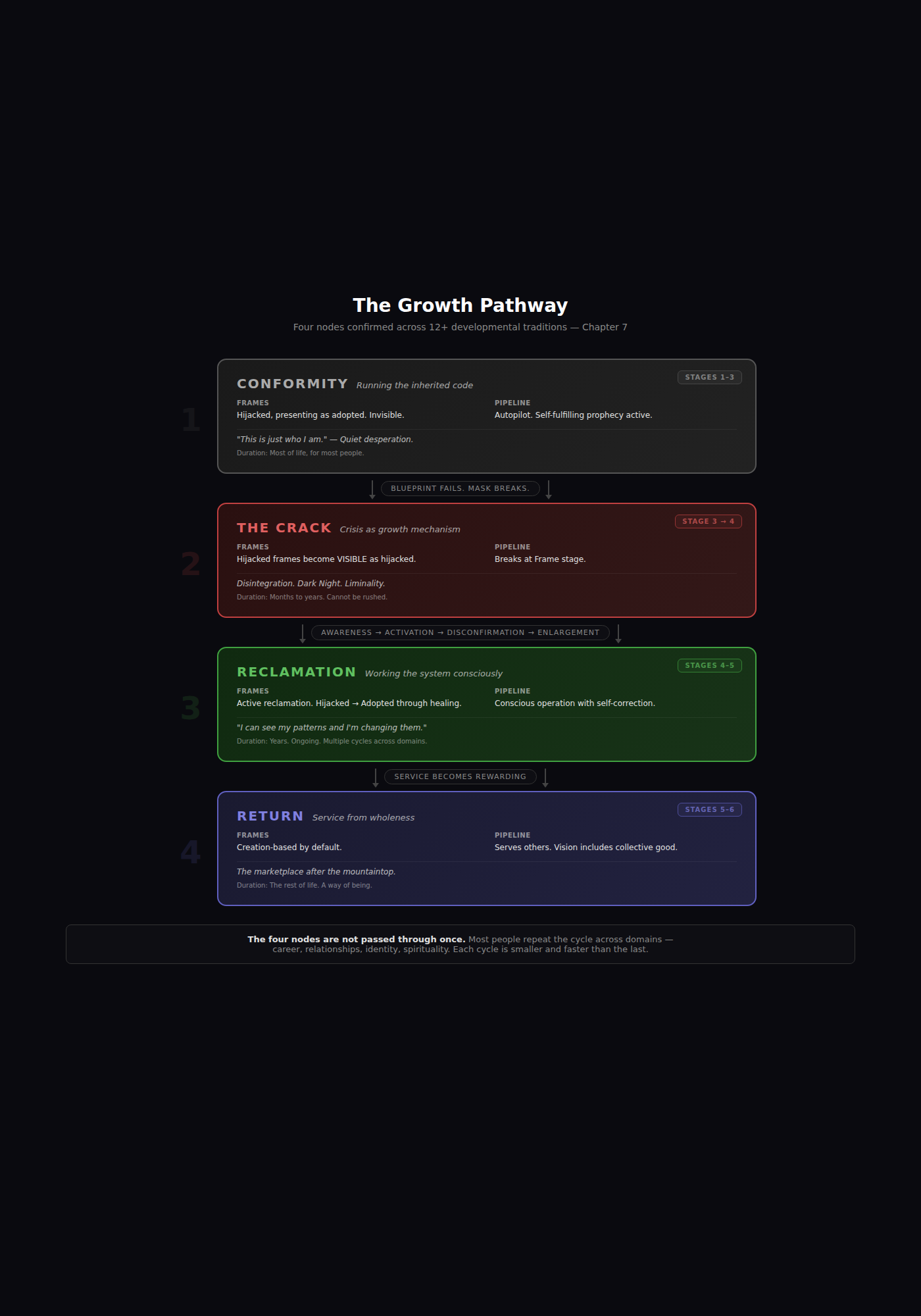
I have walked this pathway. Not once — multiple times, in different domains. Each time the cycle is shorter, faster, less catastrophic. But the first time nearly destroyed me. That’s the thing about growth pathways: the traditions all agree that the crack is necessary, but none of them adequately prepare you for how much it hurts.
7.1 Node 1: Conformity — Running the Inherited Code
The person IS the inherited blueprint. The mask feels like identity. The blueprint works well enough that questioning it feels unnecessary or dangerous.
I was the inherited code. Every mask I described in the Abstract — the socially fluent one, the competent generalist, the unbreakable one, the non-judgmental one — wasn’t a performance I was choosing. It was who I thought I was. The saviour mode wasn’t a pattern I was running. It was my identity. “I am someone who helps. I am someone who carries. I am someone who shows up for other people.” The hijacking was so complete that the masks felt like authenticity. That’s the most insidious part of Conformity — it doesn’t feel like conformity. It feels like being yourself.
Across the five dimensions:
- Mechanism: Autopilot. The Superego Chain runs without read access
- Direction: Hijacked Frames presenting as adopted. “I value excellence” is actually “I am terrified of being seen as inadequate.” The hijacking is invisible because the configuration stage keeps it below awareness
- Pipeline: Running on inherited Frames. Vision filtered through parents’ expectations. Plans avoidance-oriented but appearing disciplined. Execution is grinding, not flowing
- Conditions: Reinforced by social structures that reward compliance
- Configuration: Stages 1-3 (Distracted, Inhibited, Muted). No capacity to see own patterns
What every tradition calls this:
| Tradition | Name |
|---|---|
| Marcia | Foreclosure — committed without exploring |
| Kegan | Interpersonal (Order 3) — “I AM my relationships” |
| Loevinger | Conformist (E4) — group identity, rules |
| Kohlberg | Conventional (Stages 3-4) — social approval, law and order |
| Spiral Dynamics | Blue — purpose through discipline, absolute truth |
| Bourdieu | Habitus — feels natural because it’s the only world you’ve known |
| Winnicott | False Self — compliant mask managing the environment |
| Jung | Persona identification — identified completely with the mask |
| Nietzsche | The Camel — carries ancestral burdens. “Thou shalt.” |
| Buddhism | Tanha/Clinging — maintaining a solid self against impermanence |
| Taoism | The Carved Block — social conditioning has shaped original wholeness |
| Hinduism | Para-dharma — performing another’s duty, even successfully |
| Existentialism | Das Man / Bad Faith — doing what “one” does |
| Sufism | Nafs (ego) — the conditioned false self |
| Confucianism | Xiangyuan — the “thief of virtue,” hollow ritual |
Nietzsche’s Camel. That was me exactly. Carrying ancestral burdens and calling it strength. “Thou shalt be responsible. Thou shalt carry. Thou shalt endure.” The camel carries because it has been told that carrying is what makes it worthy. It doesn’t question the load. It questions itself when the load becomes too heavy.
The diagnostic: The person cannot distinguish their Frames from reality. “I value hard work” and “hard work is how the world works” and “hard work is who I am” are experienced as the same statement. The directional test (Chapter 2) cannot be applied because the person cannot see the Frame AS a Frame. It is the water the fish swims in.
Why it persists: It works well enough. It is invisible. Alternatives are terrifying — existential freedom (Sartre) is anxiety-inducing. Social reinforcement rewards the mask. Modern society has eliminated formal individuation rituals (Van Gennep, 1909). And structural constraint (Chapter 6) actively maintains lower configurations.
7.2 Node 2: The Crack — Crisis as Growth Mechanism
The inherited blueprint fails. The mask breaks. The False Self collapses — not because the person chose growth, but because the performance became unsustainable.
Dan Harris’s crack came live on national television — a panic attack in front of five million viewers on Good Morning America (Chapter 5), the war correspondent’s mask of unflappable competence shattering mid-sentence. Marsha Linehan’s crack came in a seclusion room at the Institute of Living at age seventeen — the system oscillating so violently that destroying her own body was the only response that made the pain bearable. My crack was quieter but no less total.
Mine broke in pieces. Not one dramatic crack but a series of fractures over years — burnout cycles that got closer together, relationship patterns that repeated with different people, a growing sense that the machinery was running on fumes. And then the recognition. AuDHD. The moment where thirty years of conscious social computation, exhausting social interactions, pattern-recognition that worked differently from everyone else’s, burst-rest cycles that no amount of discipline could flatten — all of it suddenly had a name. And the name revealed that the code I’d been running wasn’t just inherited from my parents and my culture. It was inherited from a neurotypical template that was never designed for my hardware.
That was the crack. Not the burnout. Not the relationship failures. The recognition that the operating system I’d been running was designed for a machine I was never built to be.
Three cracks — Harris, Linehan, mine — three completely different triggers, three different intensities. But the structure is identical: the inherited code fails, the mask breaks, and the person is left staring at the machinery they’d been running without knowing it.
Across the five dimensions:
- Mechanism: PFC override failure. The willpower system collapses. Bach’s consciousness protocol reactivates — the system wakes up because the optimised strategy has failed catastrophically
- Direction: Hijacked Frames become VISIBLE as hijacked. “I value excellence” is suddenly seen as “I am terrified of inadequacy.” The seeing IS the crack
- Pipeline: Breaks at the Frame stage. The self-fulfilling prophecy becomes visible. “I’ve been running avoidance plans and calling them discipline”
- Conditions: Crisis, burnout, loss of role, death of a parent, therapeutic intervention, or spiritual crisis
- Configuration: Stage 3→4 transition (Muted→Aware). The single most important transition in the entire architecture
What every tradition calls this:
| Tradition | Name |
|---|---|
| Dabrowski | Positive Disintegration (Level II→III) |
| John of the Cross | Dark Night of the Soul |
| Turner | Liminality — betwixt and between |
| Campbell | Belly of the Whale / Road of Trials |
| Kegan | Subject-object shift (Order 3→4) |
| Marcia | Moratorium — exploring, in crisis |
| Jung | Encounter with the Shadow |
| Nietzsche | The Lion — “I will.” Rejects what was imposed |
| Buddhism | Insight into Anatta (Non-self) |
| Hinduism | Arjuna’s paralysis — Para-dharma and Sva-dharma collide |
| Sufism | Tawba (Repentance) — turning from the false self |
| Teresa of Avila | 4th Mansion — self-effort alone no longer sufficient |
The Lion. After years of being the Camel, the Lion roars: “I will NOT carry this anymore.” But the Lion’s rejection is not yet creation. It’s a clearing. A burning away. The load is dropped and the space is terrifying because you built your identity around carrying it.
What forces the crack:
| Trigger | Mechanism |
|---|---|
| Neurodivergent late diagnosis | Hardware cannot sustain the performance. Metabolic cost of incompatible code exceeds capacity |
| Burnout/breakdown | PFC burning glutamate to suppress what the Muted stage can’t process. Body says no before mind does |
| Loss of the role | Job loss, divorce, retirement. The thing the hijacked Frames served disappears |
| Death of a parent | The person you were performing FOR is gone. Frame audience disappears |
| Repeated failure | Self-fulfilling prophecy becomes visible through sheer repetition |
| Therapeutic intervention | Skilled practitioner creates conditions for the Muted→Aware transition |
| Spiritual crisis | Practices meant to reinforce the ego instead dissolve it |
Mine was the first one. Neurodivergent late recognition. The hardware couldn’t sustain the performance. The metabolic cost of running a neurotypical operating system on AuDHD hardware — the masking on top of the emotional suppression on top of the social performance on top of the saviour mode — eventually exceeded what the system could pay. The body said no. The masks cracked. And underneath was an alien who’d been running someone else’s code his entire life.
Why crisis IS the mechanism — the neurological account: The Muted→Aware transition REQUIRES the failure of the willpower-based override. The Muted stage is a 7-item processor trying to override a 26-tier system (Chapter 5). It cannot win indefinitely. The metabolic cost is unsustainable.
Bach explains precisely why consciousness comes back on at this moment. The Muted person’s strategies have been optimised to the point where consciousness has disengaged — the system sees no reason to attend to what appears to be working. The Crack is the moment the optimised strategy fails catastrophically, forcing the consciousness protocol to re-attend to processes it had automated. Stage 4 is the system waking up. It is painful because the attention protocol is now processing material it had deliberately stopped tracking.
Bach also provides the mechanism for Stage 4’s characteristic suffering: suffering is a regulation failure — the mind punishing itself for failing at something it cannot succeed at. The person can see the regulation loop but cannot stop it. Awareness increases the precision of the suffering signal without providing the tools to resolve it. This is why Stage 4 is the most painful stage — and why the transition to Stage 5 (read-write access) is the critical therapeutic milestone.
The critical insight: The crisis is not pathological. It IS the growth mechanism. Every tradition agrees. Without disintegration, there is no reintegration at a higher level. Dabrowski named it precisely: Positive Disintegration. Positive BECAUSE of the disintegration.
The temptation at this stage is to fill the liminal space immediately with new Frames — which is how most people rebuild the same mask in a new container (“better boundaries,” “self-care,” the mask with minor modifications). The growth pathway requires staying in the liminal space long enough for genuine reframing to occur. Turner was explicit: “the person in transition is structurally invisible — they have no status, no role, no identity. This is terrifying and necessary.”
The developmental sequence education skips:
The natural order of human processing is Body → Feel → Accept → Think → Choose. The body registers first (Damasio’s somatic markers signal the correct strategy up to 80 decisions before the conscious mind articulates why). Feeling arises from the body’s registration. Then — critically — the feeling must be accepted: registered as information, not as identity. Only after acceptance can thinking operate on clean data. And only after thinking can genuine choice emerge.
Every education system I went through inverted this. Think first. Feel later — or never. The body is irrelevant. Acceptance is never taught. The result: a population that can analyse brilliantly and has no felt relationship to what it analyses.
Accept is the Kegan subject-object shift. Kegan’s core mechanism: what was subject at stage N becomes object at stage N+1. At the emotional level, Accept IS this move. Before Accept, you ARE your emotional response — captive to it. At Accept, the feeling becomes information: “I notice I feel this is right — now let me check.” After Accept, feelings can be evaluated against internal standards. The subject has become object. Independent judgment becomes possible.
Kegan’s research estimates ~58% of adults haven’t reached Stage 4 (Self-Authoring). The transition takes 5-10 years with the right conditions — confirmation, contradiction, and continuity. No shortcut. And the right conditions include what no mainstream education system provides: the explicit teaching of Accept as a developmental capability.
I spent months in that liminal space. No role. No mask. No identity I could point to and say “this is me.” The saviour was gone. The competent generalist was gone. The unbreakable one was demonstrably broken. What was left was the alien — the one who’d been there the whole time, underneath all the code, wondering why the operating system never quite fit.
7.3 Node 3: Reclamation — Working the System Consciously
The person has seen the inherited blueprint, survived the crisis, and is now consciously building their own Frame system. They can distinguish adopted Frames from hijacked ones. They can apply the directional test. They can run the TAP pipeline with awareness at every stage.
This is where I am now. Not finished — not even close. But conscious. I can see the saviour Frame when it activates. I can feel the hijacked loyalty when it fires. I can trace the pipeline from Frame through Plan through Execute and intervene before the self-fulfilling prophecy completes. Not every time. Not without effort. But with increasing frequency, and with decreasing metabolic cost.
Across the five dimensions:
- Mechanism: Read-write access developing. Can observe and begin to adjust precision weighting
- Direction: Active reclamation. Hijacked Frames being identified, examined, and healed through enlargement
- Pipeline: Runs consciously. Vision felt and trusted. Frames examined before they shape Plans. Execution flows rather than grinds
- Conditions: Requires therapeutic support, relational holding environments, and sufficient structural safety
- Configuration: Stages 4-5 (Aware→Intelligent). Conscious emotional management developing
What every tradition calls this:
| Tradition | Name |
|---|---|
| Dabrowski | Organised Multilevel (Level IV) |
| Kegan | Self-Authoring (Order 4) — “I HAVE my frameworks” |
| Loevinger | Conscientious → Autonomous (E6-E8) |
| Kohlberg | Post-conventional (Stages 5-6) |
| Spiral Dynamics | Orange → Yellow — first-tier to second-tier |
| Marcia | Achievement — explored, chose, committed |
| Jung | Individuation — integrating Shadow |
| Nietzsche | The Child — creates anew |
| Zen Ox-Herding | Pictures 4-7 — Catching → Taming → Riding Home |
| Sufism | Sabr → Tawakkul (Patience → Trust) |
| Teresa of Avila | 5th-6th Mansions |
| Campbell | Apotheosis / The Ultimate Boon |
Nietzsche’s Child. After the Camel carries and the Lion rejects, the Child creates. Not from nothing — from the cleared space that remains after the inherited code has been examined and the hijacked Frames have been named. The Child says “I will” — not in rebellion (that’s still the Lion) but in genuine creation. New values, new Frames, chosen consciously.
The Mechanism: Breaking the Self-Fulfilling Prophecy
The four-step cycle:
- Awareness — recognise the hijacked Frame (requires Stage 4+)
- Activation — encounter the trigger in safe conditions (Foa & Kozak’s Emotional Processing Theory: the fear structure must be activated for modification)
- Disconfirmation — the feared outcome does not happen (the system receives evidence that contradicts the hijacked prior)
- Enlargement — integrate the old Frame into a larger one that holds multiple possibilities
I’ve run this cycle dozens of times now, across different domains. The saviour Frame: awareness came through therapy and self-observation. Activation came every time someone asked for help and the old pattern fired. Disconfirmation came when I said no — and the person didn’t leave. Enlargement is ongoing: “I can help AND I can choose when. Connection doesn’t require carrying.”
Enlargement, not replacement. The old Frame (“dogs are dangerous”) is not defeated by a new Frame (“dogs are safe”). It is integrated into a larger Frame: “I had an experience where a dog hurt me; that experience is real; AND dogs can also be safe; AND I can assess which is which in the moment.” The old reaction doesn’t disappear — it becomes one data point in a richer assessment rather than the only lens available.
This is the architecture’s divergence from Craske’s inhibitory learning model. Craske shows that exposure therapy does not erase the original fear memory — it creates a competing memory. But competition implies replacement: Frame A vs Frame B, where B “wins.” Replacement creates another rigid Frame. Enlargement creates flexibility. The larger Frame holds the old one as one perspective within a wider view.
Fear can return when the larger Frame contracts. Under stress, sleep deprivation, or PFC overload, the integrated Frame narrows back to its smallest component — the original hijacked reaction. This explains relapse — not as the old Frame “winning” but as the larger Frame temporarily losing capacity. Recovery is re-expansion, not re-fighting.
I know this intimately. On a good day, the saviour Frame is one perspective I can see among many. On a bad day — sleep-deprived, burned out, triggered — the Frame contracts and the old pattern runs as if the enlargement never happened. The difference between now and before is that I recognise the contraction as contraction, not as reality. The recovery is faster because I’m not re-discovering the Frame. I’m re-expanding around it.
Neurologically, this is chunking: subcortical patterns (hijacked Frames) are made cortically manageable by being named, examined, and integrated into larger Frames. This is what Jung meant by “making the unconscious conscious” and what Kegan meant by “subject becomes object.”
The Three Layers of Shadow
The shadow has three layers, each requiring different intervention:
- Destructive shadow = anti-values clusters (trauma-hijacked Frames, actively defended). Requires healing through enlargement
- Defended-dormant shadow = unfilled spaces with active Frames against exploration (appears dormant but defended by fear). Requires exposure in safe conditions
- Genuinely dormant shadow = unexpressed values with no active defence — rare, because most avoidance has a Frame behind it. Requires activation
In every case, the direction is enlargement — not replacement, not deletion, not victory over the old Frame, but the expansion of perspective until the old Frame is one view among many.
7.4 Node 4: Return — Service from Wholeness
The growth pathway does not end with self-knowledge. Across every tradition without exception, the highest stage is return to the world. The sage goes to the marketplace. The hero brings back the boon. Transformation that does not serve others is incomplete.
Marsha Linehan’s return is the clearest example I know. A teenager who burned herself in a seclusion room became the psychologist who built DBT — validated in over 100 randomised controlled trials, now the standard of care for the condition she once embodied. She didn’t serve despite her suffering. She served from it. The suffering became the raw material for something that has since helped millions of people. That is the Return: not transcending the wound, but metabolising it into service.
Dan Harris’s return was quieter — 10% Happier, the podcast, the meditation app. Taking the panic attack that humiliated him on national television and turning it into a bridge for millions of sceptics who would never have walked into a meditation centre but might listen to a war correspondent who found something useful.
I’m not here yet. Not fully. But I can feel the pull — and it’s different from the saviour mode that used to drive me. The saviour served from fear. The Return serves from overflow. The saviour needed the other person to need him. The Return doesn’t need anything — it gives because giving is what the system does when it runs clean.
The difference is this: when I help now, I don’t check afterwards whether the person appreciated it. I don’t track whether the help earned me belonging. The transaction is gone. What’s left is something simpler — I see a pattern, I have a skill, the person needs what I have, I give it. No ledger. No fear underneath. Just the natural movement of a system that has learned to run without the contamination.
Not always. Not yet consistently. But increasingly. And the direction is clear.
Across the five dimensions:
- Mechanism: Dynamic equilibrium. Free energy near-optimal. Consciousness as resting state
- Direction: Creation-based as default. Remaining hijacked material quickly identified and processed
- Pipeline: Serves others. Vision includes collective good. Frames hold multiple perspectives simultaneously
- Conditions: The person’s presence raises the prosociality of any group (Wilson’s plasticity finding in reverse)
- Configuration: Stages 5-6 (Intelligent→Transcendent)
What every tradition calls this:
| Tradition | Name |
|---|---|
| Zen Ox-Herding | Picture 10: Entering the Marketplace with Helping Hands |
| Campbell | Master of Two Worlds / Freedom to Live |
| Teresa of Avila | 7th Mansion: Spiritual Marriage — service from wholeness |
| Dabrowski | Secondary Integration (Level V) |
| Kegan | Inter-individual (Order 5) — holds multiple self-systems |
| Maslow | Self-Transcendence — enlargement of self to include others |
| Sufism | Rida (Satisfaction) — the struggle ends |
| Buddhism | Bodhisattva — enlightened being who returns to help all |
| Taoism | The Sage / Wu Wei — acting from nature |
| Hinduism | Sannyasa + Karma Yoga — renunciation AND action |
| Christianity | The New Man — spirit and flesh reconciled |
| Confucianism | Ren (Humaneness) — ritual with genuine inner substance |
The neurological basis: Klimecki and Singer’s fMRI research (2014) — detailed in Chapter 5, Section 5.2, Stage 5 — shows that compassion training activates the same reward circuits as food and money. For a person at Stage 5+, service is not sacrifice. It is neurologically pleasurable.
The evolutionary basis: Nowak’s cooperation mathematics confirms that the Return-stage person naturally operates above the thresholds for all five cooperation rules — maintaining reputation (indirect reciprocity), sustaining relationships (direct reciprocity), building supportive networks (network reciprocity), strengthening group identity (group selection). Growth is not just psychologically optimal. It is mathematically optimal.
This is why every tradition ends with return. Not moral instruction. Neurology. The mature human wants to serve because the hardware rewards it. The pathway from inherited blueprint to authentic expression naturally culminates in contribution — not because it should, but because it does.
7.5 The Unified Pathway
NODE 1: CONFORMITY — Running the inherited code
━━━━━━━━━━━━━━━━━━━━━━━━━━━━━━━━━━━━━━━━━━━━━━
Configuration:  Stages 1-3. No read access.
Frames:         Hijacked, presenting as adopted. Invisible.
Pipeline:       Autopilot. Self-fulfilling prophecy active.
Experience:     "This is just who I am." Quiet desperation.
Duration:       Most of life, for most people.

         ↓ [TRIGGER: Blueprint fails. Mask breaks.]

NODE 2: THE CRACK — Crisis as growth mechanism
━━━━━━━━━━━━━━━━━━━━━━━━━━━━━━━━━━━━━━━━━━━━━━
Configuration:  Stage 3→4 transition (Muted→Aware)
Frames:         Hijacked frames become VISIBLE as hijacked.
Pipeline:       Breaks at Frame stage.
Experience:     Disintegration. Dark Night. Liminality.
Duration:       Months to years. Cannot be rushed.

         ↓ [MECHANISM: Awareness → Activation → Disconfirmation → Enlargement]

NODE 3: RECLAMATION — Working the system consciously
━━━━━━━━━━━━━━━━━━━━━━━━━━━━━━━━━━━━━━━━━━━━━━
Configuration:  Stages 4-5 (Aware→Intelligent)
Frames:         Active reclamation. Hijacked → Adopted through healing.
Pipeline:       Conscious operation with self-correction.
Experience:     "I can see my patterns and I'm changing them."
Duration:       Years. Ongoing. Multiple cycles across domains.

         ↓ [NATURAL PROGRESSION: Service becomes rewarding]

NODE 4: RETURN — Service from wholeness
━━━━━━━━━━━━━━━━━━━━━━━━━━━━━━━━━━━━━━━━━━━━━━
Configuration:  Stages 5-6 (Intelligent→Transcendent)
Frames:         Creation-based by default.
Pipeline:       Serves others. Vision includes collective good.
Experience:     The marketplace after the mountaintop.
Duration:       The rest of life. A way of being.
7.5a The Four Stages of Understanding
The four nodes above are not just a growth pathway. They are the four stages of understanding that every wisdom tradition independently describes — the universal arc through which a person comes to know anything deeply.
| Growth Pathway Node | Stage of Understanding | What the Person Knows |
|---|---|---|
| Conformity | Absolute Simplicity | The received version. “This is how it is.” Not examined because it doesn’t feel like a frame — it feels like reality. |
| The Crack | → Absolute Complexity | The myth collapses. The person sees the mechanisms, the contradictions, the hidden costs. Some stay here permanently — analytically brilliant, existentially stuck. |
| Reclamation | True Complexity | Both are true. The myth WAS a myth AND it served a function. The person holds both without collapsing into either. Most three-stage models stop here — but this is not the destination. |
| Return | True Simplicity | The complexity has been embodied and dissolved into lived understanding. The person acts from the knowing without needing to articulate the analysis. Cook Ding carves the ox by spirit. The simplicity on the other side of complexity. |
The distinction between True Complexity and True Simplicity is why most developmental models use three stages. Dreyfus is the only Western framework that cleanly separates them: Proficient (intuitive recognition + analytical deliberation — still effortful) vs Expert (fluid embodied performance — no deliberation).
The pre/trans fallacy (Wilber) applies: Absolute Simplicity and True Simplicity look identical from outside. The difference is invisible without the embodiment test — which is why every tradition that transmits the interior (Sufi silsila, Zen koan system, guild masterpiece) builds the test into the transmission.
I recognised these stages in myself. For most of my life I was at Absolute Simplicity about my own patterns — the inherited code was invisible, the masks felt like identity. The AuDHD recognition threw me into Absolute Complexity — suddenly I could see every mechanism, every mask, every pattern. The anger was real. The analytical brilliance of Stage 2 was intoxicating. “I see through everything now.” True Complexity came when I could hold both: the masks WERE survival strategies AND they cost me everything. The patterns WERE installed by my environment AND I am responsible for what I do with them now. Neither hagiography nor outrage. Both, held without collapsing. True Simplicity — I’m not there yet in every domain. But in music, when I play and the room moves, I’m not thinking about the theory. The complexity has dissolved into the body. That’s what it feels like.
For the full cross-domain treatment — music, education, national mythology, AI, and the embodiment tests across six traditions — see The Four Stages of Understanding. For the cross-tradition convergence on embodied knowing — Sufi dhawq, Chinese 体悟, and the neuroscience of the body knowing first — see Embodied Knowing. For how institutions systematically kill the interior of every tradition they preserve — see The Corruption Cycle.
7.6 Multiple Cycles and the Structural Constraint
The four nodes are not passed through once. Most people who individuate do so in one domain first (career, relationships, identity, spirituality) and then repeat the cycle in others. Each cycle reveals a new layer of inherited blueprint, forces a new crack (smaller each time), requires new reclamation work (faster each time, because the skills transfer), and deepens the return.
I’ve cycled through at least three times now — once in career (the medical school exit, the career pivots, the discovery that no single profession could contain the investigation), once in relationships (the saviour pattern, the boundary work, the ongoing reclamation of what connection actually means without carrying), and once in identity (the AuDHD recognition, the unmasking, the ongoing discovery of who is actually underneath all the code). Each cycle uses the same four nodes. Each one is less catastrophic than the last. The skills transfer.
Dabrowski’s multilevel language captures this: Levels III and IV involve repeated cycling through disintegration and reintegration at progressively higher levels of organisation.
The full growth pathway requires three kinds of work:
- Individual work — ESM development, Frame reclamation, pipeline cleaning
- Relational work — relationships that provide bridges, disconfirmation, holding environments (Winnicott)
- Structural work — systems that create the conditions for growth rather than maintaining compliance (Wilson’s CDPs)
Wilson’s r = 0.72 demonstrates empirically that individual and structural work are inseparable. The same person can present as Stage 5 in a supportive environment and Stage 3 in a hostile one. The vicious spiral: hostile structures select for Muted compliance, reducing prosociality, making the structure more hostile. The virtuous spiral: supportive structures select for Intelligent cooperation, increasing prosociality, making the structure more supportive. Individual development is the engine. Structural conditions are the road. Without the road, the engine spins in place.
7.7 The Destination Is Not Perfection
The Return stage is not an endpoint of completion. It is a way of being. Hijacked Frames still surface. The pipeline still gets contaminated. The difference: at the Return stage, contamination is caught quickly, processed efficiently, and the pipeline returns to clean operation. The person is not perfect. The person is well — able to choose, able to correct, able to serve.
Releasement. Through awakening, return to The Clearing. The destination was always emptiness — not as nihilism, but as the cleared space from which authentic creation flows. The marketplace after the mountaintop. The sage with helping hands.
以悟归空. Through awakening, return to emptiness. The Chinese captures it better than the English. The destination is not achievement. It is the ground state — the system running clean, the masks silent, the pipeline uncontaminated, creation flowing without performance. Home was always emptiness. The journey was learning how much you had to put down to get there.
7.8 Tensions and Limits
The four-node pathway as a universal sequence. The cross-tradition evidence (12+ traditions mapping to the same four nodes) is suggestive but does not prove universality. The traditions cited are predominantly from Eurasian contemplative and philosophical lineages. Indigenous developmental frameworks, African philosophical traditions, and other non-Western models may describe different pathways — or may confirm the same pattern through different concepts. The evidence is broad but not exhaustive.
Multiple cycles are clinically plausible but not empirically validated. The claim that people repeat the four-node sequence across domains is based on therapeutic observation, not controlled research. It is consistent with neo-Piagetian domain-specificity (Chapter 5, Section 5.8) and with Dabrowski’s multilevel theory, but has not been independently tested.
The growth pathway may privilege individualistic cultures. The Conformity → Crack → Reclamation → Return sequence centres individual awakening as the engine of growth. In collective identity cultures, development may proceed through different pathways — through communal ritual, relational transformation, or structural change rather than individual crisis. The WEIRD problem (Chapter 5, Section 5.8) applies here: the pathway may be culturally specific even if the four nodes are structurally universal.
The structural constraint is non-negotiable. The pathway exists for everyone. The conditions for walking it do not. “Just develop yourself” is an insufficient prescription when the PFC you’re developing with has been structurally constrained by the class you were born into (Chapter 6). The architecture is incomplete without a structural analysis of who benefits from keeping populations at lower configurations.
Chapter 7 maps the universal growth pathway — four nodes confirmed across 12+ developmental traditions from every major discipline. The pathway is real: inherited code → crisis → conscious reclamation → service from wholeness. But the pathway does not exist in a vacuum. It requires individual work, relational work, and structural work. The compass that guides the journey — and the philosophical orientation that prevents it from becoming either spiritual bypassing or self-help narcissism — is Chapter 8.