Part IX: The Implementation Roadmap
First 12 Months
Lead author: Ethan Seow (C4AIL) Contributors: Dominic Ligot (CirroLytix), James Stanger (CompTIA), Chiew Farn Chung (ClassDo) Status: First Draft — March 2026
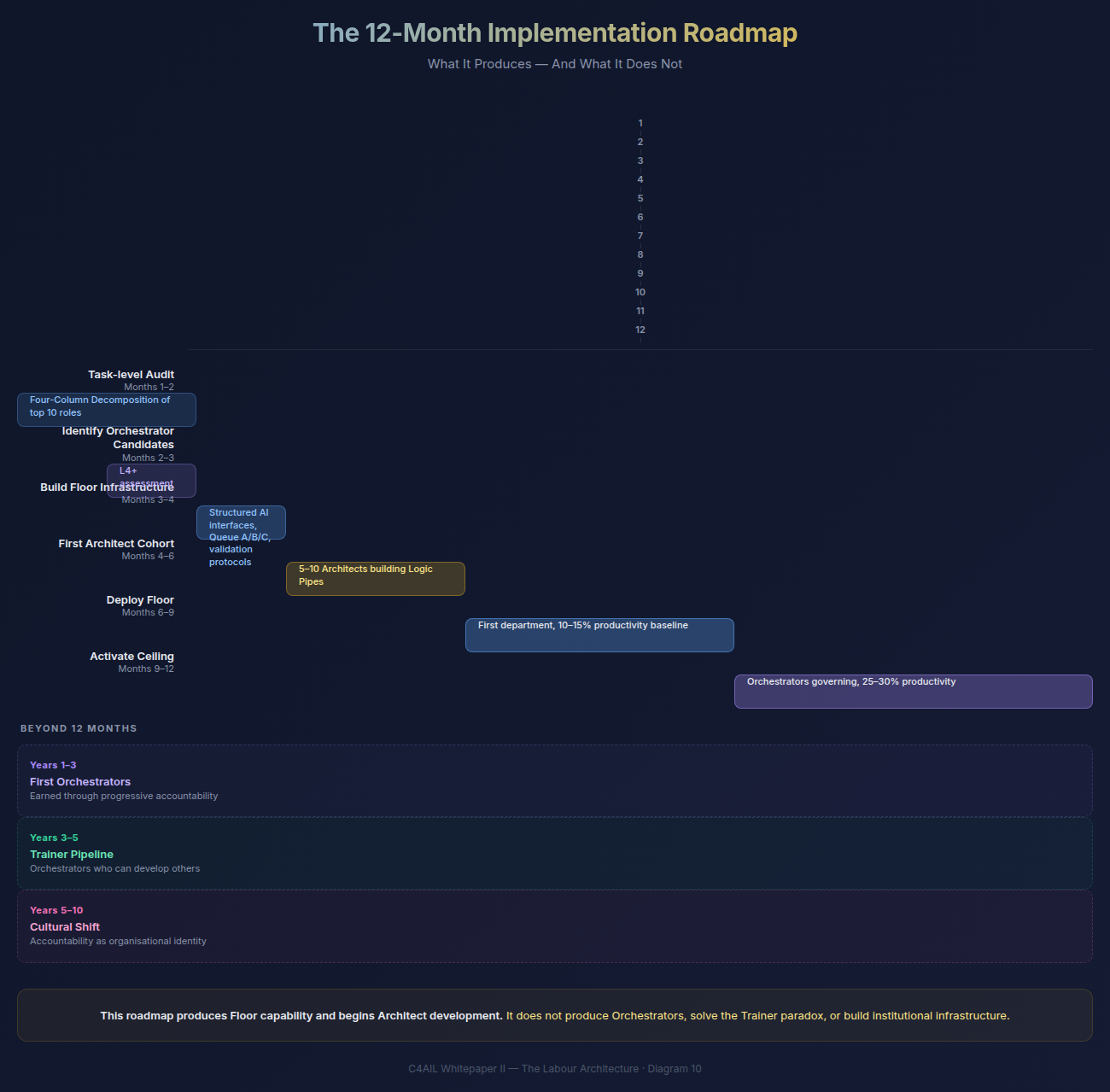
9.1 Month-by-Month Sequencing
| Month | Action | Outcome |
|---|---|---|
| 1-2 | Task-level audit of top 10 roles (Four-Column Decomposition using CompTIA methodology) | Clear map of which tasks are automated, elevated, and new |
| 2-3 | Identify Orchestrator candidates from existing senior staff (L4+ assessment) | Named pipeline of 3-5 Orchestrator candidates |
| 3-4 | Build Floor infrastructure (structured AI interfaces, Queue A/B/C triage, validation protocols) | Floor Users can work within governed AI workflows |
| 4-6 | Run first Architect development cohort (C4AIL programme or equivalent) | First cohort of 5-10 Architects building Logic Pipes |
| 6-9 | Deploy Floor to first department, measure baseline | 10-15% productivity gains (tools-only baseline) |
| 9-12 | Activate Ceiling — Orchestrators governing Logic Pipes and verification engines | 25-30% productivity gains (workflow redesign + capability) |
| 12+ | Scale to next department. Begin junior acceleration programme. Activate Trainer pipeline. | Sustainable transformation with accountability pipeline intact |
9.2 Measurement Framework
| Metric | Baseline (Month 0) | Target (Month 12) | What It Measures |
|---|---|---|---|
| Productivity gain | 0% | 25-30% | Workflow redesign effectiveness |
| AI validation accuracy | Unknown | >95% | Floor User capability |
| Verification queue throughput | N/A | Measured | System capacity |
| Junior judgment reps per week | 0 | >10 | Accountability pipeline health |
| Architect pipeline size | 0 | 5-10 | Ceiling development |
| Orchestrator readiness | 0 | 1-2 candidates | Leadership pipeline |
9.3 Throughout: Continuous Infrastructure
CompTIA certification waypoints at each level transition. AI Guildhall community participation for portfolio development and peer review. Quarterly readiness assessment via the C4AIL diagnostic (assess.c4ail.org). These are not additional programmes — they are the measurement and community infrastructure that makes the transformation legible and sustainable.
9.4 Technology Requirements — What the Architecture Actually Needs
The terms “structured AI interfaces,” “verification engines,” and “Logic Pipes” appear throughout this paper. This section specifies what they mean in concrete technology terms — not as product recommendations, but as functional requirements.
Structured AI interfaces (Floor infrastructure). The Floor User does not interact with a raw chatbot. They work through constrained interfaces that limit the scope of AI interaction to domain-valid operations. Technically, this means: role-based prompt templates with pre-set system instructions, input validation schemas that reject out-of-scope requests, output rendering that surfaces confidence indicators, and audit logging that captures every human-AI exchange. These can be built on top of any enterprise LLM API (Azure OpenAI, AWS Bedrock, Google Vertex AI, or self-hosted models) using middleware frameworks — LangChain, Semantic Kernel, or custom orchestration layers. The key design principle: the Floor User’s interface should feel like a domain tool, not a general-purpose AI.
Verification engines (Architect-built). A verification engine is a deterministic check that validates AI output against domain rules before it reaches the human reviewer. Examples: a financial verification engine that confirms all figures in an AI-generated report trace back to source data; a legal verification engine that checks contract clauses against a firm’s approved language library; a compliance verification engine that cross-references AI recommendations against the current regulatory register. Technically, these are rule-based systems — not AI judging AI, but structured logic (decision trees, regex validation, database lookups, API calls to authoritative sources) applied to AI output. They are the “cage” around the AI: the AI generates, the verification engine constrains.
Logic Pipes (the workflow layer). A Logic Pipe is an end-to-end workflow that channels AI output through a defined sequence: generation → verification → triage → human review → approval → audit trail. The Queue A/B/C triage system sits within the Logic Pipe: Queue A (high-confidence, auto-approved with audit log), Queue B (medium-confidence, routed to a Translator for review), Queue C (low-confidence or novel, escalated to an Architect or Orchestrator). Logic Pipes are implemented as workflow orchestration — using tools like Temporal, Apache Airflow, n8n, or custom state machines — with the verification engines as nodes in the pipeline.
What this is NOT. This is not a recommendation to purchase a specific vendor stack. The technology is commodity — the hard part is the domain knowledge embedded in the verification rules, the triage thresholds, and the escalation logic. That domain knowledge is what Architects build and Orchestrators govern. The technology is the plumbing; the architecture is the design of the house.
9.5 What This Roadmap Does Not Solve
This 12-month roadmap produces Floor capability and begins Architect development. It does not produce Orchestrators. It does not solve the Trainer paradox. It does not build the institutional infrastructure that Germany and Switzerland inherited from centuries of guild tradition.
The roadmap is a first year, not a complete transformation. The complete picture:
| Timeline | What It Produces | What It Requires |
|---|---|---|
| Months 1-6 | Floor capability (validation, AI literacy) | Training — conventional, scalable |
| Months 6-12 | Architect pipeline (first cohort building systems) | Mentorship — requires existing L3+ staff |
| Years 1-3 | First Orchestrators (earned through progressive accountability) | Developmental environment — Genius Bar, portfolio system, community of practice |
| Years 3-5 | Trainer pipeline (Orchestrators who can develop others) | Institutional commitment — sustained investment in human development despite ROI pressure to automate instead |
| Years 5-10 | Cultural shift (accountability as organisational identity) | Leadership patience — the hardest resource to secure |
The next section explains why the timeline cannot be shortened — and what sits underneath it.
9.6 Order-of-Magnitude Cost Model
No validated cost-benefit analysis exists for this framework (see Limitation #6). The following estimates are indicative, drawn from the German dual system (BIBB, 2022/23), corporate learning benchmarks (ATD, 2024), and consulting rate equivalents. They assume a 500-person enterprise deploying the Five Roles model.
| Cost Category | Year 1 | Years 2-3 | Basis |
|---|---|---|---|
| Floor deployment (AI tools, structured interfaces, validation training) | $130-210K | $50-100K/yr maintenance | Enterprise AI seat licences at $360-470/user/yr (e.g., Microsoft 365 Copilot at $360/yr, 2025 pricing) deployed to 60-80% of workforce ($108-188K) + 2-day validation training per employee ($20-30K) |
| Translator identification & development (assessment, domain-AI bridging workshops) | $80-120K | $40-60K/yr | Assessment instruments + cohort-based development (15-25 Translators at $5-8K each) |
| Architect development (mentored pipeline, portfolio system, Genius Bar infrastructure) | $120-200K | $150-250K/yr | 5-10 Architects at $15-25K development cost each + L4+ mentor time (opportunity cost) |
| Trainer capacity (L4+ practitioners allocated to development) | $50-100K | $200-400K/yr | Opportunity cost: 10-20% of senior practitioner time redirected from production to development |
| Community infrastructure (Guildhall participation, portfolio platform, quarterly assessments) | $30-50K | $20-40K/yr | Platform costs + facilitation + CompTIA/C4AIL certification fees |
| Total Year 1 | $410-680K | ||
| Total ongoing (Years 2-3) | $460-850K/yr |
What the same enterprise spends on AI infrastructure
The numbers above cover human capability development only. They do not include the AI infrastructure the enterprise is simultaneously purchasing — which typically dwarfs the human investment.
| Infrastructure Category | Cost | Timeframe | Source |
|---|---|---|---|
| Cloud AI services (API calls, hosted inference) | $120-300K/yr | Annual | $10-25K/month for a 500-person enterprise with moderate usage; Microsoft/OpenAI/Anthropic enterprise API tiers. CloudZero (2025): average enterprise AI spend ~$86K/month across all categories. |
| On-premise inference hardware (GPU servers) | $85K-4.5M | One-time purchase | Minimal production setup (2x NVIDIA H100, serving 70B-parameter models): $85-110K. Single 8-GPU node (DGX H100 or Dell XE9680): $350-480K. Enterprise cluster (32x H100, one-rack pod): $2.5-4.5M. (CDW/Insight Enterprises, 2025 pricing) |
| 3-year TCO on hardware (power, cooling, staff, data centre) | 2.8-3.2x purchase price | Over 3 years | Gartner (2024): operational costs account for ~65% of total AI infrastructure cost. A $350K single node costs $1-1.1M over 3 years including 10.2 kW power draw, cooling, and MLOps staff ($220-350K/yr per engineer, Levels.fyi 2024). |
| Software and platform licences (MLOps, vector databases, orchestration) | $50-200K/yr | Annual | Weights & Biases, Databricks, Snowflake AI features, or equivalent open-source infrastructure and support contracts |
Gartner (2025) estimates that 80% of enterprise GenAI spending goes to infrastructure. A 500-person enterprise making even a modest on-premise investment (one 8-GPU node plus cloud API access) is spending $500K-800K on infrastructure in Year 1 alone — comparable to or exceeding the entire human capability model proposed above. Enterprises pursuing serious on-premise deployment (a full rack pod) are spending $2.5-4.5M on hardware before a single workflow is redesigned. The ratio is striking: for every dollar spent developing the humans who use AI, most enterprises spend three to five dollars on the machines themselves.
This ratio inverts what the evidence suggests. Accenture’s longitudinal research makes the pattern visible: only 12% of companies have achieved AI maturity (“The Art of AI Maturity,” 2022, N=1,176 firms across 16 industries), and while AI-led companies achieve 2.5x higher revenue growth than peers, 84% of enterprises have still not scaled AI beyond experimentation (“Reinventing Enterprise Operations with Gen AI,” 2024, N=2,000 executives). The bottleneck is not infrastructure — it is human capability. Eighty-two percent of early-maturity companies have no talent strategy for AI (Accenture, 2024). Deloitte (2025) found that only 16% of organisations have redesigned roles, processes, and operating models for AI integration. McKinsey (2025) reports that only 39% of organisations attribute any EBIT impact to AI at all.
The infrastructure investment is necessary. But infrastructure without human capability development produces the 95% pilot failure rate documented by MIT’s NANDA Initiative (“The GenAI Divide,” 2025, N=300+ public deployments and 150+ executive interviews — specifically, 95% of GenAI pilot programmes failed to deliver measurable P&L impact). The aggregate figure masks significant variation: vendor-purchased AI tools showed ~67% success rates versus ~22% for internal builds, suggesting that the failure is concentrated where organisations attempt to build capability they do not have. The proposed model does not replace infrastructure spending — it ensures the infrastructure produces returns.
Context for the human capability numbers
- Cost of external hiring for Ceiling roles: Senior AI-capable hires cost $80-150K in total acquisition costs — recruiter fees at 20-25% of $157-191K median salaries (Burtch Works/Veritone, 2025), onboarding, and risk-weighted replacement costs given ~38% first-year attrition (SHRM). Developing 5 internal Architects costs roughly the same as hiring 2 externally — with better retention and institutional knowledge.
- German benchmark: EUR 26,200 gross / EUR 8,086 net cost per apprentice per year (BIBB, Kosten-Nutzen-Erhebung 2022/23). The net cost is low because apprentices produce value during training — productive output averages EUR 18,124 per apprentice per year. The same principle applies: Architects and Translators produce value while developing.
- Per-employee cost: $820-1,360 per employee in Year 1 (500-person enterprise). ATD’s 2024 State of the Industry report benchmarks corporate learning spend at $1,283 per employee (2023 data) — this model is within the same range but redirected from courses to developmental infrastructure.
These estimates will vary significantly by industry, geography, and existing AI maturity. The cost model is included as a planning heuristic, not a budget — Limitation #6 identifies validated cost-benefit analysis as a research priority.